Gold Price Forecast: XAU/USD corrects after three-day winning streak ahead of key US data
- Gold declines to near $4,040 as the US Dollar regains ground.
- The Fed aims to reduce the number of monetary policy decisions to six from 2028.
- Investors keenly await the US flash Q3 GDP and PCE Inflation data for September.

Gold is down 0.65% to near $4,040 after failing to extend its three-day winning streak on Thursday. The precious metal comes under pressure as the US Dollar (USD) regains ground after a corrective move on Wednesday, following the Federal Reserve’s (Fed) monetary policy announcement.
As of writing, the US Dollar Index (DXY), which gauges the Greenback’s value against six major currencies, trades almost flat, but is holding its key support level at 102.10.
What happened at the meeting?
As expected, the Fed left interest rates unchanged in the 3.75%-4.00% range, and signaled that the Fed is ready to act, citing upside inflationary pressures. “Inflation is very high”, Fed Chairman Kevin Warsh said at the press conference, and added, “We have made clear our readiness to act.”
Two policymakers, Fed Governor Lisa Cook and Cleveland Fed Bank President Beth Hammack dissented in favor of a 25-basis-point rate hike, citing fears of persistently high inflation amid energy supply shocks.
The unusual was proposal from Fed Chair Warsh that the number of interest-rate decisions could be reduced from eight to six per year. In 2028, the Fed will plan to host two meetings focused on strategy discussions and the remaining six will be centred on policy setting, Warsh said, CNBC reported.
Lower policy meetings mean lesser Fed communication at a time when Chairman Warsh is already against so-called “forward-guidance” would add uncertainty in global markets.
US economic data awaited
During the day, investors will pay close attention to the preliminary United States (US) Q3 Gross Domestic Product (GDP) and Personal Consumption Expenditure (PCE) Price Index data for September, which will be published at 12:30 GMT.
According to TD Securities, upcoming US activity data are expected to underscore that the economy “will likely show a resilient economy that can handle more restriction.” The bank anticipates that “Q3 GDP [will] show robust underlying growth, PCE prices [will] reflect elevated inflation, and ECI [will] report manageable wage growth,” pointing to a still-firm macro backdrop despite tighter financial conditions. In terms of the headline growth figures, TD Securities notes that “GDP growth picked up in Q3 to 2.5% from 2.2% previously with underlying activity remaining robust,” broadly in line with other projections that emphasize solid consumption and investment even as some components, such as net exports and inventories, act as modest drags.
Gold Technical Analysis
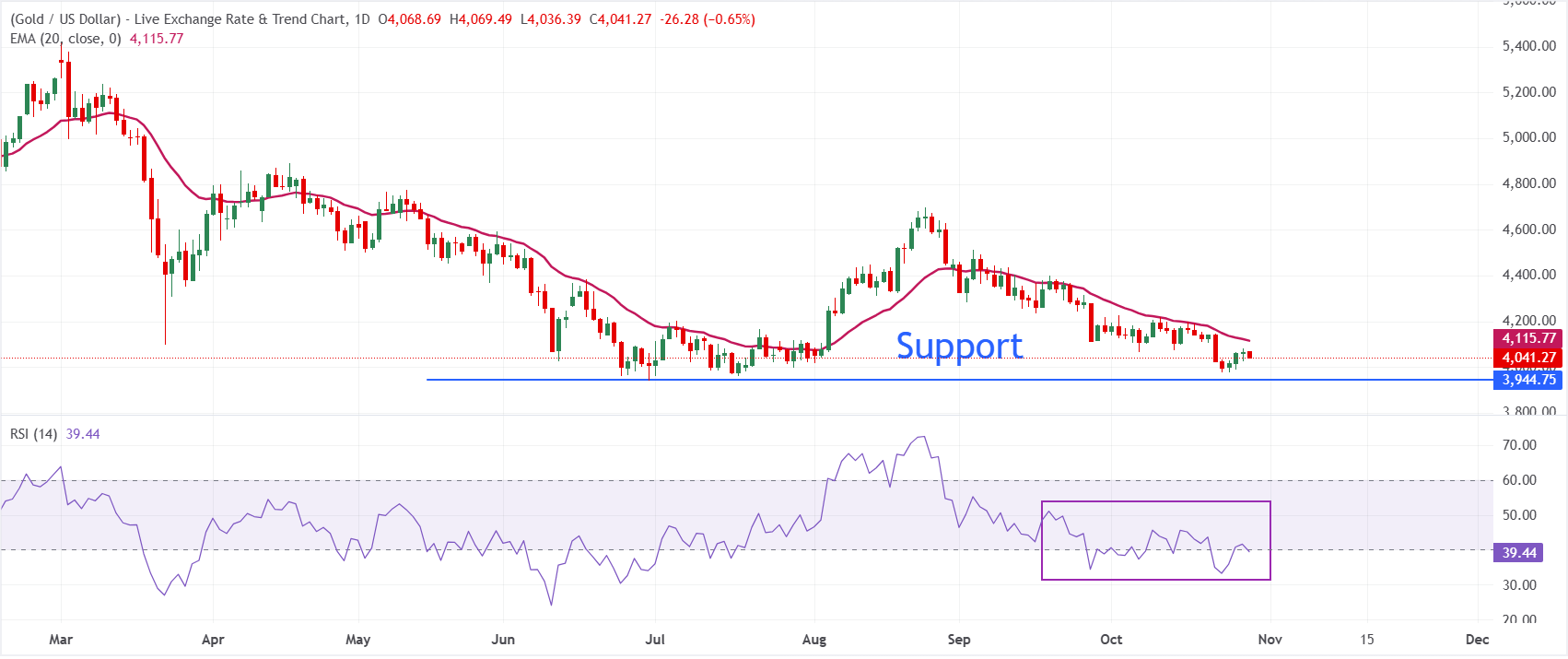
In the daily chart, XAU/USD trades at $4,040, keeping a bearish near-term tone as spot remains below the 20-day Exponential Moving Average (EMA) at $4,115.80. The metal is capped by this short-term trend indicator, suggesting sellers retain control, while the Relative Strength Index (14) around 39 points to subdued momentum rather than outright oversold conditions.
On the topside, initial resistance is located at the 20-day EMA near $4,115.80, and a daily close above this barrier would be needed to ease immediate downside pressure. Looking down, the June low at $3,941.76 is the key support level.
(The technical analysis of this story was written with the help of an AI tool. Know more.)
Gold FAQs
Gold has played a key role in human’s history as it has been widely used as a store of value and medium of exchange. Currently, apart from its shine and usage for jewelry, the precious metal is widely seen as a safe-haven asset, meaning that it is considered a good investment during turbulent times. Gold is also widely seen as a hedge against inflation and against depreciating currencies as it doesn’t rely on any specific issuer or government.
Central banks are the biggest Gold holders. In their aim to support their currencies in turbulent times, central banks tend to diversify their reserves and buy Gold to improve the perceived strength of the economy and the currency. High Gold reserves can be a source of trust for a country’s solvency. Central banks added 1,136 tonnes of Gold worth around $70 billion to their reserves in 2022, according to data from the World Gold Council. This is the highest yearly purchase since records began. Central banks from emerging economies such as China, India and Turkey are quickly increasing their Gold reserves.
Gold has an inverse correlation with the US Dollar and US Treasuries, which are both major reserve and safe-haven assets. When the Dollar depreciates, Gold tends to rise, enabling investors and central banks to diversify their assets in turbulent times. Gold is also inversely correlated with risk assets. A rally in the stock market tends to weaken Gold price, while sell-offs in riskier markets tend to favor the precious metal.
The price can move due to a wide range of factors. Geopolitical instability or fears of a deep recession can quickly make Gold price escalate due to its safe-haven status. As a yield-less asset, Gold tends to rise with lower interest rates, while higher cost of money usually weighs down on the yellow metal. Still, most moves depend on how the US Dollar (USD) behaves as the asset is priced in dollars (XAU/USD). A strong Dollar tends to keep the price of Gold controlled, whereas a weaker Dollar is likely to push Gold prices up.
Author

Sagar Dua
FXStreet
Sagar Dua is associated with the financial markets from his college days. Along with pursuing post-graduation in Commerce in 2014, he started his markets training with chart analysis.