Gold Price Forecast: XAU/USD consolidates around $2,175 ahead of a fresh catalyst

XAU/USD Current price: $2,176.44
- The US Dollar eased at the beginning of the week but retains its overall strength.
- Market players await a United States inflation update before taking firmer positions.
- XAU/USD turned neutral in the near term, bulls paused but retain control.
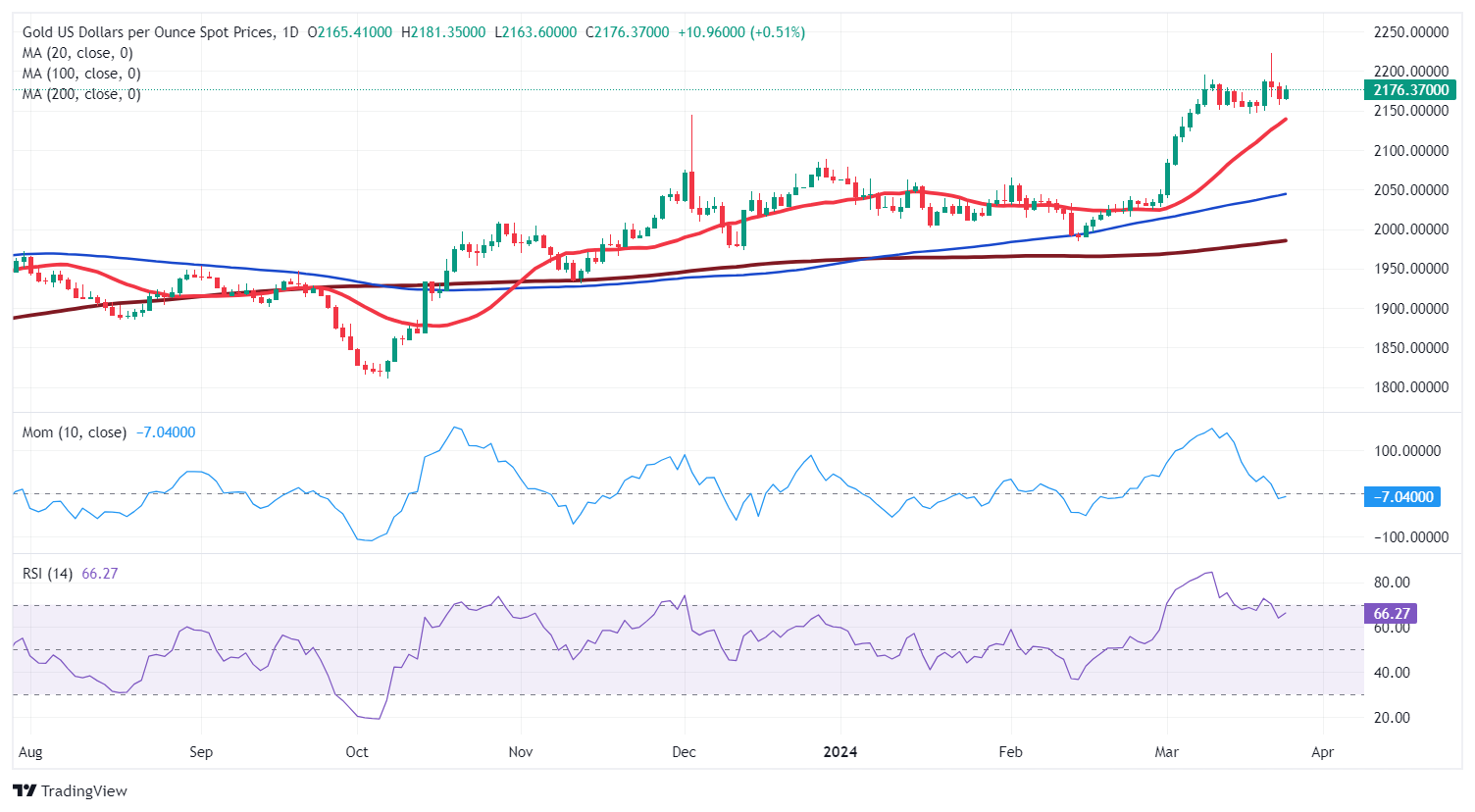
Gold trades within familiar levels on Monday amid a scarce macroeconomic calendar and easing US Dollar demand. XAU/USD currently hovers around $2,175, down from an intraday high of $2,180.52. Market participants are reassessing the picture following a batch of major central banks' decisions in the last two weeks and trying to figure out what will come next. Generally speaking, the US Dollar is on a strengthening path amid continued signs the economy is in much better shape than what inflation and record rates might mean.
A modest USD decline at the beginning of the week could be attributed to some profit-taking and the absence of relevant macroeconomic news. The Greenback eased despite the risk sentiment soured on the back of Asian news. On the one hand, Russia suffered a terrorist attack that spurred alerts among major economies. On the other, the People's Bank of China (PBoC) set the Yuan mid-point at 7.0996 against the US Dollar, much higher than the previous 7.2290.
The focus this week will be on the United States (US) March Personal Consumption Expenditures (PCE) Price Index, the Federal Reserve's (Fed) favourite inflation gauge. The core PCE Price Index is expected at 2.8% YoY, matching February's reading.
XAU/USD short-term technical outlook
The daily chart for the XAU/USD pair shows that bulls retain control. The bright metal develops above all its moving averages, with the 20 Simple Moving Average (SMA) heading firmly north below the current level while above also bullish 100 and 200 SMAs. At the same time, technical indicators have turned flat within positive levels after correcting extreme overbought conditions, reflecting absent selling interest.
For the near term, the 4-hour chart shows XAU/USD has turned neutral. XAU/USD hovers around a bullish 20 SMA, although it seems sellers are aligned around the indicator, preventing Gold from advancing further. At the same time, the 100 and 200 SMAs maintain their bullish slopes below the current level, limiting the bearish potential. Finally, technical indicators turned flat, with the Relative Strength Index (RSI) holding just above its midline, while the Momentum indicator develops within negative levels.
Support levels: 2,163.40 2,145.10 2,134.70
Resistance levels: 2,192.10 2,2006.45 2,222.65
Author

Valeria Bednarik
FXStreet
Valeria Bednarik was born and lives in Buenos Aires, Argentina. Her passion for math and numbers pushed her into studying economics in her younger years.
















