Gold Price Forecast: XAU/USD buyers take a breather before the next leg north
- Gold consolidates Friday’s record rally to $3,600 early Monday amid risk-off flows.
- US Dollar recovers from the Nonfarm Payrolls-led blow; Fed rate cut bets could limit its upswing.
- Heavily overbought RSI on the daily chart indicates buyers’ exhaustion as focus shifts to US CPI inflation this week.

Gold is hanging close to the all-time high of $3,600 in Asian trading on Monday, in the aftermath of awful US labor data for August released on Friday.
Gold pauses its record run ahead of US inflation test
Despite the latest pullback from record highs, Gold buyers retain control amid sustained dovish expectations surrounding the US Federal Reserve (Fed), lingering Russia-Ukraine geopolitical tensions, and additional Gold buying by China’s central bank last month.
The August US jobs report underscored the fourth consecutive month of weak hiring, cementing a 25 basis points (bps) Fed interest rate cut later this month.
The Bureau of Labor Statistics (BLS) showed Friday that the headline US Nonfarm Payrolls (NFP) increased by 22,000, far below forecasts of 75,000, while the Unemployment Rate climbed to 4.3%, the highest level since late 2021.
Additionally, Russia carried out its biggest air strike of the war on Ukraine over the weekend. In response, Ukrainian President Volodymyr Zelensky said the barrage of drones and missiles left four people dead and caused widespread damage across the north, south and east of the country, per Reuters.
Furthermore, the official data showed on Sunday that the People’s Bank of China (PBoC) added Gold to its reserves in August, extending purchases of bullion into a 10th straight month.
However, Gold buyers turn cautious amid renewed US Dollar upswing, led by a steep surge in the USD/JPY pair after the Japanese Yen (JPY) tumbled on the domestic political instability.
Japanese Prime Minister Shigeru Ishiba stepped down from his position on Sunday, following a string of election defeats that stripped his Liberal Democratic Party (LDP) of its majority in both houses of Parliament.
A slowdown in Chinese imports in August raised concerns over the dragon nation’s economic prospects, threatening the Gold price upside. China is the world’s top yellow metal consumer.
Looking ahead, traders could resort to liquidating their Gold long trades, repositioning before the critical US Consumer Price Index (CPI) and Producer Price Index (PPI) inflation data due later in the week.
The inflation data will help confirm whether the Fed will deliver a jumbo rate cut this month.
Gold price technical analysis: Daily chart
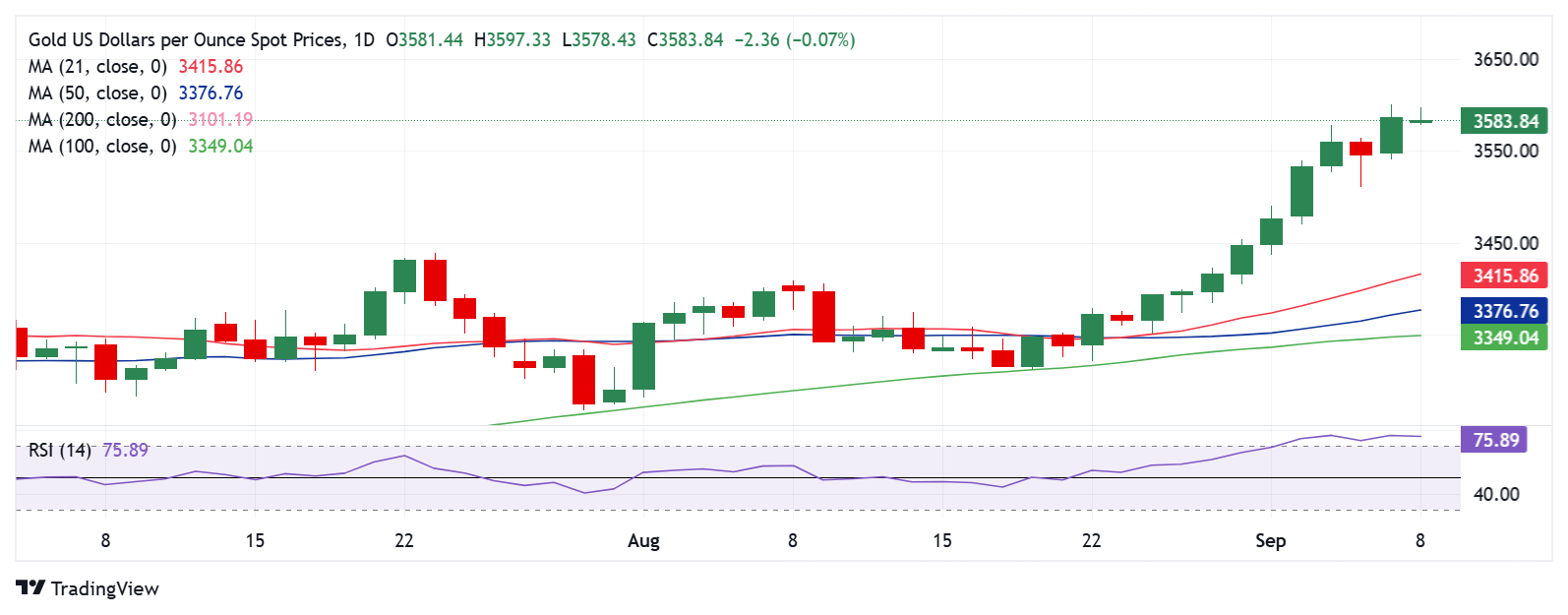
Technically, Gold could see a brief corrective decline as the 14-day Relative Strength Index (RSI) remains in a heavily overbought zone. The leading indicator is currently near 76.
Any pullback in Gold could challenge the initial support at the $3,550 psychological level, below which the September 4 low of $3,511 will be tested.
A sustained break below the latter will open up a fresh downside toward this month’s low of 3,437.
However, the Bull Cross of the 21-day Simple Moving Average (SMA) and the 50-day SMA could keep bargain hunting alive.
If buyers regain poise, the next topside barrier is seen at the $3,600 psychological mark/ record high. Further north, all eyes will be on the $3,650 figure.
Inflation FAQs
Inflation measures the rise in the price of a representative basket of goods and services. Headline inflation is usually expressed as a percentage change on a month-on-month (MoM) and year-on-year (YoY) basis. Core inflation excludes more volatile elements such as food and fuel which can fluctuate because of geopolitical and seasonal factors. Core inflation is the figure economists focus on and is the level targeted by central banks, which are mandated to keep inflation at a manageable level, usually around 2%.
The Consumer Price Index (CPI) measures the change in prices of a basket of goods and services over a period of time. It is usually expressed as a percentage change on a month-on-month (MoM) and year-on-year (YoY) basis. Core CPI is the figure targeted by central banks as it excludes volatile food and fuel inputs. When Core CPI rises above 2% it usually results in higher interest rates and vice versa when it falls below 2%. Since higher interest rates are positive for a currency, higher inflation usually results in a stronger currency. The opposite is true when inflation falls.
Although it may seem counter-intuitive, high inflation in a country pushes up the value of its currency and vice versa for lower inflation. This is because the central bank will normally raise interest rates to combat the higher inflation, which attract more global capital inflows from investors looking for a lucrative place to park their money.
Formerly, Gold was the asset investors turned to in times of high inflation because it preserved its value, and whilst investors will often still buy Gold for its safe-haven properties in times of extreme market turmoil, this is not the case most of the time. This is because when inflation is high, central banks will put up interest rates to combat it. Higher interest rates are negative for Gold because they increase the opportunity-cost of holding Gold vis-a-vis an interest-bearing asset or placing the money in a cash deposit account. On the flipside, lower inflation tends to be positive for Gold as it brings interest rates down, making the bright metal a more viable investment alternative.
Author

Dhwani Mehta
FXStreet
Residing in Mumbai (India), Dhwani is a Senior Analyst and Manager of the Asian session at FXStreet. She has over 10 years of experience in analyzing and covering the global financial markets, with specialization in Forex and commodities markets.