Gold Price Forecast: Will US CPI data rescue XAU/USD buyers?
- Gold price consolidates above $3,200, near one-week lows ahead of US CPI data.
- The US Dollar retreats as markets weigh the US-China trade truce and Fed easing bets.
- Gold price cracked the 21-day SMA support, but buyers refuse to give up yet.

Gold price has managed to defend the $3,200 mark again, consolidating Monday’s 3% slump early Tuesday. Gold sellers take a breather as traders await the high-impact US Consumer Price Index (CPI) data, which is expected to drive the next trading impetus.
Gold price eyes US CPI data for some reprieve
The gold price is showing some fresh signs of life in Asian trading this Tuesday as the US Dollar (USD) pulls back after a strong performance following news of a highly anticipated US-China trade truce.
Following the weekend’s trade talks in Geneva, both sides agreed that the US would reduce levies on Chinese imports from 145% to 30% during a 90-day negotiation period, and China would lower duties from 125% to 10%.
Risk flows intensified amid optimism about the China trade deal, easing US recession fears and reducing bets for aggressive Federal Reserve (Fed) interest rate cuts this year, which in turn powered the USD’s ongoing recovery at the expense of the traditional safe-haven Gold price.
Additionally, a ceasefire between India and Pakistan, along with optimism ahead of Thursday’s Russia-Ukraine peace talks, contributed to the downside in the Gold price.
In Tuesday’s trading so far, USD sellers appear to have regained control, as investors remain wary of the prospects for a permanent thaw in the US-China trade war. Fanning these concerns, US Trade Representative Jamieson Greer said late Monday that China has agreed to remove countermeasures. However, if things don’t work out, China tariffs can be reinstated.
Furthermore, traders resort to profit-taking on their USD longs heading into the US CPI showdown, thereby capping the downside of the Gold price.
The next directional move in the bright metal hinges on the outcome of the US inflation data release. Markets are expecting the headline annual US CPI to rise 2.4% in April, at the same pace as in March. The core CPI inflation is set to remain at 2.8% over the year in the same period.
An upside surprise to the CPI figures would double down on the renewed hawkish sentiment surrounding the Fed, bolstering the USD rally while fuelling a fresh decline in the non-interest-bearing Gold price. On the other hand, an unexpected slowdown in the US CPI growth could revive expectations of more than two Fed rate cuts, lending support to the bullion.
However, any headlines from the Trump administration regarding potential trade deals with the US’ major trading partners could outweigh the market reaction to the US CPI data, driving the Gold price action.
Speeches from Fed policymakers will also be closely scrutinized.
Gold price technical analysis: Daily chart
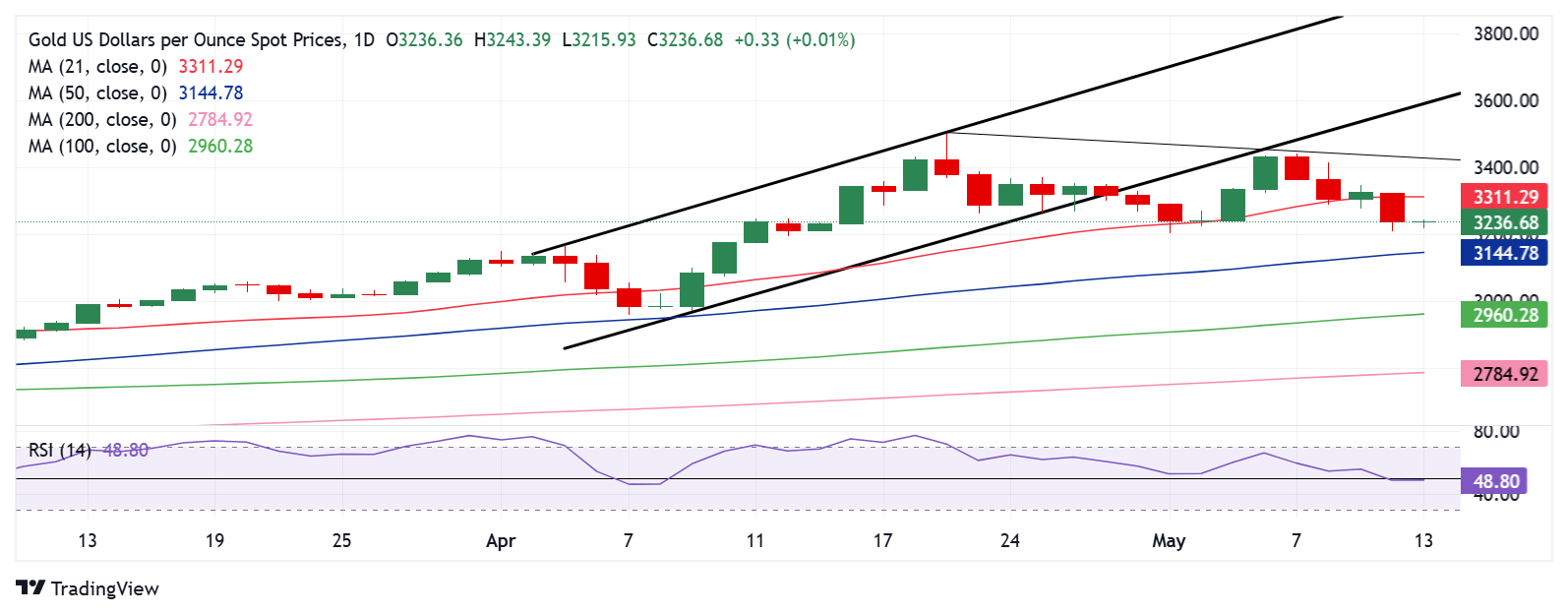
Gold price cracked the 21-day Simple Moving Average (SMA), then at $3,313 on a daily closing basis on Monday, opening the door for further downside.
The 14-day Relative Strength Index (RSI) also turned bearish after closing below the midline for the first time since early April.
At the time of this press, the leading indicator is flirting with the midline, near 49, as buyers vie for control.
Thus, it remains to be seen if a hotter-than-expected US CPI data fuel a fresh leg down in Gold price toward the 50-day SMA at $3,145.
The next healthy support levels are seen at the $3,100 round level and the April 10 low of $3,072.
In case the US CPI data surprises to the downside, Gold price could recapture the 21-day SMA support-turned-resistance, now at $3,311. Acceptance above that level will call for a test of the falling trendline resistance at $3,430, where the intermittent resistance aligns.
A sustained move above that level will open the door toward the record high of $3,500.
Author

Dhwani Mehta
FXStreet
Residing in Mumbai (India), Dhwani is a Senior Analyst and Manager of the Asian session at FXStreet. She has over 10 years of experience in analyzing and covering the global financial markets, with specialization in Forex and commodities markets.















