Gold Price Forecast: Set-up favours XAU/USD bulls, Powell’s testimony awaited
- A combination of diverging forces infused some intraday volatility around gold on Tuesday.
- Stronger US CPI prints reaffirmed hawkish Fed expectations and boosted USD, capping gains.
- COVID-19 jitters extended some support to the safe-haven XAU/USD and helped limit losses.

Gold witnessed some good two-way price moves on Tuesday, albeit remained well within a narrow trading band held over the past one week or so. The commodity, which is often considered as a hedge against inflation, benefitted from a sharp increase in US consumer prices. In fact, the headline CPI smashed market expectations and climbed 0.9% in June – marking the largest rise since June 2008. The rate of inflation in the 12 months that ended in June jumped to 5.4% from 5% previous. Another closely watched measure of inflation that omits volatile food and energy prices – core CPI – also rose 0.9% during the reported month and the yearly rate stood at a 29-year high level of 4.5%.
The headline reading has been trending higher every month since January and showed no signs of slowing yet, raising raised fresh questions about whether the spike in prices will subside as quickly as the Fed predicts. This, in turn, further fueled speculations that the Fed will tighten its monetary policy sooner than anticipated. In fact, the markets now seem to have brought forward rate hike expectations to late 2020, which triggered a sharp spike in the US Treasury bond yields. The combination of factors provided a goodish lift to the US dollar and capped gains for the dollar-denominated commodity, rather prompted some fresh selling at higher levels.
The downside, however, remained cushioned amid worries about the economic fallout from the spread of the highly contagious Delta variant of the coronavirus. The XAU/USD once again showed some resilience below the $1,800 mark, instead attracted some dip-buying and reversed modest intraday losses. The momentum extended through the Asian session on Wednesday, though the upside seems limited ahead of Fed Chair Jerome Powell's semi-annual congressional testimony. Powell's remarks on the inflation figures should influence market expectations about the Fed's near-term monetary policy outlook. This will play a key role in driving the USD in the near term and provide a fresh directional impetus to the non-yielding yellow metal.
Short-term technical outlook
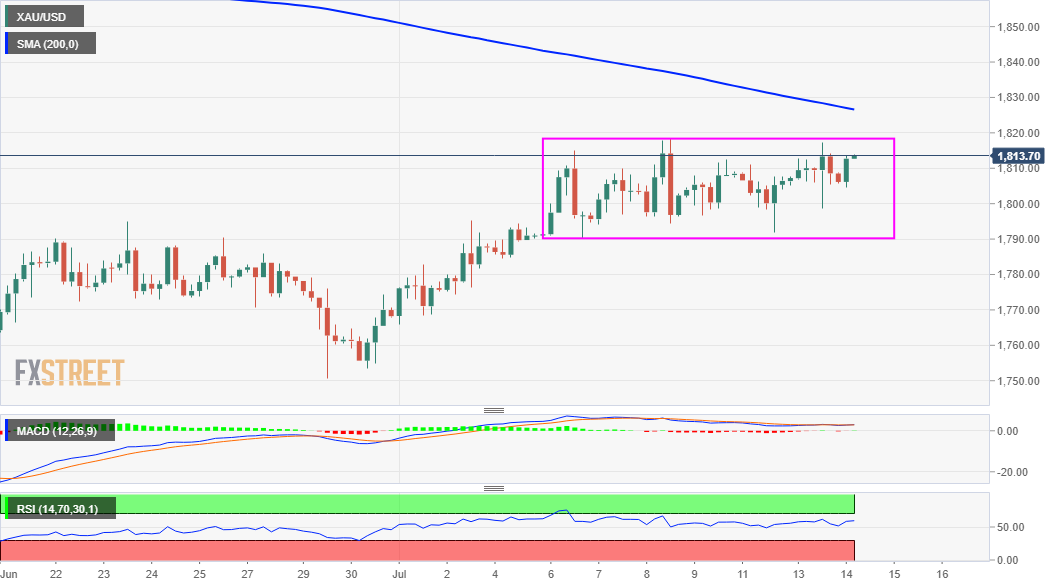
From a technical perspective, the recent range-bound price action constitutes the formation of a rectangle on hourly charts. Given the recent bounce from two-and-half-month lows, this might still be categorized as a bullish continuation pattern and supports prospects for additional gains. That said, it will still be prudent to wait for a sustained move beyond the monthly swing highs, around the $1,818 region, before placing fresh bullish bets.
The commodity might then accelerate the momentum towards challenging the very important 200-day SMA, currently around the $1,828-29 zone. Some follow-through buying should pave the way for a move beyond an intermediate barrier, around the $1,852-55 region, towards testing the next major hurdle near the $1,870 level.
On the flip side, dips below the $1,800 mark might continue to find decent support near the lower boundary of the recent trading range, pegged near the $1,792-90 area. Sustained weakness below might be seen as a fresh trigger for bearish traders and prompt some aggressive technical selling. The XAU/USD might then fall to the $1,775 support area, which if broken decisively will shift the near-term bias back in favour of bearish traders. The commodity might then turn vulnerable and accelerate the fall towards the $1,762-60 area before eventually dropping to retest June monthly swing lows, around the $1,750 area.
Author

Haresh Menghani
FXStreet
Haresh Menghani is a detail-oriented professional with 10+ years of extensive experience in analysing the global financial markets.

















