Gold Price Forecast: Overbought conditions threaten the XAU/USD record rally ahead of US data
- Gold refreshes record highs near $3,550, then retreats early Wednesday.
- US Dollar holds firm amid renewed haven demand as global bond sell-off intensifies.
- Focus shifts to US labor data, with JOLTS Job Openings in immediate focus.
- Gold risks a pullback as the RSI remains heavily overbought on the daily chart.

Gold is sitting at the highest level on record near $3,550 early Wednesday, bracing for the upcoming US labor data for fresh trading impetus.
Gold shines on safe-haven flows, awaits US jobs data
The buying interest in Gold remains unabated with the return of the global bond market crisis, with the long-dated yields surging through the roof and rattling investors’ sentiment.
Gold tends to benefit in a risk-averse market environment as it is considered a traditional safe-haven asset.
Growing concerns over the United Kingdom’s (UK) fiscal situation fuelled a sharp rally in the 30-year gilt yields on Wednesday, smashing gilts while spilling over into the European and Japanese bond markets.
The long-end of the Japanese government bond yields jumped further on the back of fresh political tensions in Japan.
Japan’s Liberal Democratic Party (LDP) Secretary-General Hiroshi Moriyama, PM Shigeru Ishiba’s key power broker within the ruling party, said he will quit if Ishiba approves a new LDP presidential election on Wednesday.
Amidst brewing political and fiscal crisis in the UK and Japan, investors scurried for safety in traditional safe havens such as Gold, the US Dollar (USD) etc.
Additionally, increasing calls for a jumbo interest rate cut by the US Federal Reserve (Fed) this month, in anticipation of weak US employment data, keep the buoyant tone intact around the non-interest-bearing Gold price alongside lingering Ukraine-Russia geopolitical tensions.
All eyes now remain on the US JOLTS Job Openings Survey on Wednesday, which will pave the way for a batch of critical US employment data, with the key focus on Friday’s Nonfarm Payrolls data.
The US jobs data will be key to determining the health of the country’s labor market, which remains a concern for the Fed.
In the meantime, the record rally in Gold price could be threatened by the parallel surge in the US Dollar. And a strong US JOLTS data could bolster the USD’s recovery rally, eventually curbing Gold’s upside.
Gold price technical analysis: Daily chart
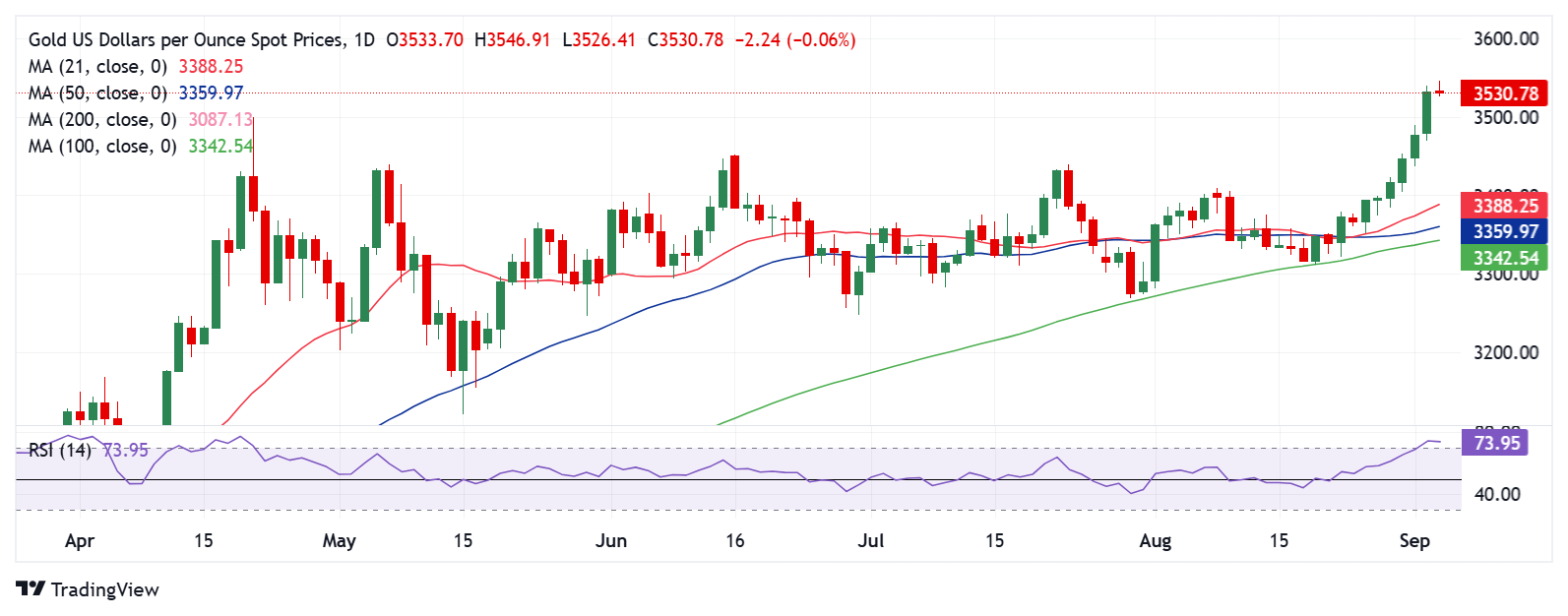
Technically also, Gold risks a pullback as the 14-day Relative Strength Index (RSI) remains in a heavily overbought zone. The leading indicator is currently near 75.
Any corrective declines in Gold could challenge the initial support at the $3,500 round level, below which the previous day’s low of $3,470 will be tested.
Sellers will then target the weekly low of $3,437 if the downside intensifies.
However, the Bull Cross of the 21-day Simple Moving Average (SMA) and the 50-day SMA could help limit losses.
If buyers regain poise, the next topside barrier is seen at the $3,550 psychological mark. Further north, all eyes will be on the $3,600 round figure.
Gold FAQs
Gold has played a key role in human’s history as it has been widely used as a store of value and medium of exchange. Currently, apart from its shine and usage for jewelry, the precious metal is widely seen as a safe-haven asset, meaning that it is considered a good investment during turbulent times. Gold is also widely seen as a hedge against inflation and against depreciating currencies as it doesn’t rely on any specific issuer or government.
Central banks are the biggest Gold holders. In their aim to support their currencies in turbulent times, central banks tend to diversify their reserves and buy Gold to improve the perceived strength of the economy and the currency. High Gold reserves can be a source of trust for a country’s solvency. Central banks added 1,136 tonnes of Gold worth around $70 billion to their reserves in 2022, according to data from the World Gold Council. This is the highest yearly purchase since records began. Central banks from emerging economies such as China, India and Turkey are quickly increasing their Gold reserves.
Gold has an inverse correlation with the US Dollar and US Treasuries, which are both major reserve and safe-haven assets. When the Dollar depreciates, Gold tends to rise, enabling investors and central banks to diversify their assets in turbulent times. Gold is also inversely correlated with risk assets. A rally in the stock market tends to weaken Gold price, while sell-offs in riskier markets tend to favor the precious metal.
The price can move due to a wide range of factors. Geopolitical instability or fears of a deep recession can quickly make Gold price escalate due to its safe-haven status. As a yield-less asset, Gold tends to rise with lower interest rates, while higher cost of money usually weighs down on the yellow metal. Still, most moves depend on how the US Dollar (USD) behaves as the asset is priced in dollars (XAU/USD). A strong Dollar tends to keep the price of Gold controlled, whereas a weaker Dollar is likely to push Gold prices up.
Author

Dhwani Mehta
FXStreet
Residing in Mumbai (India), Dhwani is a Senior Analyst and Manager of the Asian session at FXStreet. She has over 10 years of experience in analyzing and covering the global financial markets, with specialization in Forex and commodities markets.