Gold Price Forecast: Israel-Iran conflict fuels dip-buy in XAU/USD as focus shifts to Fed
- Gold price finds buyers near $3,380 again early Tuesday, reversing Monday’s pullback.
- US Dollar pops up on renewed concerns over Israel-Iran geopolitical conflict, trade headlines.
- Technically, Gold price remains a ‘buy-the-dip’ trade ahead of the Fed policy announcements.

Gold price is reversing a part of the previous pullback from two-month highs, looking to regain $3,400 in Asian trades on Tuesday. Renewed concerns over the Israel and Iran conflict and trade updates continue to drive the sentiment around the safe-haven US Dollar.
Gold price keeps sight on record highs, Fed
A fresh risk-aversion wave hit Asian markets early Tuesday following reports that US President Donald Trump is leaving the Group of Seven leaders’ (G7) Summit early to head back to Washington DC.
Fox News reported that Trump requested the US National Security Council (NSC) to be prepared in the Situation Room. This headline added to the risk-off flows as markets began speculating that the US could initiate an offensive operation against Iran, supporting its ally, Israel.
However, the White House was quick to dismiss such chatters, though it is unclear as to why Trump and his Secretary of State Marc Rubio left the G7 early to return to DC.
Investors once again scurry for safety in the ultimate store of value, Gold price, while propping the haven appeal of the US Dollar (USD). The renewed USD uptick seems to cap the Gold price rebound.
Further, the bright metal also finds comfort from the news that the US and Japan failed to reach a trade deal on the sidelines of the G7 Summit. Trade uncertainties could act as a headwind to the Greenback, allowing Gold price to sustain the comeback.
“There are still some points on which the two sides are not on the same page, so we have not yet reached an agreement on the trade package,” Japanese Prime Minister Shigeru Ishiba said late Monday.
Against this backdrop, all eyes turn to the US Federal Reserve (Fed) monetary policy announcements due on Wednesday, with the two-day meeting starting off later on Tuesday.
The Fed is widely expected to keep the fed funds rate unchanged in the range of 4.25%-4.5% this month, with a 60% probability of the Fed lowering the rates in September.
Markets continue to price two 25 basis points (bps) rate cuts by year-end, and therefore, the Fed’s updated economic projections, the so-called Dot Plot chart, will be closely scrutinized alongside Chairman Jerome Powell’s comment to gauge the scope and the timing of the next rate cut.
Any dovish tilt in the Fed’s communication or in the updated forecasts could provide an extra- boost to the non-yielding Gold price while reviving the USD downtrend.
In the meantime, the focus remains on the Bank of Japan (BoJ) policy decision and the US Retail Sales report due later in the day.
The BoJ policy announcements could fuel the USD/JPY pair-driven volatility in the Greenback, eventually impacting the USD-denominated Gold price. But the impact could be limited as Middle East geopolitical headlines and trade updates will likely remain the key market drivers.
Gold price technical analysis: Daily chart
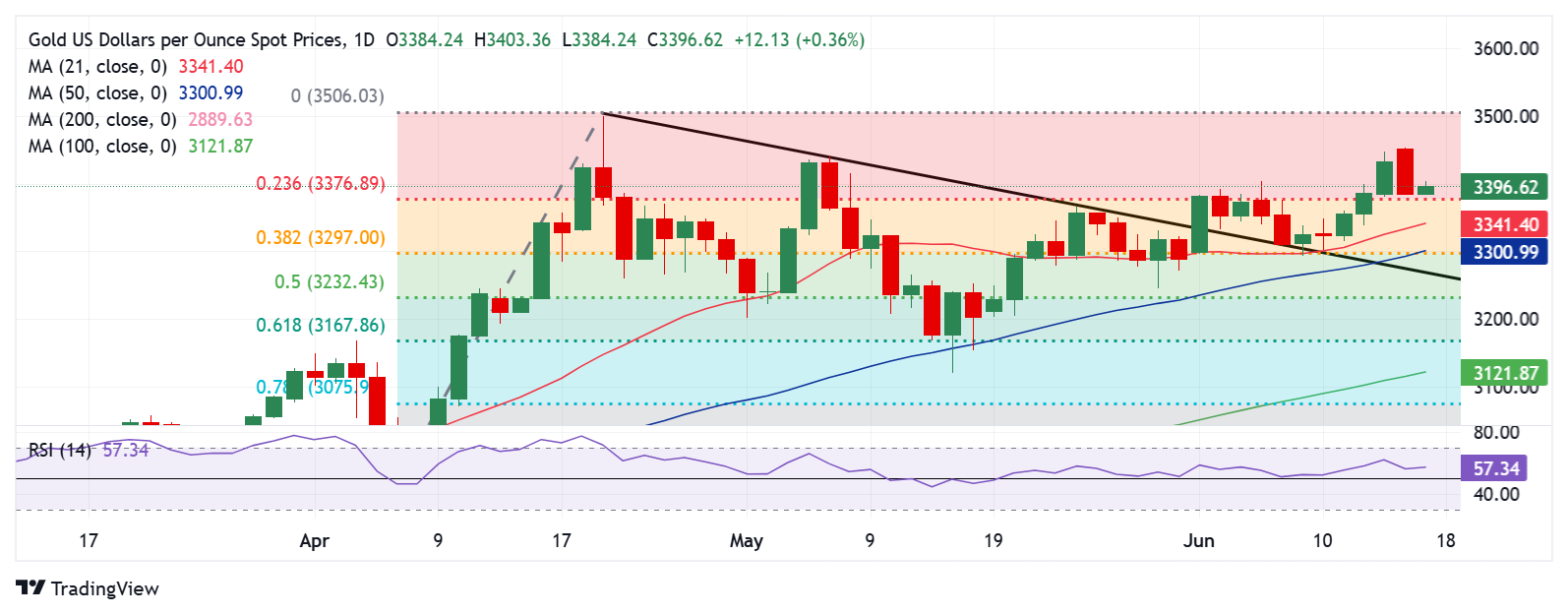
Technically, the bullish bias remains intact for Gold price as the 14-day Relative Strength Index (RSI) turns higher above the midline, currently near 57.50.
For a sustained move higher, acceptance above the static resistance at $3,440 is critical.
The next topside target is seen at the two-month highs of $3,453, above which the record highs of $3,500 could be challenged.
If the previous correction resumes, sellers could challenge the previous strong resistance now support at $3,377, the 23.6% Fibonacci Retracement (Fibo) level of the April record rally.
The next downside cushion will be aligned at the 21-day Simple Moving Average (SMA) at $3,341 if the $3,350 psychological barrier gives way.
Gold FAQs
Gold has played a key role in human’s history as it has been widely used as a store of value and medium of exchange. Currently, apart from its shine and usage for jewelry, the precious metal is widely seen as a safe-haven asset, meaning that it is considered a good investment during turbulent times. Gold is also widely seen as a hedge against inflation and against depreciating currencies as it doesn’t rely on any specific issuer or government.
Central banks are the biggest Gold holders. In their aim to support their currencies in turbulent times, central banks tend to diversify their reserves and buy Gold to improve the perceived strength of the economy and the currency. High Gold reserves can be a source of trust for a country’s solvency. Central banks added 1,136 tonnes of Gold worth around $70 billion to their reserves in 2022, according to data from the World Gold Council. This is the highest yearly purchase since records began. Central banks from emerging economies such as China, India and Turkey are quickly increasing their Gold reserves.
Gold has an inverse correlation with the US Dollar and US Treasuries, which are both major reserve and safe-haven assets. When the Dollar depreciates, Gold tends to rise, enabling investors and central banks to diversify their assets in turbulent times. Gold is also inversely correlated with risk assets. A rally in the stock market tends to weaken Gold price, while sell-offs in riskier markets tend to favor the precious metal.
The price can move due to a wide range of factors. Geopolitical instability or fears of a deep recession can quickly make Gold price escalate due to its safe-haven status. As a yield-less asset, Gold tends to rise with lower interest rates, while higher cost of money usually weighs down on the yellow metal. Still, most moves depend on how the US Dollar (USD) behaves as the asset is priced in dollars (XAU/USD). A strong Dollar tends to keep the price of Gold controlled, whereas a weaker Dollar is likely to push Gold prices up.
Author

Dhwani Mehta
FXStreet
Residing in Mumbai (India), Dhwani is a Senior Analyst and Manager of the Asian session at FXStreet. She has over 10 years of experience in analyzing and covering the global financial markets, with specialization in Forex and commodities markets.