Gold Price Forecast: Buyers’ exhaustion could set in as XAU/USD tops $4,000 for first time
- Gold’s record rally remains unstoppable as buyers conquer the key $4,000 level.
- Heightened global uncertainty fuels safe-haven flows into the US Dollar and Gold.
- Gold is extremely overbought on the daily chart, risks a profit-taking pullback before the next leg north.

Gold captures the key $4,000 barrier for the first time in history early Wednesday as the explosive record run remains uninterrupted.
Gold: Buyers could face exhaustion
Markets are witnessing a ‘buy everything’ trading scenario amid US Federal Reserve (Fed) easing hopes, despite heightened global economic and political uncertainties. The clear winner appears to be Gold, which is up roughly 50% so far this year.
The latest leg north in Gold is driven by intensifying concerns over the mass layoff of Federal employees likely to be announced by US President Donald Trump any time soon as the government shutdown extends into a second week.
However, CNN News reported earlier on, citing officials familiar with the talks, “the White House is now planning to hold off at least a little longer on sending out notices of Reductions in Force (RIFs, as the government firings are typically referred to).”
“The White House initially planned for layoffs in the immediate aftermath of the shutdown,” the officials said.
Looming mass layoffs and delayed key US economic data releases only boost the chances of the US Federal Reserve (Fed) opting for two interest rate cuts this year, with markets pricing in a 95% probability of such a move at the October 28-29 monetary policy meeting.
The shutdown-induced increased demand for safe havens keeps underpinning the sentiment around the US Dollar (USD) and Gold, especially in times of the ongoing political upheaval in France and Japan.
Additionally, sustained Gold buying by global central banks adds to the bullish pressures around the yellow metal.
Looking ahead, speeches from Fed officials remain in focus for fresh insights on the US economy and the Fed’s path forward on interest rates, in the absence of any official data publication.
That said, Gold remains at risk of a steep pullback from a short-term technical perspective.
Gold price technical analysis: Daily chart
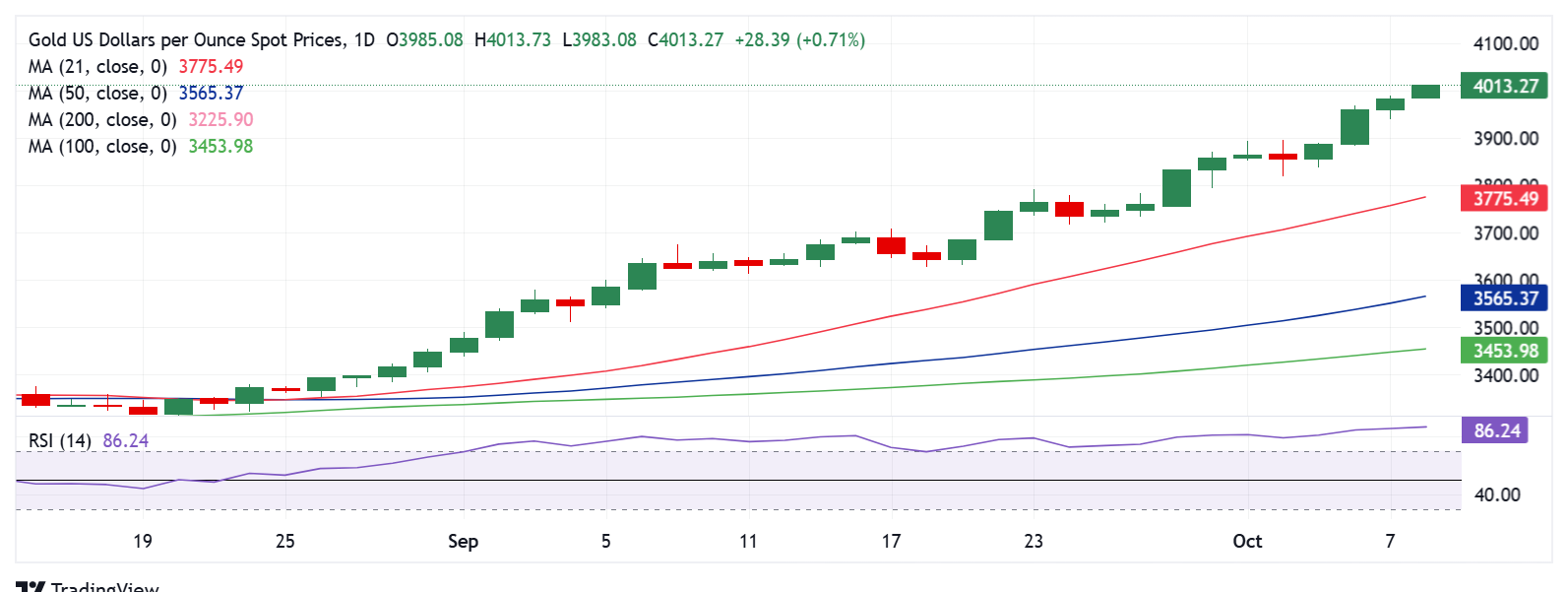
The daily chart shows that the 14-day Relative Strength Index (RSI) is stretching further in the extreme overbought zone, currently near 86.50.
The leading indicator suggests that a deep correction appears in the offing if buyers fail to sustain the break above $4,000 on a daily candlestick closing basis.
If that materializes, doors will open up for a test of the $4,050 psychological level, with the next target seen at $4,100.
On the flip side, if buyers finally give up, Gold could test the initial psychological support at $3,950, below which this week’s low of $3,884 will be challenged.
The line in the sand for Gold buyers will likely be the October 2 low of $3,820.
Risk sentiment FAQs
In the world of financial jargon the two widely used terms “risk-on” and “risk off'' refer to the level of risk that investors are willing to stomach during the period referenced. In a “risk-on” market, investors are optimistic about the future and more willing to buy risky assets. In a “risk-off” market investors start to ‘play it safe’ because they are worried about the future, and therefore buy less risky assets that are more certain of bringing a return, even if it is relatively modest.
Typically, during periods of “risk-on”, stock markets will rise, most commodities – except Gold – will also gain in value, since they benefit from a positive growth outlook. The currencies of nations that are heavy commodity exporters strengthen because of increased demand, and Cryptocurrencies rise. In a “risk-off” market, Bonds go up – especially major government Bonds – Gold shines, and safe-haven currencies such as the Japanese Yen, Swiss Franc and US Dollar all benefit.
The Australian Dollar (AUD), the Canadian Dollar (CAD), the New Zealand Dollar (NZD) and minor FX like the Ruble (RUB) and the South African Rand (ZAR), all tend to rise in markets that are “risk-on”. This is because the economies of these currencies are heavily reliant on commodity exports for growth, and commodities tend to rise in price during risk-on periods. This is because investors foresee greater demand for raw materials in the future due to heightened economic activity.
The major currencies that tend to rise during periods of “risk-off” are the US Dollar (USD), the Japanese Yen (JPY) and the Swiss Franc (CHF). The US Dollar, because it is the world’s reserve currency, and because in times of crisis investors buy US government debt, which is seen as safe because the largest economy in the world is unlikely to default. The Yen, from increased demand for Japanese government bonds, because a high proportion are held by domestic investors who are unlikely to dump them – even in a crisis. The Swiss Franc, because strict Swiss banking laws offer investors enhanced capital protection.
Author

Dhwani Mehta
FXStreet
Residing in Mumbai (India), Dhwani is a Senior Analyst and Manager of the Asian session at FXStreet. She has over 10 years of experience in analyzing and covering the global financial markets, with specialization in Forex and commodities markets.
















