Gold Price Forecast: Acceptance above $2,025 critical to sustaining the rebound
- Gold price clings to recovery gains above $2,020, as the US Dollar weakens early Friday.
- Gold price cheers Middle East geopolitical escalation despite easing Fed rate cut bets.
- Gold price is not out of the woods yet so long as the 50-day SMA resistaince holds.
Gold price is looking to extend the previous rebound while trading above $2,020 early Friday, benefiting from intensifying geopolitical tensions in the Middle East and a broadly weaker US Dollar. All eyes now remain on the upcoming US consumer sentiment data and Fedspeak for the next move in the Gold price.
Geopolitical risks save the day for Gold price
The US Dollar is replicating the downbeat moves seen in the Asian session a day ago, despite the cautious optimism, allowing Gold price to gather pace for its next push higher. The bright metal continues to draw support from the ongoing conflict in the Middle East, which stokes up concerns over its impact on global inflationary pressures.
Fresh reports hit the wires earlier this morning that Iran-backed Houthi terrorists launched two anti-ship ballistic missiles at M/V Chem Ranger, a Marshall Island-flagged, U.S.-Owned, Greek-operated tanker ship. This comes after the United States (US) launched new strikes against Houthi anti-ship missiles aimed at the Red Sea on Thursday.
Escalating geopolitical tensions in the Red Sea fuels worries of the strife becoming a wider regional conflict, underpinning the safe-haven demand for the Gold price.
Despite traders cutting bets for aggressive US Federal Reserve (Fed) interest rate cuts this year, Gold price stood resilient and staged a solid comeback, as geopolitical risks overshadowed.
Easing Fed rate cut bets got bolstered after strong US jobs data on Thursday, which showed weekly Initial Jobless Claims fell to their lowest level in nearly 1-1/2 years, suggesting tighter labor market conditions. The tempered Fed rate cut outlook offered a fresh life to the US Dollar notwithstanding the tech rally on Wall Street.
The probability for a March Fed rate cut is now below 60%, the CME Group’s FedWatch Tool, as against a roughly 75% chance seen at the start of the week. Strong Retail Sales data from the US and the recent hawkish Fed commentary have also contributed to the change in the Fed expectations.
Markets now look forward to the US University of Michigan (UoM) Consumer Sentiment and Inflation Expectations data, as well as, speeches from the Fed policymakers for further hints on the interest rate outlook, which will have a strong bearing on the non-yielding Gold price. The Fed enters its ‘blackout period’ from Saturday ahead of the February 1 policy meeting.
Gold price technical analysis: Daily chart
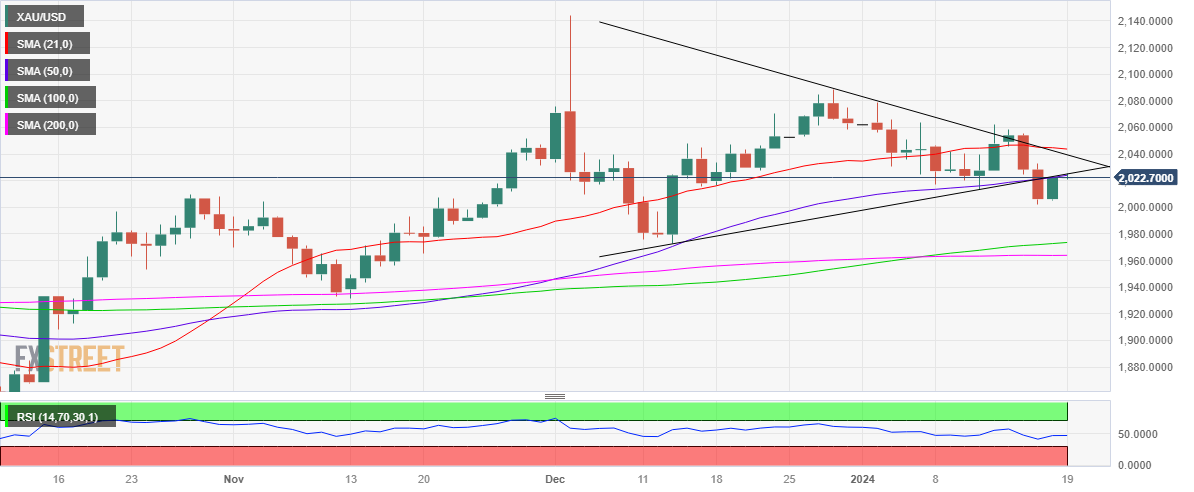
Gold price is testing the critical support-turned-resistance at $2,025 on its road to recovery. That level is the intersection of the 50-day Simple Moving Average (SMA) and the triangle support.
Gold price confirmed a downside break from a symmetrical triangle on Wednesday while the 14-day Relative Strength Index (RSI) indicator stayed below the midline, still keeping Gold sellers hopeful.
Acceptance above the 50-day SMA support-turned-resistance is critical to initiate a recovery toward the confluence of the 21-day SMA and the triangle resistance at around $2,040.
A sustained move above the latter will reopen doors for a test of the $2,050 psychological level.
Alternatively, if Gold buyers fail to sustain the recovery momentum, sellers could barge in and knock Gold price down to the $2,000 mark once again. However, the $2,010 round level could offer some temporary relief to them. The next strong cushion is seen around the $1,975 region.
Gold FAQs
Why do people invest in Gold?
Gold has played a key role in human’s history as it has been widely used as a store of value and medium of exchange. Currently, apart from its shine and usage for jewelry, the precious metal is widely seen as a safe-haven asset, meaning that it is considered a good investment during turbulent times. Gold is also widely seen as a hedge against inflation and against depreciating currencies as it doesn’t rely on any specific issuer or government.
Who buys the most Gold?
Central banks are the biggest Gold holders. In their aim to support their currencies in turbulent times, central banks tend to diversify their reserves and buy Gold to improve the perceived strength of the economy and the currency. High Gold reserves can be a source of trust for a country’s solvency. Central banks added 1,136 tonnes of Gold worth around $70 billion to their reserves in 2022, according to data from the World Gold Council. This is the highest yearly purchase since records began. Central banks from emerging economies such as China, India and Turkey are quickly increasing their Gold reserves.
How is Gold correlated with other assets?
Gold has an inverse correlation with the US Dollar and US Treasuries, which are both major reserve and safe-haven assets. When the Dollar depreciates, Gold tends to rise, enabling investors and central banks to diversify their assets in turbulent times. Gold is also inversely correlated with risk assets. A rally in the stock market tends to weaken Gold price, while sell-offs in riskier markets tend to favor the precious metal.
What does the price of Gold depend on?
The price can move due to a wide range of factors. Geopolitical instability or fears of a deep recession can quickly make Gold price escalate due to its safe-haven status. As a yield-less asset, Gold tends to rise with lower interest rates, while higher cost of money usually weighs down on the yellow metal. Still, most moves depend on how the US Dollar (USD) behaves as the asset is priced in dollars (XAU/USD). A strong Dollar tends to keep the price of Gold controlled, whereas a weaker Dollar is likely to push Gold prices up.
Author

Dhwani Mehta
FXStreet
Residing in Mumbai (India), Dhwani is a Senior Analyst and Manager of the Asian session at FXStreet. She has over 10 years of experience in analyzing and covering the global financial markets, with specialization in Forex and commodities markets.