Swiss National Bank leaves interest rates unchanged at 0%

Swiss National Bank (SNB) leaves its key policy rates unchanged at 0%, as expected by market particiapnts.
Key highlights of SNB’s monetary policy assessment
Banks' sight deposits held at the SNB will be remunerated at the SNB policy rate up to a certain threshold.
SNB sees 2026 inflation at 0.7% (previous forecast was for 0.6%).
SNB sees 2028 inflation at 0.8% (previous forecast was for 0.7%).
SNB sees 2027 inflation at 0.8% (previous forecast was for 0.6%).
Medium-term inflationary pressure has increased only slightly.
The main risk to the economic outlook for Switzerland stems from developments in the global economy.
In particular, the situation in the Middle East could deteriorate further and curb global economic activity more strongly.
The rise in goods inflation was mainly driven by higher prices for oil products.
The trade policy environment and exchange rate developments also continue to be sources of uncertainty.
Inflation will continue to rise somewhat in the fourth quarter, before declining again over the course of 2027.
Market reaction
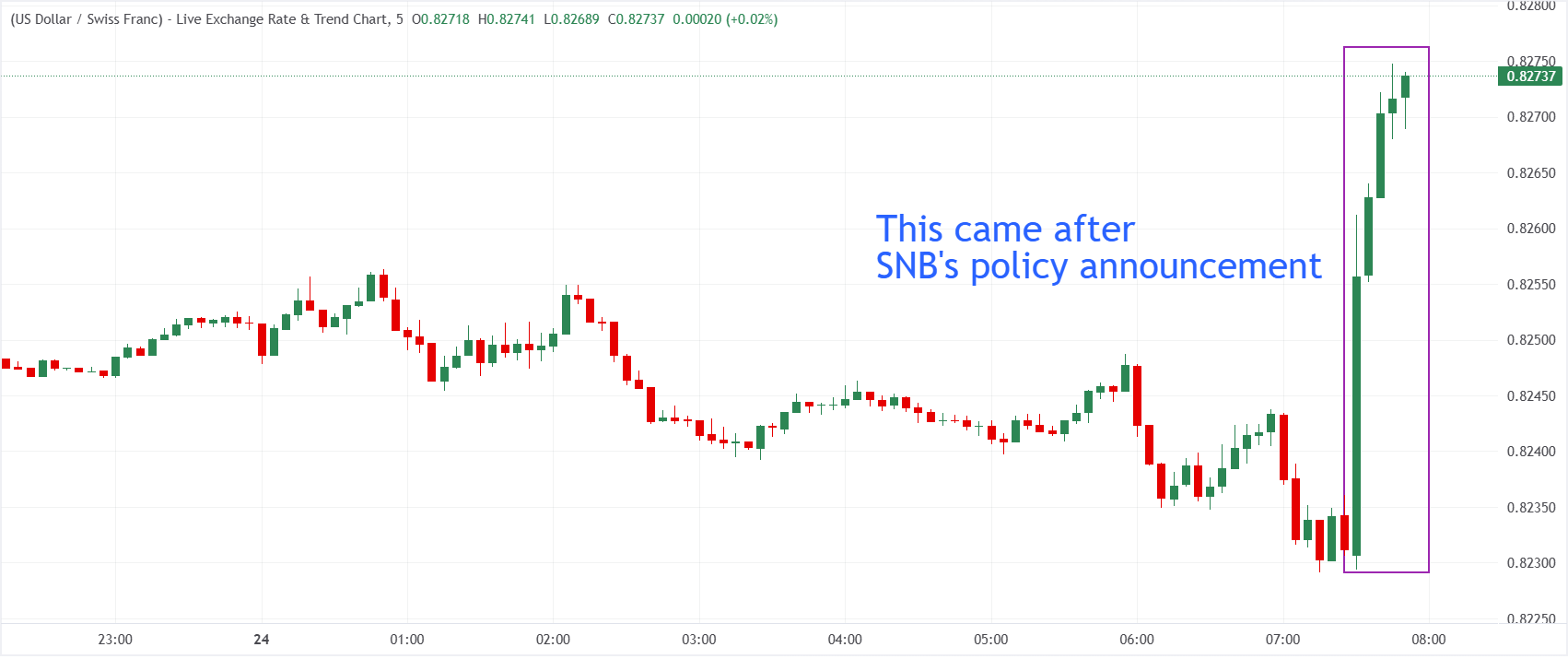
The Swiss Franc (CHF) witnesses an intense sell-off after the the SNB's monetray policy announcement. As of writing, USD/CHF is up 0.22% to near 0.8270, the highest level seen in over a year.
SNB FAQs
The Swiss National Bank (SNB) is the country’s central bank. As an independent central bank, its mandate is to ensure price stability in the medium and long term. To ensure price stability, the SNB aims to maintain appropriate monetary conditions, which are determined by the interest rate level and exchange rates. For the SNB, price stability means a rise in the Swiss Consumer Price Index (CPI) of less than 2% per year.
The Swiss National Bank (SNB) Governing Board decides the appropriate level of its policy rate according to its price stability objective. When inflation is above target or forecasted to be above target in the foreseeable future, the bank will attempt to tame excessive price growth by raising its policy rate. Higher interest rates are generally positive for the Swiss Franc (CHF) as they lead to higher yields, making the country a more attractive place for investors. On the contrary, lower interest rates tend to weaken CHF.
Yes. The Swiss National Bank (SNB) has regularly intervened in the foreign exchange market in order to avoid the Swiss Franc (CHF) appreciating too much against other currencies. A strong CHF hurts the competitiveness of the country’s powerful export sector. Between 2011 and 2015, the SNB implemented a peg to the Euro to limit the CHF advance against it. The bank intervenes in the market using its hefty foreign exchange reserves, usually by buying foreign currencies such as the US Dollar or the Euro. During episodes of high inflation, particularly due to energy, the SNB refrains from intervening markets as a strong CHF makes energy imports cheaper, cushioning the price shock for Swiss households and businesses.
The SNB meets once a quarter – in March, June, September and December – to conduct its monetary policy assessment. Each of these assessments results in a monetary policy decision and the publication of a medium-term inflation forecast.
Author

Sagar Dua
FXStreet
Sagar Dua is associated with the financial markets from his college days. Along with pursuing post-graduation in Commerce in 2014, he started his markets training with chart analysis.