Gold Price Forecast: $1,940 is a tough nut to crack for XAU/USD bulls ahead of United States data
- Gold price returns to the red amid a pause in the US Dollar sell-off.
- The latest uptick in the US Treasury bond yields weighs on Gold price.
- Investors take profits on Gold longs ahead of critical United States data.
- Gold price correction could see a retest of the $1,900 barrier.

Gold price is retreating from a new nine-month high of $1,943 as bulls give into the bearish pressures early Wednesday. Broad risk aversion has capped the downside in the United States Dollar (USD) while the US Treasury bond yields also attempt a tepid bounce, weighing down on the Gold price.
The US Dollar downside stalls amid risk aversion
Risk sentiment remains in a weaker spot so far this Wednesday, reflective of the 0.45% drop in the US S&P 500 futures, as investors digest a downbeat revenue forecast from Microsoft Corp. Microsoft turned into the red after hours in the US after warning that revenue growth in its Azure cloud-computing business would decelerate. This sapped investors' confidence, as they refrained from betting on riskier assets, which helped cushion the downside in the United States Dollar at the expense of the Gold price. Meanwhile, the US Treasury bond yields see a minor uptick, following the previous day’s slump, which is adding to the weight on the Gold price.
Despite the corrective decline, Gold price remains hopeful ahead of the United States Preliminary Gross Domestic Product (GDP) release for the fourth quarter of 2022, due on Thursday. Should the US growth figures show signs of deteriorating economic performance, it could prompt the US Federal Reserve (Fed) to pause its tightening cycle or even go for rate cuts later this year. Softer Gross Domestic Product data from the US could bode well for the non-interest-bearing Gold price in the wake of the dovish Federal Reserve outlook.
Gold price finds comfort from increased Switzerland’s Gold exports
Another factor that could help stay Gold optimists afloat is the surge in Switzerland’s exports of Gold to countries including China, Turkey, Singapore and Thailand. The Swiss Gold exports to these Asian countries reached fresh multi-year highs in 2022, suggesting increased Asian physical demand for Gold. However, the record-high Gold prices in India could threaten the demand prospects from the world’s second-biggest Gold consumer.
Gold price technical analysis: Daily chart
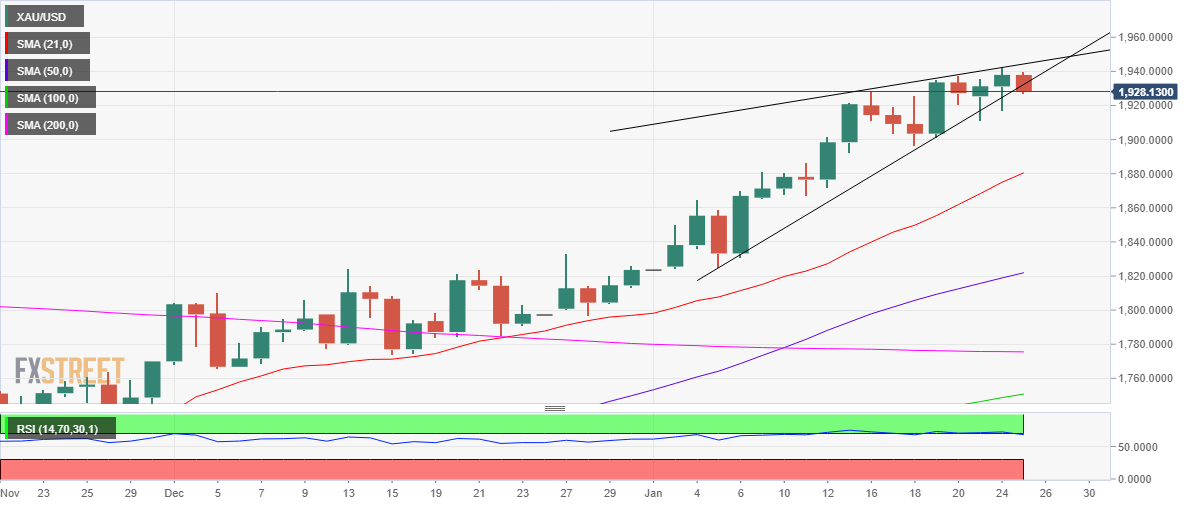
Nothing seems to have changed significantly for Gold price in terms of the short-term technical outlook, although Gold price could be briefly punished after having failed to clear the $1,940 barrier on multiple occasions.
Gold sellers need a daily closing below the lower boundary of the rising wedge formation, now at $1,933, to confirm a downside break.
On a rising wedge breakdown, Gold price could extend the correction toward Monday’s high of $1,911, below which the $1,900 round figure could be tested.
The last line of defense for bulls is seen at the January 18 low of $1,897.
The 14-day Relative Strength Index (RSI) still holds comfortably above the midline, retreating from the overbought territory, suggesting that any pullbacks in Gold price could be a good buying opportunity for traders.
Acceptance above the $1,940 hurdle is critical to renewing the upside. Further, a daily closing above the rising wedge resistance at $1,944 is needed to could negate the bearish bias in the near term.
Author

Dhwani Mehta
FXStreet
Residing in Mumbai (India), Dhwani is a Senior Analyst and Manager of the Asian session at FXStreet. She has over 10 years of experience in analyzing and covering the global financial markets, with specialization in Forex and commodities markets.