Gold overtakes Euro as second-largest global reserve asset

Due to a combination of central bank gold buying and the surging price of gold, gold has overtaken the euro as the world’s number two reserve asset.
But it’s not so much that gold is replacing the euro. It is supplanting the dollar.
Based on data released by the European Central Bank and analyzed by CNBC, at the end of 2024, gold made up 19.6 percent of global reserves, with the euro accounting for 15.9 percent.
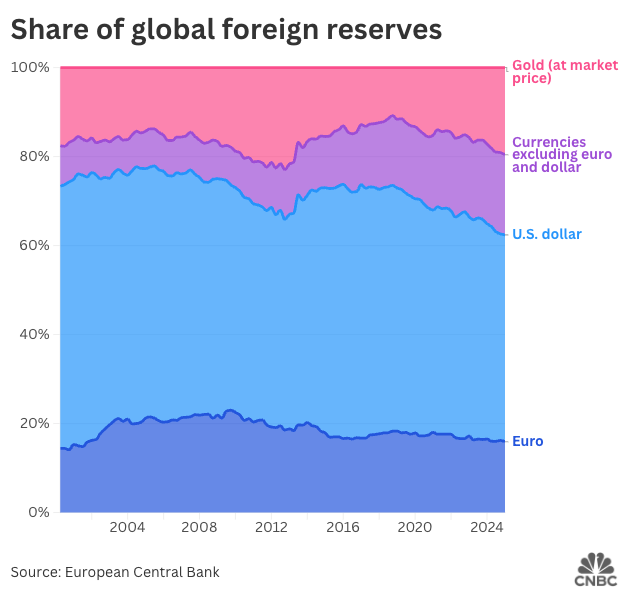
The euro’s share of global reserves fell six-tenths of one percent from 2023 to 2024, from 16.5 percent to 15.9 percent. Gold’s share leapt from 18.1 percent to 19.6 percent.
Meanwhile, the percentage of dollars held as a global reserve asset tumbled from 48.4 percent to 46.5 percent.
Gold’s share of global reserves has increased rapidly over the past several years. In 2018, it was only 11.6 percent of total reserves.
At the end of 2018, the dollar commanded 54.6 percent of global reserves.
Central bank gold demand topped 1,000 tonnes for the third straight year in 2024. To put that into perspective, central bank gold reserves increased by an average of just 473 tonnes annually between 2010 and 2021.
According to IMF data, between 2006 and 2023, central banks globally increased their official holdings by about 200 million troy ounces (6221 tonnes). This doesn’t account for the large amount of gold being purchased by the People’s Bank of China (and likely other countries) off the books.
CNBC pointed out that gold has been increasingly attractive to countries “concerned about sanctions and the potential erosion of the role of major currencies in the international monetary system.”
In other words, they are trying to shield themselves from the weaponization and depreciation of the dollar. CNBC noted that “a turning point for the precious metal came around the time of Russia’s full-scale invasion of Ukraine in February 2022.”
This should come as no surprise. According to a report by the Atlantic Council, “In recent years, and especially since Russia’s invasion of Ukraine and the Group of Seven (G7)’s subsequent escalation in the use of financial sanctions, some countries have been signaling their intention to diversify away from dollars.”
As a Forbes article put it, “gold is neither exposed to counterparty risk nor to international sanctions, some central banks (e.g., Russia) ought to fret over.”
Concerns about U.S. fiscal irresponsibility and the use of tariffs as a negotiating tool have also undermined faith in the dollar. An analyst told CNBC, “As the U.S. wants to take a more isolationist approach in trade, it makes sense for central banks of its key trading partners to diversify their reserves away from the U.S. dollar.”
Capital Economics climate and commodities economist Hamad Hussain told CNBC that central banks will likely keep accumulating gold.
“Indeed, the perception of gold as hedge against global fiscal, inflationary, and geopolitical risks supports the case for central bank reserve managers to allocate a greater share of their portfolio to gold. Recent doubts over the dollar’s safe-haven status could also boost the attractiveness of both gold and the euro as reserve assets over the coming years.”
To receive free commentary and analysis on the gold and silver markets, click here to be added to the Money Metals news service.
To receive free commentary and analysis on the gold and silver markets, click here to be added to the Money Metals news service.
Author

Joshua D. Glawson
Money Metals Exchange
Joshua D. Glawson is a writer on such topics as philosophy, politics, economics, finance, and personal development. He graduated with a Bachelor in Political Science from the University of California Irvine. His website is JoshuaDGlawson.com.

















