Gold navigates central bank credibility as markets prepare for the ECB

Key takeaways
- Gold trades within the 4,120–4,140 participation zone as investors increasingly evaluate the credibility of future central bank communication.
- The ECB meeting has become the week's dominant macro event, with markets focused on policy guidance rather than the expected decision to leave rates unchanged.
- Real yields, US Dollar positioning and reserve diversification continue transmitting policy expectations into gold pricing.
- The Renko structure remains in a confirmed Release phase, reflecting elevated institutional participation as the recovery matures.
Gold enters a credibility-driven market
Gold enters Wednesday's session with investors progressively shifting their attention from recent inflation releases toward the quality of upcoming monetary-policy communication.
The latest inflation data have already been incorporated into market pricing across the major economies. Attention is now centered on how central banks interpret that information and how future policy guidance influences financial conditions over the coming months.
The European Central Bank meeting scheduled for Thursday represents the next major step in that process.
Markets broadly expect policymakers to maintain the refinancing rate at 2.40%, while President Christine Lagarde's assessment of inflation, energy prices and economic growth is expected to become the principal driver of market positioning.
Gold has responded positively to this evolving backdrop.
Reuters reports that bullion has advanced to its highest level in two weeks as investors rebuild positions ahead of the next Federal Reserve meeting while continuing to monitor geopolitical developments across the Middle East. Portfolio flows have increasingly reflected confidence in gold's role as a reserve asset during periods when monetary-policy expectations remain fluid.
The market is therefore entering a phase where credibility increasingly shapes valuation.
Central bank communication becomes the dominant transmission layer
Monetary policy influences gold through expectations rather than through the current level of interest rates.
Every central-bank communication contributes to investors' assessment of future financial conditions.
Confidence in inflation control influences real-yield expectations.
Real yields influence capital allocation.
Capital allocation influences demand for reserve assets.
Gold sits at the end of that transmission chain.
The ECB meeting therefore carries significance beyond Thursday's policy decision.
Market participants will evaluate how policymakers describe the interaction between inflation, energy markets and economic activity following the recent increase in geopolitical tensions. Energy prices have recovered over recent weeks, creating additional uncertainty around the medium-term inflation outlook and reinforcing the importance of policy credibility.
The Federal Reserve meeting scheduled for next week extends that framework.
Together, both institutions shape expectations regarding the future path of real yields and the opportunity cost of holding gold.
Gold continues functioning as a credibility asset
Gold's current recovery reflects more than traditional safe-haven demand.
Reserve diversification continues providing structural support.
Central-bank purchases continue reinforcing long-term participation.
Institutional investors continue evaluating gold through its relationship with monetary stability.
Whenever policy credibility strengthens, markets reassess the future trajectory of real yields.
Whenever policy uncertainty increases, reserve allocation becomes increasingly important.
Gold absorbs both dynamics simultaneously.
Reuters notes that investors have used the recent correction to rebuild exposure as expectations surrounding future monetary policy continue evolving. This gradual rebuilding of participation illustrates how confidence in future policy communication increasingly influences capital allocation decisions across precious metals.
The credibility of future decisions therefore becomes a tradable variable.
Technical structure
The Renko chart confirms that gold remains in a powerful recovery structure supported by sustained institutional participation.
Price continues trading well above the EMA 9, EMA 21 and the long-term EMA 200, confirming that trend alignment remains fully constructive across multiple participation horizons.
The breakout above 4,075 has transformed that former resistance into the principal structural pivot supporting the current advance.
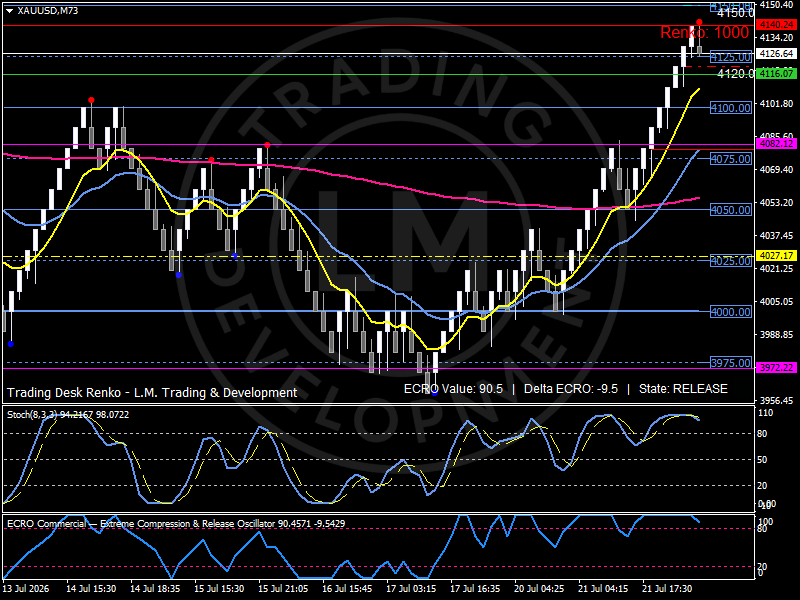
The market has now entered the 4,120–4,140 participation zone, where buying activity continues accompanying the broader recovery.
The ECRO oscillator currently reads approximately 90.5, confirming that participation remains firmly within the Release regime. Institutional engagement therefore continues supporting the prevailing trend.
Delta ECRO stands near -9.5, indicating that participation is stabilizing following the recent acceleration. This evolution remains consistent with a mature expansion phase where buying interest continues operating from an elevated base.
The stochastic oscillator remains above 90, illustrating that momentum continues accompanying the prevailing structure while participation remains concentrated near recent highs.
Immediate resistance develops around 4,140, followed by the next expansion objective near 4,150.
Initial support emerges around 4,120, while 4,075 continues serving as the principal structural pivot supporting the broader recovery.
Overall participation remains firmly aligned with the current macro environment.
Bird's eye view
Gold is increasingly pricing the credibility of future policy communication.
The ECB meeting represents the next important transmission point.
The Federal Reserve follows immediately afterward.
Real-yield expectations continue evolving through central-bank guidance.
Reserve diversification continues reinforcing structural demand.
The Renko structure reflects this macro backdrop through a confirmed Release phase, elevated participation and a mature recovery centered above the 4,075 structural pivot.
Outlook
Gold enters the second half of the week with monetary-policy credibility becoming the dominant macro driver.
The ECB's communication regarding inflation, energy prices and economic conditions will provide the next important reference for financial markets, while investors continue preparing for the upcoming Federal Reserve meeting.
The interaction between policy credibility, real-yield expectations, US Dollar positioning and reserve diversification is likely to remain the principal transmission mechanism supporting gold participation during the coming sessions.
Author

Luca Mattei
LM Trading & Development
Luca Mattei is a market analyst focusing on FX, metals, and macroeconomic trends. He develops trading tools for retail and professional traders, coding indicators and EAs for MT4/MT5 and strategies in Pine Script for TradingView.