Gold is rapidly declining in price: Statistics hardly help

Gold fell to 4,033 USD per ounce on Thursday, extending its losing streak. Pressure on the market is being exerted by a sharp rise in oil prices amid intensified attacks in the Middle East, which is once again heightening inflationary fears and expectations of tighter central bank policies.
On Wednesday, the United States launched new strikes on Iranian targets. At the same time, Donald Trump stated that Tehran had signalled its readiness to return to negotiations, which somewhat reduced the geopolitical temperature.
Some support for gold came from weaker-than-expected US inflation data. In June, producer prices unexpectedly fell for the first time in nearly a year, largely due to cheaper energy. Earlier, softer-than-forecast consumer inflation data were also released.
However, June's figures do not yet reflect the consequences of the renewed US-Iran conflict. The interim peace deal reached last month has effectively lapsed, meaning the risks of accelerating inflation and further pressure on gold remain firmly in place.
Technical analysis
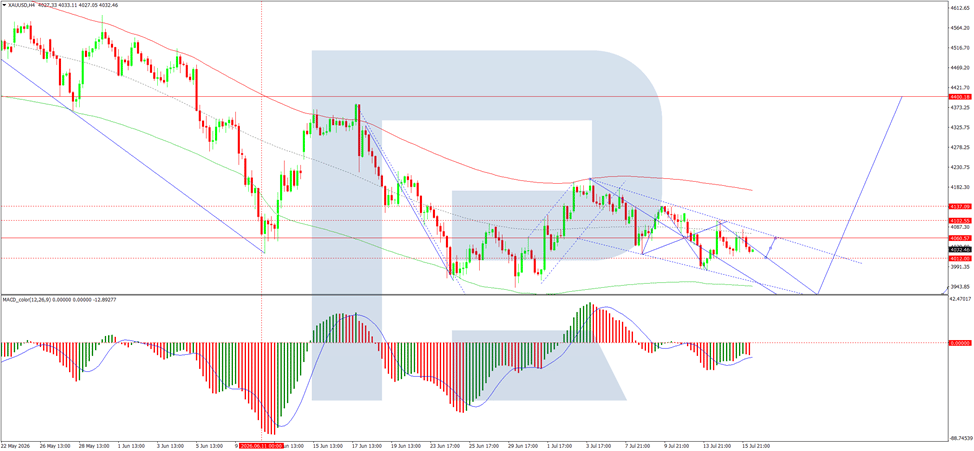
On the H4 XAU/USD chart, the market has formed a consolidation range around the 4,060 USD level. A downward wave to 4,015 USD and a growth leg to 4,080 USD have been completed. A continuation of the downward wave to 3,920 USD is expected, followed by a potential rise to 4,055 USD, with the prospect of the wave extending to 4,150 USD. The MACD indicator confirms the current downside momentum, with its signal line below the centre line and pointing strictly downwards.
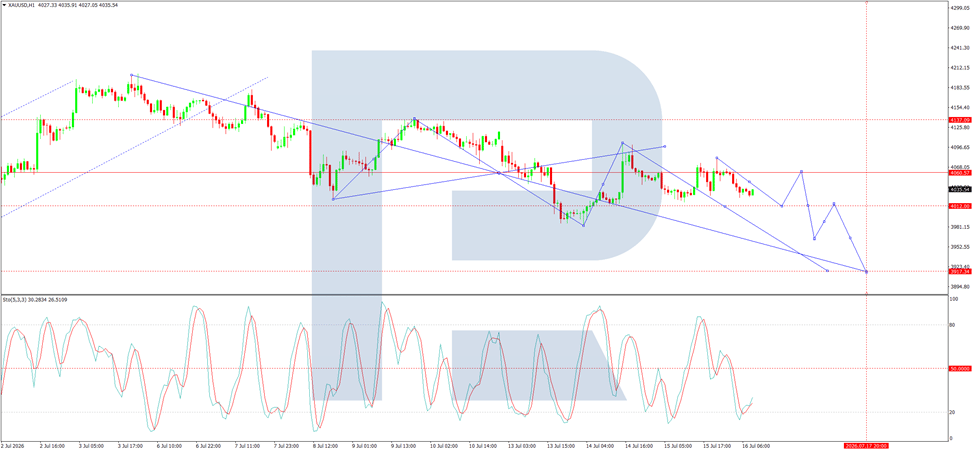
On the H1 chart, the market has broken below the 4,060 USD level and is forming a downward wave structure towards 4,012 USD. A wide consolidation range is practically forming around 4,060 USD. The Stochastic oscillator confirms this scenario, with its signal line remaining below the 50 level and under pressure to decline to 20.
Conclusion
Gold continues its sharp decline as rising oil prices and heightened Middle East tensions reinforce inflationary fears and expectations of tighter monetary policy. While US inflation data for June came in softer than expected-with producer prices unexpectedly falling-these figures predate the collapse of the interim peace deal and the renewed US-Iran hostilities. As a result, the risks of accelerating inflation and further pressure on gold remain firmly intact. Technical indicators point to further downside towards 3,920 USD, with any recovery likely to be capped by persistent geopolitical and inflation concerns. The metal's safe-haven appeal is being overshadowed by the prospect of sustained central bank tightening.
Author

RoboForex Analysis Department
RoboForex
RoboForex Analysis Department provides timely market insights, expert technical analysis, and actionable forecasts across forex, commodities, indices, and equities.