Gold holds firm as Fed minutes and Iran risks keep markets cautious

Gold (XAUUSD) remains at elevated levels as lower Treasury yields and the US Treasury’s larger debt buyback plan provide support. However, the Federal Reserve’s concerns about persistent inflation could limit further gains. Geopolitical tensions involving Iran and uncertainty around the Strait of Hormuz also remain in focus. The technical structure stays positive after gold turned higher from the lower wedge support. Markets will now focus on Fed policy signals and geopolitical developments for the next direction.
Gold stays strong as Fed signals and Iran tensions keep markets on edge
Gold is trading at elevated levels as the latest advance keeps the positive momentum intact. The US Treasury provided initial support after announcing larger buybacks of longer-dated Treasury securities. The department will double buyback sizes for 10- to 30-year Treasury debt securities to at least $4 billion per operation. The plan will apply to the 10-year to 20-year and 20-year to 30-year sectors. The announcement helped ease pressure in bond markets and pushed Treasury yields lower.
Lower Treasury yields and a weaker US Dollar initially supported gold. However, the metal gave back part of its gains as markets assessed the Federal Reserve’s July meeting minutes. The minutes showed growing concern about persistent inflation. Several policymakers remained open to raising interest rates. Many also said a rate increase could become necessary if inflation fails to return toward the Fed’s 2% target. This policy stance could keep Treasury yields elevated and limit further gains in gold.
Geopolitical uncertainty also remains in focus. President Donald Trump threatened stronger economic measures against Iran and urged US allies to increase pressure on the country. Fading hopes for the reopening of the Strait of Hormuz have kept energy supply risks elevated. However, oil prices have not accelerated sharply. Fed policy signals and developments involving Iran could remain important for gold’s next direction.
Gold price analysis: XAU/USD rebounds from wedge support
The gold chart below shows a large ascending broadening wedge that has guided price action since 2025. The pattern formed as price moved between two rising and expanding trendlines. Gold advanced strongly within this structure and reached the upper trendline. Price then reversed sharply from this resistance and declined toward the lower wedge support. The overall wedge structure remained intact.
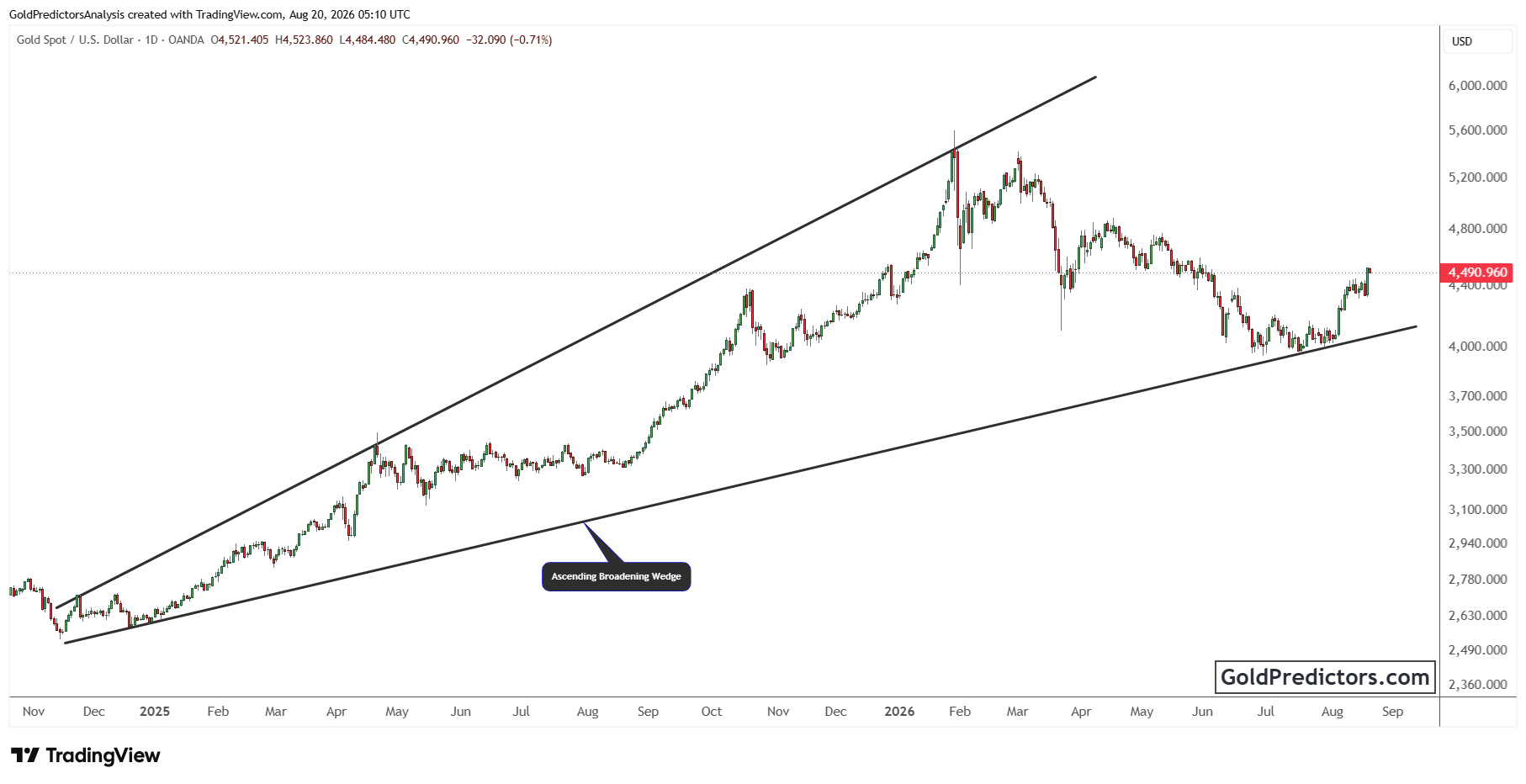
Gold found support near the $4,000 area and turned higher. The recovery has since carried price back toward the $4,450 area. This reaction highlights the importance of the lower wedge trendline as support. Gold is now trading well above this trendline, which keeps the technical outlook positive.
The latest price action shows gold attempting to extend its recovery after the reaction from wedge support. A clear move above the $4,500 area could strengthen the recovery and open the way toward the next resistance levels. The $4,800 area could become the next important level if price extends higher. On the downside, the lower wedge trendline remains the main structural support. A break below this trendline would weaken the current technical outlook.
Gold outlook: Fed policy, Treasury yields and Iran risks drive the next move
Gold maintains its strength as lower Treasury yields and larger debt buybacks from the US Treasury support the metal. However, persistent inflation concerns could keep the Federal Reserve cautious and limit further gains. Geopolitical tensions involving Iran and uncertainty around the Strait of Hormuz also remain important. The reaction from the lower wedge support keeps the technical outlook positive. A clear move above $4,500 could open the way toward $4,800. Markets will now focus on Fed policy signals and developments involving Iran for the next direction.
Unlock exclusive gold and silver trading signals and updates that most investors don’t see. Join our free newsletter now!
Author

Muhammad Umair, PhD
Gold Predictors
Muhammad Umair is a financial markets analyst and investor who focuses on the forex and precious metals markets.