Gold gains momentum on Fed rate cut signals and Dollar weakness

Gold (XAUUSD) is gaining momentum as markets sharply raise expectations for a Federal Reserve rate cut in December. Comments from key Fed officials signaled that current interest rates may be too restrictive, prompting a shift in sentiment. At the same time, rising geopolitical tensions in Ukraine and the Middle East have renewed demand for safe-haven assets. With the U.S. Dollar losing momentum and global risks intensifying, gold is positioned for further strength heading into the year-end.
Gold strengthens on rising Fed rate cut bets and weakening Dollar
Gold is gaining strength as expectations for a Federal Reserve rate cut rise sharply. The market responded to comments from key Fed officials who signaled that current rates may be too restrictive. New York Fed President John Williams suggested that easing policy would not compromise the Fed’s inflation objectives, while Fed Governor Waller pointed to a cooling job market as justification for a December cut. These statements pushed the probability of a rate cut to 80%, according to CME’s FedWatch tool.
Following this shift, the U.S. Dollar has come under pressure despite its earlier strength. As rate cut bets increased, the Dollar lost momentum, providing support for gold. Lower interest rates reduce the opportunity cost of holding gold, making it more attractive. The combination of policy easing and Dollar softness has strengthened gold’s position heading into the year-end.
At the same time, geopolitical tensions are fueling safe-haven demand. Russia launched fresh attacks on Kyiv, intensifying the conflict as peace negotiations continue. Meanwhile, tensions in the Middle East remain elevated due to repeated violations of ceasefire agreements. These developments add urgency and risk to the global outlook. Investors are turning to gold as a store of value in uncertain times. This fundamental backdrop continues to favor the bullish case for gold.
Gold holds channel support as triangle pattern signals potential breakout
The gold chart below shows a well-defined ascending channel that began in early 2024. Price action has remained well-contained within this structure, consistently responding to both upper resistance and lower support. Throughout this rising formation, gold has maintained a steady upward path, confirming the strength of the prevailing trend.
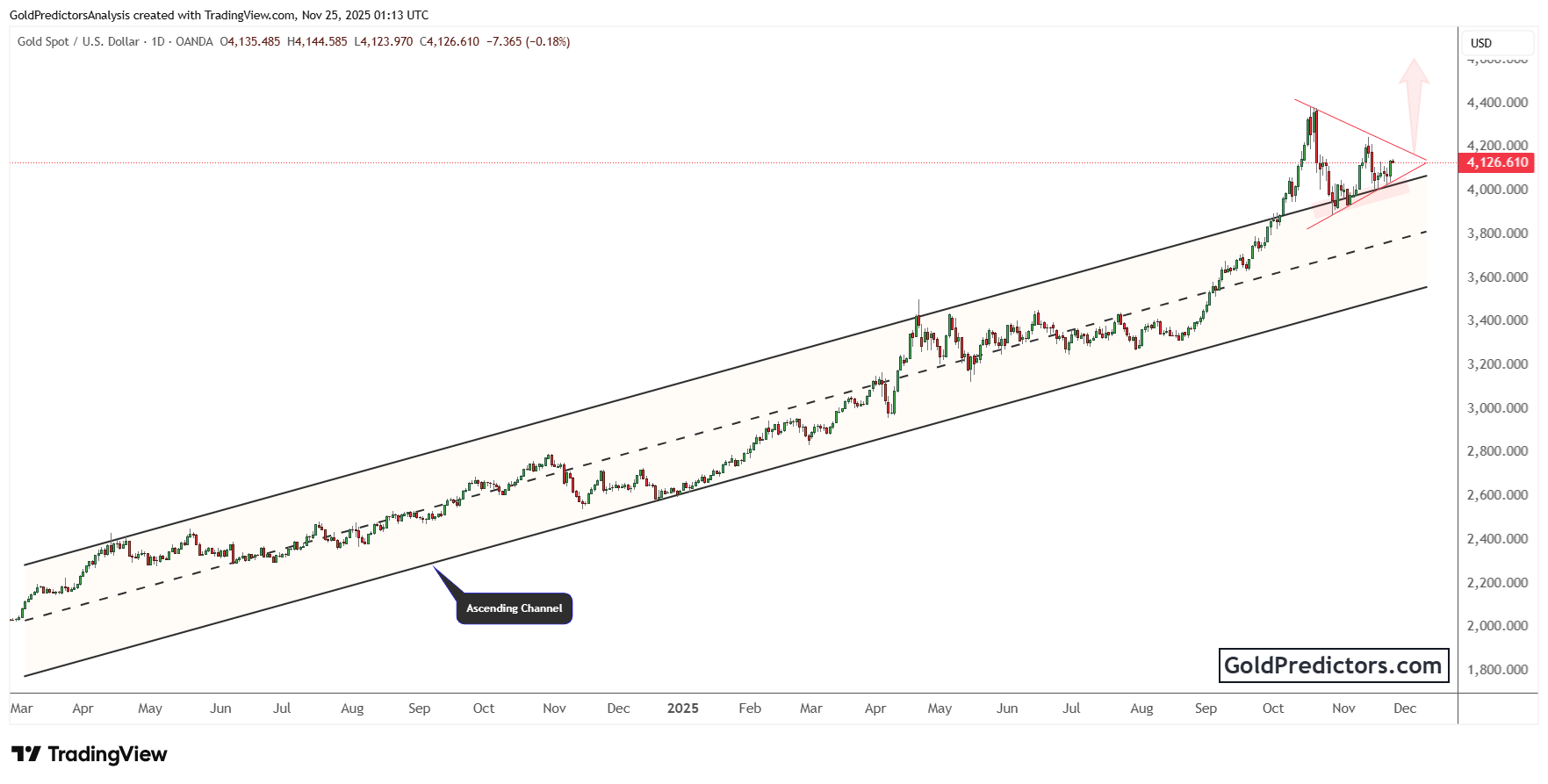
Recently, a symmetrical triangle has formed near the upper end of the channel. This pattern indicates price compression, which often leads to a breakout. The triangle’s base sits near the lower edge of the recent move, highlighting solid support just above $4,000. Price is approaching the upper boundary of the triangle.
A breakout above the triangle could open the door to a new phase of upside. The move may push gold toward the $4,400 region, in line with recent trend projections. A successful breakout would confirm ongoing strength within the broader bullish trend. On the downside, a failure to hold above $4,000 could delay further gains, though the larger trend would remain intact.
Conclusion: Bullish outlook supported by Fed shift and geopolitical risks
Gold holds a strong position as rate cut expectations rise and geopolitical risks boost safe-haven demand. Expectations of policy easing, combined with Dollar softness and global unrest, have strengthened the bullish backdrop. At the same time, price action respects bullish structures, with the ascending channel and tightening triangle highlighting the strength of the trend. As year-end approaches, gold appears poised to break higher, with momentum building toward key resistance levels.
Unlock exclusive gold and silver trading signals and updates that most investors don’t see. Join our free newsletter now!
Author

Muhammad Umair, PhD
Gold Predictors
Muhammad Umair is a financial markets analyst and investor who focuses on the forex and precious metals markets.