Gold demand surged to record level in third quarter


Gold demand grew by 3 percent year-on-year in Q3, hitting 1,313 tonnes, the highest quarterly level in history.
Third quarter demand was even more impressive in dollar terms, increasing by 44 percent to a record of $146 billion.
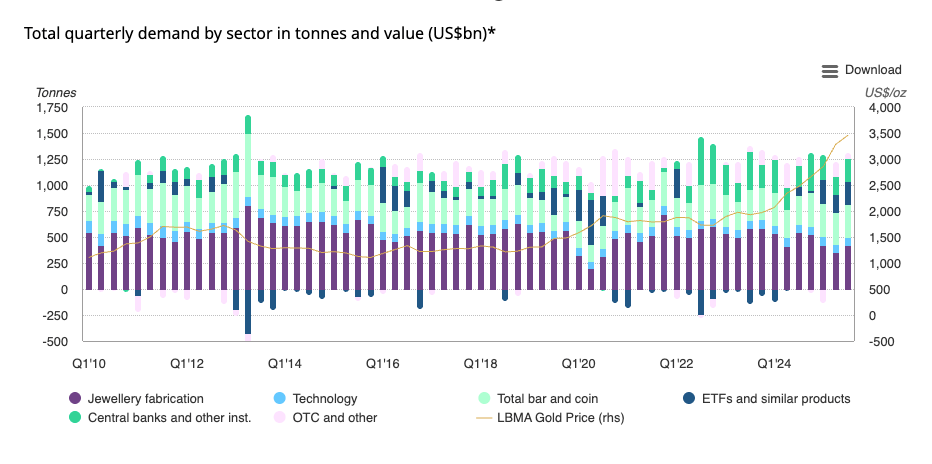
Year-to-date, gold demand is up by 1 percent at 3,717 tonnes, valued at $384 billion. That represents a 41 percent increase in value terms.
Third quarter demand grew even as the gold price surged 16 percent and set 13 new all-time highs. The gold price averaged $3,456 during the quarter, up 40 percent year-on-year and 5 percent from the last quarter.
Investment buying drove overall demand higher, accounting for over half of total demand so far in 2025.
Total third-quarter investment demand came in at 537 tonnes, pushing the year-to-date total to 1,566 tonnes, just 6 percent shy of the peak through the first three quarters of 2020 during the pandemic.
In terms of value, the World Gold Council called it “uncharted waters.”
“Investment for the first nine months of the year amounted to $161 billion – well over double that of the same period last year ($63billion) and 74 percent above the prior $92 billion record from 2020.”
Gold bar and coin demand hit 315.5 tonnes, a 17 percent year-on-year increase. It was the fourth consecutive quarter of bar and coin demand over 300 tonnes. The last time that happened was in 2013.
China and India both reported strong physical gold sales. Year-to-date demand of 184 tonnes in India was the strongest for the first nine-month period since 2013. It came in just shy of the average post-COVID full-year demand of 196 tonnes.
The only region with a decline in gold bar and coin demand was the U.S., coming in at a paltry 7 tonnes. That was the lowest quarterly total since the 2017-2019 trough. According to the World Gold Council, U.S. demand picked up in September as the price broke through the $4,000 level.
ETFs globally added 222 tonnes of gold to their holdings.
At the end of Q3, global ETF gold holdings totaled 3,838 tonnes, just 2 percent below the peak in November 2020.
A gold ETF is backed by a trust company that holds metal owned and stored by the trust. In most cases, investing in an ETF does not entitle you to any amount of physical gold. You own a share of the ETF, not gold itself. ETFs are a convenient way for investors to play the gold market, but owning ETF shares is not the same as holding physical gold.
The World Gold Council projects strong investment demand to continue through the rest of the year.
“The investment-friendly environment for gold that has persisted throughout the year so far remains in place for now, given still-heightened geopolitical uncertainty, ongoing U.S. dollar weakness and expectations for future U.S. rate cuts. Added to which, richly valued equity markets have not only highlighted gold’s role as a diversifier, but also its role as a hedge against potential equity market corrections. The stage therefore looks set for continued strength in investment flows, a trend that has been observed so far in Q4.”
While investment demand surged, higher prices put a damper on gold jewelry demand. The third quarter came in as the weakest Q3 since the pandemic low in 2020.
Globally, gold jewelry demand was 371.3 tonnes, a 19 percent year-on-year decline.
The drag created by higher prices was particularly evident in India, where jewelry demand fell by 31 percent through the first nine months of the year.
Despite the drop in sales volume, the higher prices benefited retailers, with the value of total demand rising 13 percent to $41 billion.
Central bank gold buying continued to support the broader market. Central banks globally officially added 220 tonnes of gold in Q3. That was up 28 percent from Q2.
Year-to-date, central bank gold buying is down from last year, coming in at 634 tonnes, compared to 724 tonnes through the first three quarters of last year.
To put the numbers into context, central bank gold reserves increased by an average of just 473 tonnes annually between 2010 and 2021.
The National Bank of Kazakhstan was the biggest gold buyer in Q3, adding 18 tonnes of gold to its reserves. Meanwhile, the Central Bank of Brazil added gold for the first time since 2021.
World Gold Council analysts expect the central bank gold buying trend to continue, with buying “close to the range seen over the past three years on continued elevated trade-related risks and uncertainty premia in U.S. assets.”
Interestingly, the World Gold Council estimates that 66 percent of the third quarter’s central bank demand remains unreported. This dovetails with work done by Money Metals researcher Jan Nieuwenhuijs. He estimates that the Chinese central bank is currently sitting on more than 5,000 tonnes of monetary gold located in Beijing – more than TWICE what has been publicly admitted.
Demand for gold in technology and industry fell modestly by 2 percent in Q3, coming in at 82 tonnes. Electronics demand was flat year-on-year at 69 tonnes.
Electronics demand generally gets a bump in the third quarter as companies launch new production. However, according to the World Gold Council, the prospect of U.S. tariff hikes encouraged a surge in demand during H1 as a pre-emptive move to avoid customs levies. As a result, Q3 demand was negatively impacted.
Gold supply was up by 3 percent in Q3, with mine output up 2 percent year-on-year. A 6 percent year-on-year surge in recycling also helped boost supply.
To receive free commentary and analysis on the gold and silver markets, click here to be added to the Money Metals news service.
To receive free commentary and analysis on the gold and silver markets, click here to be added to the Money Metals news service.
Author
Mike Maharrey
Money Metals Exchange
Mike Maharrey is a journalist and market analyst for MoneyMetals.com with over a decade of experience in precious metals. He holds a BS in accounting from the University of Kentucky and a BA in journalism from the University of South Florida.

















