Gold breakout: Road to $5,000 as central banks keep buying
- Gold explodes to record highs, surging beyond $4,070/oz after Trump’s 100% tariff threat on China sparked a global rush to safety.
- Weekend relief headlines — including a peace deal between Israel and Hamas and Trump’s softened tone on China — brought stability but didn’t derail the uptrend.
- Institutional forecasts and central bank buying now reinforce the next leg toward $5,000, as gold cements itself as the dominant safe haven of 2025.

From tariff shock to golden surge

Markets were rocked last week by a sequence of extraordinary headlines — and gold was at the center of it all.
On October 11, Donald Trump declared that the U.S. will impose a 100% tariff on Chinese imports starting November 1, in response to China’s new export controls.
The reaction was instant and violent: equities collapsed, yields plunged, and gold catapulted to new all-time highs above $4,150.
The 4H chart shows it clearly — gold swept liquidity below $3,958, then launched in a straight line toward $4,180, marking a perfect smart money accumulation and displacement structure.
Just two days later, however, the tone shifted dramatically. Trump softened his message, praising President Xi and saying the U.S. “wants to help China, not hurt it.”
That comment briefly cooled the market’s panic — but gold’s structure remained bullish, signaling that the underlying demand wasn’t just fear-driven.
This was institutional positioning, not retail hype.
1. Trump’s 100% tariff threat ignites safe-haven panic
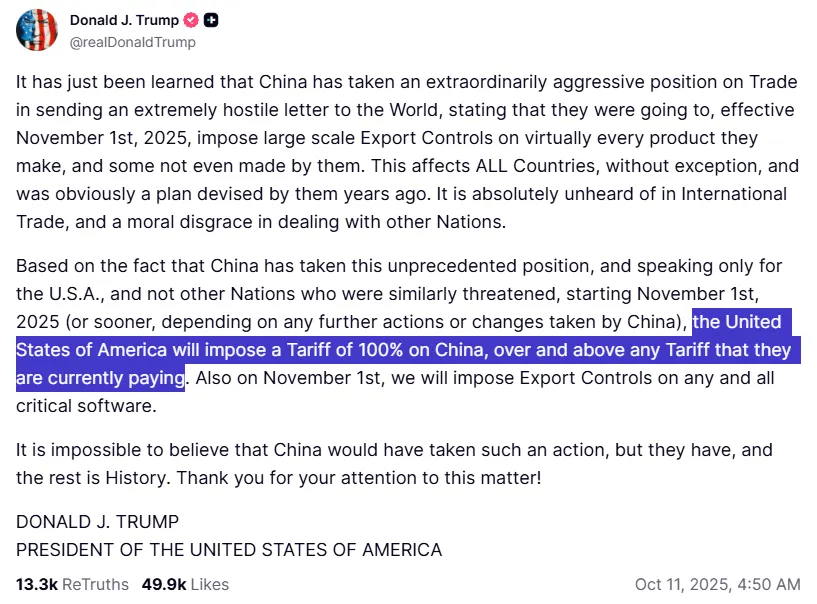
“The United States of America will impose a Tariff of 100% on China, over and above any Tariff that they are currently paying.”
- Donald J. Trump, Truth Social, Oct 11, 2025
That single line sent shockwaves through global markets.
The Nasdaq fell -3.6%, the S&P 500 dropped -2%, and Bitcoin lost nearly 8% in sympathy. Gold, however, soared — rising almost $200 within 48 hours as traders piled into safe-haven assets.
This wasn’t just another move — it was a macro re-pricing of uncertainty. The tariff announcement became the fear trigger that propelled gold into uncharted territory.
2. Weekend relief: Trump softens his China tone
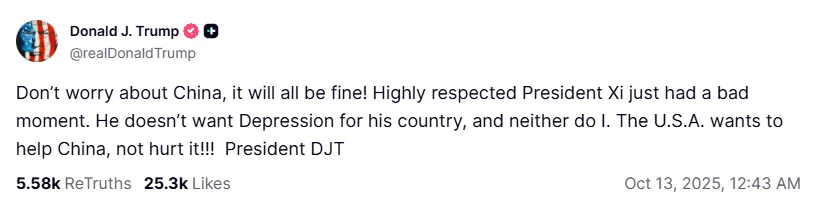
By October 13, Trump tried to calm global nerves, posting:
“Don’t worry about China, it will all be fine! Highly respected President Xi just had a bad moment... The U.S.A. wants to help China, not hurt it!”
Markets took it as a temporary de-escalation.
Risk assets stabilized slightly, while gold paused just under $4,200.
Yet even as the panic cooled, price refused to give back much ground - signaling that the smart money had already built long exposure beneath the $4,000 base.
This is a classic “reaccumulation after breakout” phase - where shallow retracements confirm strength, not exhaustion.
3. Israel–Hamas peace plan brings short-term calm

Adding to the weekend’s positive tone, Trump also announced that Israel and Hamas signed off on the first phase of a U.S.-brokered peace plan.
The deal includes hostage releases and partial troop withdrawal, which briefly reduced global risk sentiment.
While this reduced immediate safe-haven flows, it also showed that gold’s recent surge wasn’t just geopolitical panic — it was macro conviction.
Gold held above $4,000 even as peace headlines hit, confirming that the structural bid for gold remains alive.
4. Institutions raise targets, central banks keep buying
The fundamentals behind gold’s climb continue to strengthen.
Major institutions have begun revising their forecasts upward, reflecting the shift toward fiscal uncertainty, dovish central banks, and deglobalization risks.
- Bank of America lifted its 2026 gold forecast to $5,000/oz, citing “an unprecedented alignment of macro forces favoring non-yielding assets.”
- HSBC expects gold to average $3,800/oz in 2025, with potential spikes above $4,200 as monetary easing accelerates.
- J.P. Morgan maintains its view that gold remains “undervalued relative to real yields,” targeting $4,500 within 12 months.
Meanwhile, central banks are quietly hoarding more gold than ever.
According to the World Gold Council, net purchases by central banks have now exceeded 400 tons year-to-date, led by China, Turkey, and Poland.
Even with prices at record highs, this accumulation hasn’t slowed — suggesting that official demand is price-insensitive and strategic.
This institutional convergence — private and public — forms the strongest structural tailwind gold has seen in decades.
Technical outlook: smart money sweep to expansion
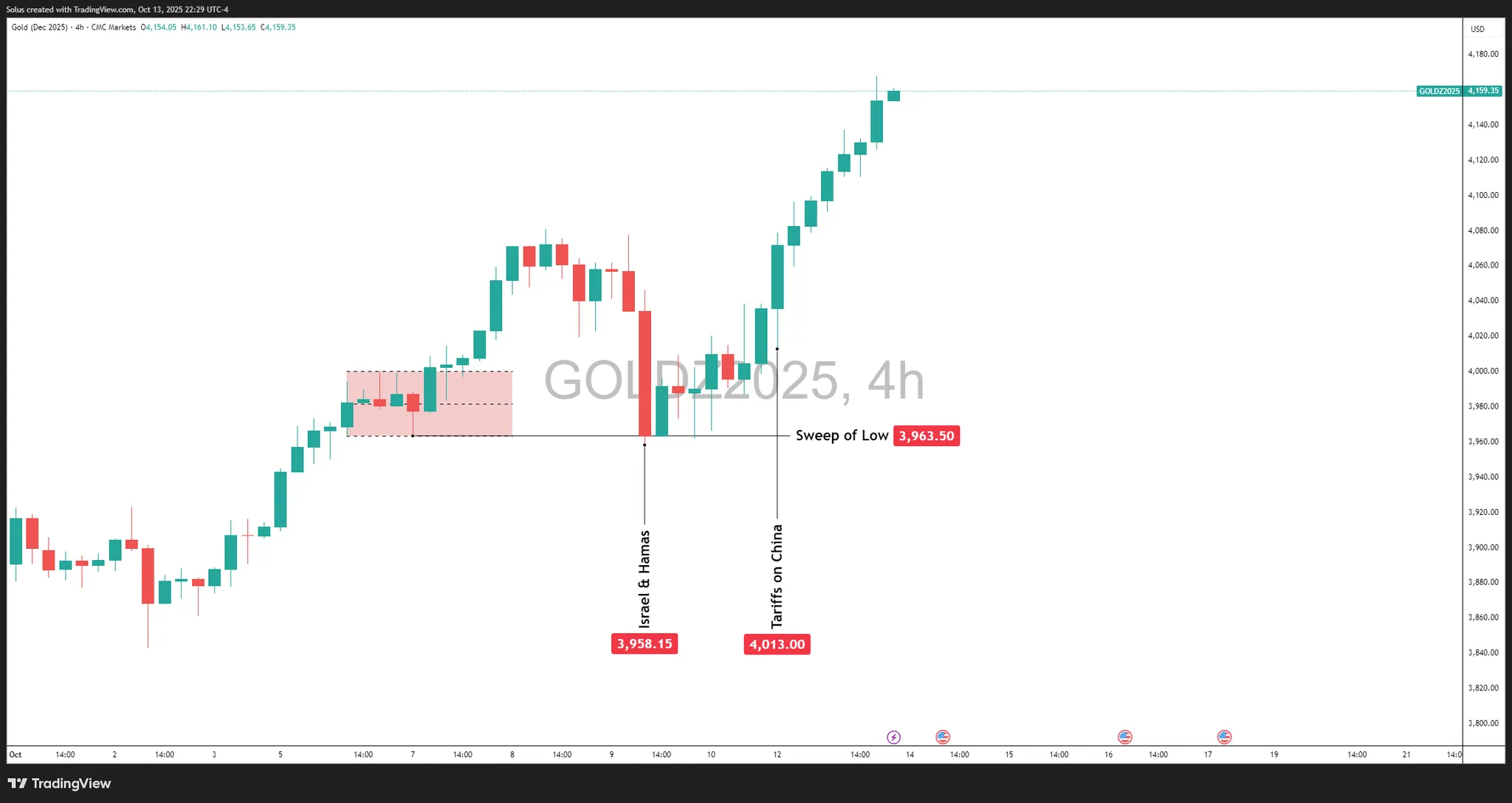
Your 4H gold chart captures this transition beautifully:
- Liquidity sweep: The dip to $3,958.15 wiped out weak hands and invited smart-money entries.
- Tariff catalyst: The 100% tariff announcement acted as the ignition point, causing displacement through $4,013.
- Expansion: Price accelerated into price discovery, tapping $4,180, where it’s currently consolidating.
The structure is textbook: accumulation → catalyst → displacement → expansion.
Until $3,950 breaks, the bullish bias remains firmly intact.
Bullish scenario: Road to $5,000
- Holding above $4,000–$4,050 confirms market strength.
- Break above $4,180–$4,200 opens the path to $4,300 → $4,420 → $4,500 → $5,000.
- Macro catalysts — Fed rate cuts, central bank buying, and institutional flows — support the rally.
Bearish scenario: Controlled pullback before continuation
- Temporary relief or position trimming could trigger a dip toward $3,950–$4,000 (Fair Value Gap zone).
- A close below $3,880 would signal overextension, though it’s unlikely without a fundamental reversal.
Final thoughts: The golden era is here
Gold’s breakout wasn’t a fluke — it was the culmination of macro tension, monetary repricing, and institutional conviction.
From the tariff shock to peace deals, from retail panic to central bank confidence, one message is clear:
- Gold is no longer just a hedge — it’s the benchmark for trust in uncertain times.
As long as liquidity imbalances and rate cuts dominate 2025’s narrative, the road to $5,000 remains wide open.
Author

Jasper Osita
Independent Analyst
Jasper has been in the markets since 2019 trading currencies, indices and commodities like Gold. His approach in the market is heavily accompanied by technical analysis, trading Smart Money Concepts (SMC) with fundamentals in mind.