Gold approaches macro inflection as PCE data tests Fed outlook

Gold markets are entering a crucial macro window as investors position ahead of a series of United States economic releases that could reshape expectations for Federal Reserve policy. The Core PCE price index, alongside growth and labour market indicators due later in the session, is likely to become the primary catalyst for price action across precious metals.
Because the Core PCE index represents the Federal Reserve’s preferred measure of inflation, the data carries particular weight for global financial markets. Investors remain divided over whether the current inflation cycle is steadily stabilising or whether underlying price pressures remain persistent enough to keep interest rates elevated for longer.
This uncertainty has already translated into cautious positioning across commodities, currencies and equities. Gold, which remains highly sensitive to real interest rate dynamics and movements in the US Dollar, is therefore entering the data window within a relatively tight trading structure as traders wait for clearer signals from the macro environment.
Inflation uncertainty keeps markets focused on Fed policy
The upcoming inflation data may prove decisive in shaping expectations for the Federal Reserve’s next steps. If inflation once again surprises to the upside, markets may delay expectations for policy easing, potentially strengthening the US Dollar and pushing Treasury yields higher.
Such a scenario would normally place pressure on gold, since higher real yields increase the opportunity cost of holding non yielding assets.
On the other hand, if inflation readings show clearer signs of moderation, investors could begin to anticipate a gradual easing cycle later in the year. That outcome would tend to stabilise or reduce real yields, a development that historically provides support for bullion.
For this reason, gold traders are not simply reacting to inflation levels themselves but to how inflation data reshapes expectations for the path of monetary policy.
Real yield dynamics remain the central driver
The broader macro backdrop remains complex for precious metals. In recent months, markets have repeatedly oscillated between two competing narratives. One suggests that inflation pressures are gradually cooling, allowing central banks to eventually loosen financial conditions. The other argues that structural factors such as energy prices, supply chain adjustments and resilient labour markets may keep inflation above target for longer.
Gold sits directly at the centre of this debate because of its strong relationship with real interest rates.
When inflation expectations decline faster than nominal yields, real yields rise, making gold comparatively less attractive. Conversely, when real yields soften or when investors begin to question the sustainability of restrictive monetary policy, bullion tends to regain support as a defensive asset.
Recent movements in energy markets have also contributed to the discussion around inflation persistence. Firm oil prices can filter into transportation and production costs, potentially reinforcing inflation expectations and complicating the Federal Reserve’s effort to fully anchor price stability.
Cross asset flows reflect cautious positioning
Current cross asset behaviour suggests that investors are becoming increasingly cautious ahead of the macro data.
Equity markets remain uneven across regions, reflecting a mixture of optimism around economic resilience and concerns about tighter financial conditions. In currency markets, flows indicate that traders continue to selectively favour the US Dollar as a defensive allocation during periods of macro uncertainty.
Within the commodity complex, positioning also appears relatively restrained. Energy markets have remained firm while industrial metals have displayed mixed performance, leaving precious metals caught between macro driven flows and broader commodity sentiment.
Gold’s behaviour during recent sessions illustrates this hesitation. The metal has managed to stabilise after earlier weakness, yet buying momentum has not been strong enough to produce a decisive breakout above nearby resistance levels.
This pattern suggests that investors are temporarily stepping back from aggressive directional trades while awaiting confirmation from macroeconomic indicators.
Renko structure reveals tightening range near resistance
From a technical perspective, the Renko structure highlights a market currently consolidating after a volatile sequence of price swings.
Gold recently moved lower toward the 5075 region before rebounding toward the 5125 area. The rebound indicates that buyers remain active on pullbacks, yet the inability to extend the move significantly higher suggests that bullish conviction remains limited ahead of the data releases.
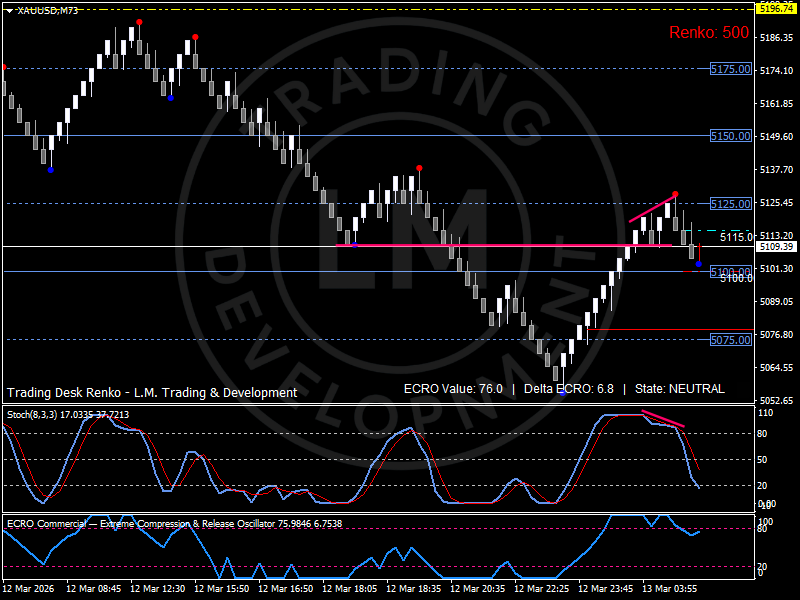
The 5125 zone has emerged as a key resistance area within the current Renko configuration. Several attempts to build momentum above this region have encountered selling pressure, reinforcing its role as a short term ceiling.
If prices manage to push above that level with sufficient strength, the next potential resistance zone may emerge near the 5150 region where previous price activity suggests additional supply.
On the downside, the 5100 level now acts as the first near term support. A deeper move below that area could bring the earlier reaction zone around 5075 back into focus.
Overall, the Renko pattern reflects a market caught between competing forces. Buyers continue to defend support levels while sellers remain active near resistance, creating a tightening range that may soon require a decisive catalyst to resolve.
Momentum signals suggest temporary pause
Momentum indicators support the view that gold is currently entering a pause phase rather than building immediate breakout strength.
The stochastic oscillator recently reached elevated levels during the rebound toward resistance but has since started to turn lower. This behaviour typically appears when markets transition from directional movement into consolidation.
The ECRO compression and release oscillator offers a similar interpretation. Earlier in the rebound phase the indicator signalled a strong release of momentum following a compression period. However, the current stabilisation suggests that the momentum burst is fading as the market waits for new macro information.
Such conditions often precede renewed volatility once a clear catalyst enters the market.
Outlook
Looking ahead, the immediate trajectory for gold will likely depend on how the upcoming data reshapes expectations for Federal Reserve policy.
If the Core PCE data confirms persistent inflation while economic activity remains resilient, markets may interpret the results as a signal that interest rates will remain restrictive for longer. In that scenario, rising real yields and a stronger US Dollar could place renewed pressure on bullion.
Alternatively, if inflation shows clearer signs of moderation or growth indicators begin to soften, investors may once again anticipate a future easing cycle. That outcome would tend to reduce real yield pressure and could allow gold to regain upward momentum.
From a technical standpoint, the 5125 region remains the key threshold for a potential bullish extension, while the 5100 and 5075 levels provide the primary support structure.
With macro expectations finely balanced and technical signals pointing to consolidation, gold now appears to be approaching a pivotal moment. The incoming economic data may determine whether the current pause evolves into a renewed advance or develops into a broader corrective phase across the precious metals complex.
Author

Luca Mattei
LM Trading & Development
Luca Mattei is a market analyst focusing on FX, metals, and macroeconomic trends. He develops trading tools for retail and professional traders, coding indicators and EAs for MT4/MT5 and strategies in Pine Script for TradingView.

















