Gold and Silver rally as geopolitical risk returns to the forefront


Precious metals markets surged sharply as gold and silver climbed to fresh record levels, extending a rally that has already been extraordinary last year. Gold was up roughly 66%, while silver has gained more than 160%. As geopolitical tensions intensify and economic uncertainty deepens, investors increasingly seek protection against risks that are difficult to quantify or hedge through traditional assets.
The immediate trigger for the surge came from President Trump’s announcement of sweeping new tariff threats against several European countries. These measures have fundamentally altered market expectations for 2026. What many investors hoped would be a year of stabilisation and policy normalisation is now being repriced as another period of trade conflict, diplomatic strain, and heightened volatility.
Even before the latest escalation in geopolitical tensions, major investment banks were already positioning for further strength in precious metals in 2026. At the end of last year, Goldman Sachs projected gold prices could climb to around $4,900 per ounce by December 2026 under its base-case scenario.
Morgan Stanley also turned more constructive, revising its 2026 gold forecast higher on multiple occasions, first to $4,400 per ounce and later to $4,800 by the fourth quarter, while cautioning that gains next year were likely to be more incremental than the explosive rally seen in 2025. On silver, banks have struck a more cautious tone, highlighting elevated volatility ahead as the metal’s industrial exposure makes it more sensitive to shifts in growth expectations.
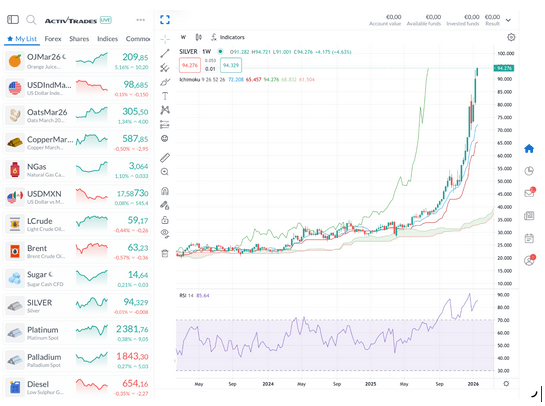
Weekly Silver Chart - Source: ActivTrader
Greenland becomes a new source of global tension
At the centre of current market anxiety is President Trump’s renewed and increasingly forceful effort to acquire Greenland from Denmark. While the idea initially surfaced years ago, it has now taken on far greater significance amid shifting global power dynamics and rising competition for strategic resources.
Greenland’s importance has grown as melting Arctic ice opens new shipping routes across the North Atlantic, shortening trade corridors between major economies. Beyond logistics, the island is believed to hold vast untapped natural resources, including coal, zinc, copper, iron ore, and rare minerals. Although the exact scale of these reserves remains uncertain, the strategic potential is enough to attract intense geopolitical interest.
The U.S. administration has framed Greenland’s current status as a national security issue, arguing that control of the territory is essential to protecting American interests in the Arctic. This position has been firmly rejected by Denmark and other European allies. Danish officials have responded with unusually direct language, making it clear that Greenland is not for sale under any circumstances.
For markets, the issue is not Greenland itself, but what it represents: a willingness to escalate disputes with long-standing allies and use economic pressure as leverage. That perception has been deeply unsettling for investors.
Tariff threats against Europe rekindle trade war fears
The situation escalated further when President Trump announced plans to impose a 10% tariff on imports from Denmark, Norway, Sweden, France, Germany, the United Kingdom, the Netherlands, and Finland starting February 1. More alarming for markets, the administration indicated these tariffs could rise to 25% by June if the United States is not allowed to purchase Greenland.
This marks an extraordinary confrontation between NATO allies and raises the prospect of a full-scale transatlantic trade conflict. European leaders, who have often opted for cautious diplomacy, have responded more openly, warning that such measures would inflict serious economic damage on both sides.
Industries across Europe are already assessing the potential fallout. German automakers have cautioned that additional tariffs could significantly weaken Europe’s industrial base, while British exporters fear that higher costs would render their products uncompetitive in the U.S. market. Manufacturers face limited ability to reroute supply chains or accelerate shipments, as the timeline between announcement and implementation is unusually short.
Meanwhile, European officials are preparing for the possibility of retaliation. Emergency discussions in Brussels on Thursday are likely to be focused on counter-tariffs targeting U.S. exports such as liquefied natural gas, aircraft, and industrial equipment. Even the threat of such measures has increased market anxiety, as investors recall how quickly previous trade disputes escalated and disrupted global growth.
Why is Gold benefiting from increasing geopolitcal tensions?
Gold’s surge reflects its traditional role as a refuge during periods of geopolitical stress. When investors lose confidence in political stability or economic predictability, gold tends to attract capital because it is not tied to the policies or fiscal health of any single government.
Tariffs also introduce inflationary risks, as higher import costs often feed through to consumer prices. Gold has long been viewed as a hedge against inflation, particularly when price pressures are driven by supply disruptions rather than demand growth. At the same time, uncertainty surrounding trade policy raises questions about currency stability, especially for the U.S. dollar and the euro. In such environments, investors often diversify away from fiat currencies and into hard assets.
Central banks have also played a role in the last few years and are likely to keep supporting prices. In recent years, geopolitical fragmentation has encouraged many monetary authorities to increase gold reserves as a form of financial insurance. Rising official-sector demand provides an additional layer of support beneath prices, reinforcing bullish momentum.
Could Silver’s rally continue and go even further?
Silver’s outsized gains in 2025 reflect its unique dual role. Like gold, it is viewed as a monetary metal and a store of value during uncertain times. Unlike gold, however, silver is also a critical industrial input, used extensively in electronics, renewable energy technologies, AI, and manufacturing.
Trade disruptions and geopolitical uncertainty can tighten supply chains, prompting industrial users to secure silver inventories pre-emptively. This demand can rise sharply just as investors are also buying silver as a hedge, creating powerful price momentum. Silver’s lower price relative to gold also makes it more accessible to retail investors and speculative traders, which tends to amplify moves during periods of strong sentiment.
Can Gold and Silver keep rising?
Whether the rally continues will depend largely on how the geopolitical situation evolves. If tariff threats are implemented and retaliatory measures follow, markets are likely to remain volatile, supporting continued demand for precious metals. Prolonged trade tensions could slow global growth, weaken currencies, and reinforce the appeal of assets perceived as safe and scarce.
However, prices are already reflecting a significant amount of risk. Any signs of de-escalation, diplomatic compromise, or delay in tariff implementation could trigger periods of consolidation or pullbacks, particularly in silver, which tends to be more sensitive to shifts in sentiment.
For now, the underlying drivers seem to remain in place. Uncertainty is high, policy direction is unpredictable, and geopolitical risks are expanding rather than receding. In that environment, gold and silver are doing what they have historically done best: acting as financial shelters when confidence in the broader system begins to erode, which could mean another great year for both metals.
Stay up to date with what's moving and shaking on the world's markets and never miss another important headline again! Check ActivTrades daily news and analyses here.
Author
Carolane de Palmas
ActivTrades
Carolane graduated with a Masters in Corporate Finance & Financial Markets and got the AMF Certification (Financial Markets Regulator in France). Afterward, she became an independent trader, investing mostly in European and American stocks/indices.