Global consumer rebound: As safe as... household incomes


Summary
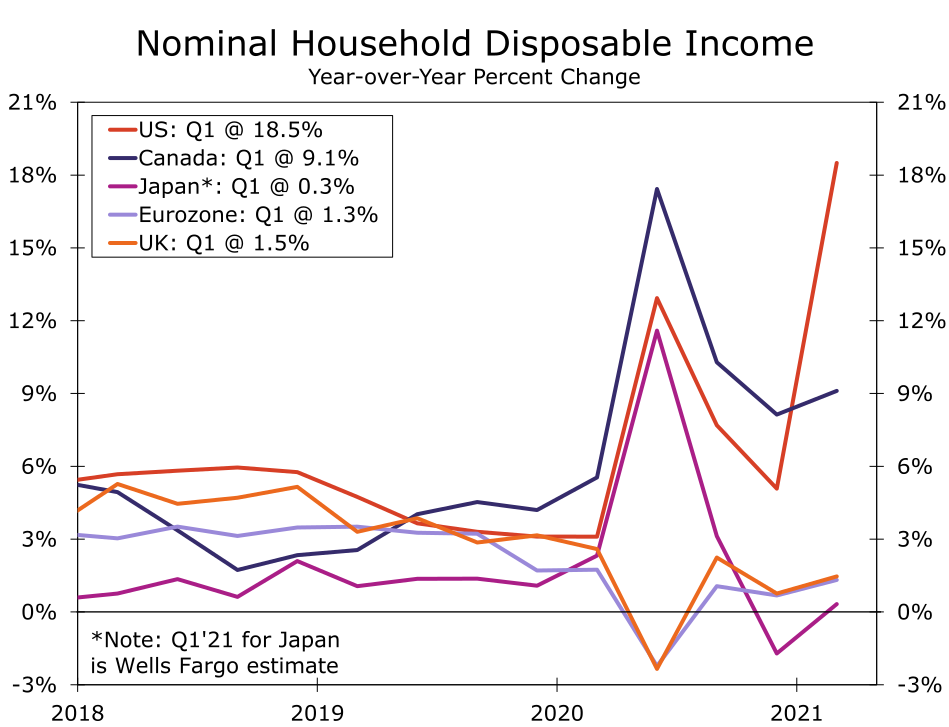
- Through Q1-2021, consumer finances remain in good shape, which should support the economic recovery across the major developed economies going forward. Despite the employment declines over the course of the pandemic, disposable incomes climbed in the first quarter of this year, with notable year-over-year rises in the United States, Canada, United Kingdom and Eurozone. In addition, household savings rates are also at historically high levels, which bodes well for future consumer spending as well as economic prospects within the G10.
- Improved vaccination campaigns in Canada and Europe have led to increased mobility. Despite a slow start, vaccination rates in Canada and Europe are now on par with the U.S. and U.K., and playing a key role in rising mobility. However, Japan is an outlier and is lagging developed market peers not only in consumer finances, but vaccinations and mobility levels as well.
- In our view, strong consumer finances and improving international vaccination campaigns still support our view for a robust global economic recovery. Japan's recovery is likely to lag the overall G10 recovery as restrictions remain in place and consumer finance dynamics are relatively weak.
Consumer Finances Still in Sound Shape
Over the past several months we have regularly reported on household incomes and spending across some of the major developed economies. We have returned to this theme for a number of reasons. First, for the major developed economies, consumer demand is uniformly the most sizable component of overall GDP, and typically by a wide margin. Thus, the fortunes of the consumer are also often the key driver of the overall economy. Second, throughout the pandemic many governments have been particularly active on the fiscal policy front, especially in providing income support measures. In that sense, trends in employment as well as wage and salary compensation, have not always been precise guides to trends in overall household incomes. Finally, given the size of the shock from the COVID pandemic, income trends have also been more volatile than usual on a quarter-to-quarter basis.
With the release in recent weeks of household income details from the Eurozone and United Kingdom, as well as partial information from Japan, we now have insight into consumer finances through Q1 of this year for all the major developed economies. The key takeaway is that despite employment declines suffered during the pandemic, trends in household disposable income remain favorable for all the major developed economies. That is particularly the case for the United States and Canada where, compared to Q1-2020, household disposable incomes are up around 19% and 9%, respectively (Figure 1). In the Eurozone and the United Kingdom growth in disposable income has been more modest, but positive nonetheless. Overall, trends in disposable income for the major developed economies have been remarkably resilient—disposable incomes have already risen back above pre-pandemic levels by Q1-2021 for the key major developed economies including, we estimate, for Japan.
Author
Wells Fargo Research Team
Wells Fargo