|

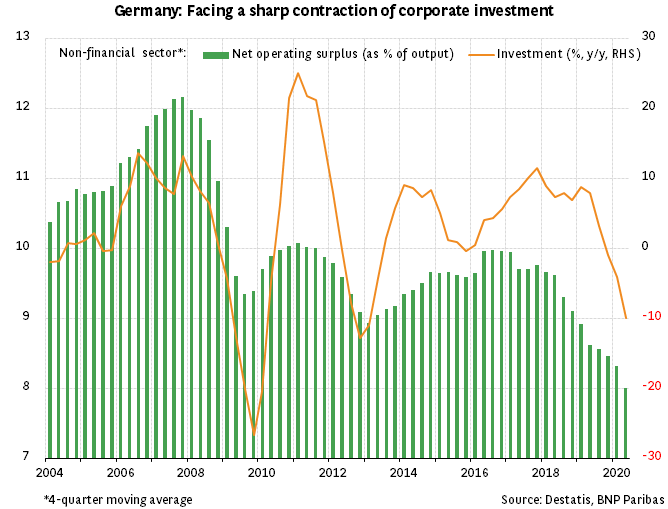
Germany: Facing a sharp contraction of corporate investment
The Covid-19 pandemic has led to the most severe recession in Germany’s post-war history. The sudden drop in revenues in combination with only partly adjustable costs has led to a fast depletion of firms’ cash buffers. Business felt compelled to reduce inventories, cancel orders and defer investment projects. This had the effect of deepening the recession.

It might be tempting to think that investment could quickly regain traction again, as it did following the Great Recession in 2008-09. This sounds too optimistic. European Investment Bank (EIB) researchers estimate that the European corporate sector could have lost revenue between 13% and 24% of GDP because of the Covid-19 pandemic[1]. In the most benign scenario, they assume that cash positions may have absorbed revenue losses to the amount of 3% of GDP and corporate indebtedness would rise between 4% and 6% of GDP. In that case, EU corporate investment would shrink between 31% and 52%. For Germany, this implies that corporate investment would contract much more than during the Great Recession, when it declined by 26%.
Author

BNP Paribas Team

BNP Paribas Team

BNP Paribas

BNP Paribas Economic Research Department is a worldwide function, part of Corporate and Investment Banking, at the service of both the Bank and its customers.


More from BNP Paribas Team
Share:

Editor's Picks

EUR/USD holds lower ground near 1.1850 ahead of EU/ US data

EUR/USD remains in the negative territory for the fourth successive session, trading around 1.1850 in European trading on Friday. A broadly cautious market environment paired with modest US Dollar demand undermines the pair ahead of the Eurozone GDP second estimate and the critical US CPI data. 

GBP/USD keeps losses around 1.3600, awaits US CPI for fresh impetus

GBP/USD holds moderate losses at around 1.3600 in the European session on Friday, though it lacks bearish conviction. The US Dollar remains supported amid softer risk tone and ahead of the US consumer inflation figures due later in the NA session on Friday. 

Gold trims intraday gains to $5,000 as US inflation data loom

Gold retreats from the vicinity of the $5,000 psychological mark, though sticks to its modest intraday gains heading into the European session. Traders now look forward to the release of the US consumer inflation figures for more cues about the Fed policy path. The outlook will play a key role in influencing the near-term US Dollar price dynamics and provide some meaningful impetus to the non-yielding bullion.

US CPI data set to show modest inflation cooling as markets price in a more hawkish Fed

The US Bureau of Labor Statistics will publish January’s Consumer Price Index data on Friday, delayed by the brief and partial United States government shutdown. The report is expected to show that inflationary pressures eased modestly but also remained above the Federal Reserve’s 2% target.

A tale of two labour markets: Headline strength masks underlying weakness

Undoubtedly, yesterday’s delayed US January jobs report delivered a strong headline – one that surpassed most estimates. However, optimism quickly faded amid sobering benchmark revisions.

Solana Price Forecast: Mixed market sentiment caps recovery

Solana (SOL) is trading at $79 as of Friday, following a correction of over 9% so far this week. On-chain and derivatives data indicates mixed sentiment among traders, further limiting the chances of a price recovery.