German housing market: Affordability pillars show signs of strain

The recovery in Germany’s housing market has continued, albeit at a slower pace. A combination of somewhat rising mortgage rates, increasing house prices, and slowing wage growth has weighed on affordability and dampened demand.
Price momentum defies market slowdown
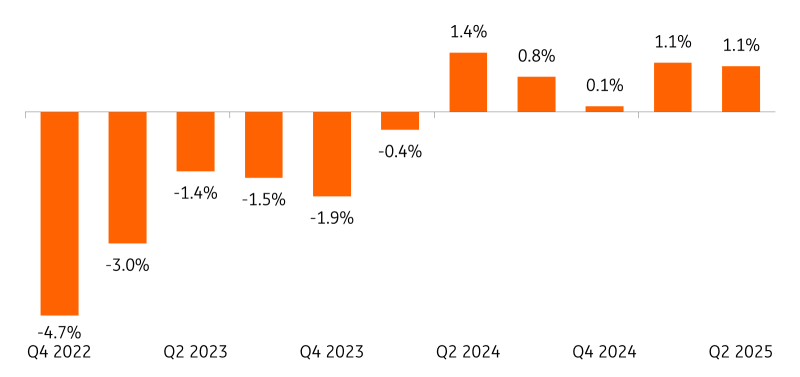
After a decline in house prices that lasted into early 2024, the market has staged a decent recovery. However, as with most rebounds, the pace has begun to taper off in recent months though prices continued to rise in the second quarter of 2025.
Between April and June, house prices were up 1.1% quarter-on-quarter. This means that prices are now up 5% from the trough reached in the first quarter of 2024 although they still remain some 9% below the peak level reached in the second quarter of 2022.
House price index
(%QoQ).
Source: German Federal Statistical Office; ING Economic & Financial Analysis
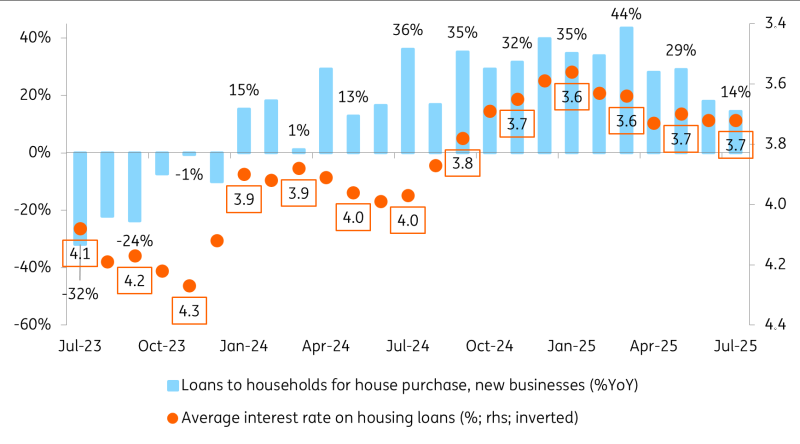
The moderate rise in house prices in the second quarter defied the trend of slowing mortgage lending growth. While mortgage lending was still up by almost 40% year-on-year in the first quarter, growth slowed to some 25% YoY between April and June. While base effects also have an impact here, the main reasons for the slowing recovery in the German housing market are rising mortgage rates, increasing house prices, and slowing wage growth. In short, weakening affordability.
Average mortgage rates and demand for housing loans
Source: LSEG Datastream; ING Economic & Financial Analysis
Mortgage rates have reached the highest level since autumn 2024, reversing the downward trend seen earlier in the year. Expectations of rising government debt pushed up long-term government bond yields, which fed through into lending rates. While the absolute increase may seem rather limited, the psychological impact could be more significant – a mortgage rate of above 3.7% could feel markedly less affordable than one close to 3.5%. Especially when one symbolic threshold is followed by another.
In August, the number of unemployed persons registered exceeded the three million mark for the first time since 2015. Labour market uncertainty is high, not only as a result of the crossing of this symbolic number, but also because of ongoing news about restructuring, job cuts and austerity measures. Accordingly, consumers’ propensity to save remains elevated, while their willingness to spend remains weak.
Moreover, wage growth, while improving, remains moderate. Nominal wages rose by 4.1% in 2Q, up from 3.6% in 1Q, translating into real wage growth of 1.9%. This is well below the levels seen during the wage catch-up phase of 2023–2024. With labour unions now probably prioritising job security over pay increases, further acceleration seems unlikely.
Meanwhile, house prices continue to rise – adding another layer of pressure on affordability.
Structural drivers to keep housing market recovery intact
Looking ahead, despite a worsening of affordability, there is still a significant mismatch between supply and demand in the German housing market. In 2024, the construction of 251,900 homes was completed, the lowest number since 2015. The construction backlog, i.e., the number of homes that have already been approved but not yet completed, also decreased, standing at 759,700 homes at the end of 2024. This is a significant decline compared to 2022, when the construction backlog still stood at around 885,000. However, this decline was driven by a simultaneous drop in building permits, not faster construction. Consequently, structural price pressures remain.
All in all, we expect the housing market to continue its modest recovery. Elevated uncertainty, weak consumer sentiment, and affordability constraints will likely keep momentum in check. The mismatch between supply and demand, high rents and low homeownership ratios, however, will be clear drivers of continued growth.
Read the original analysis: German housing market: affordability pillars show signs of strain
Author
ING Global Economics Team
ING Economic and Financial Analysis
From Trump to trade, FX to Brexit, ING’s global economists have it covered. Go to ING.com/THINK to stay a step ahead.