GBP/USD Weekly Outlook: Pound Sterling’s upside bias persists as traders brace for US NFP week
- The Pound Sterling corrected from three-year highs of 1.3593 against the US Dollar.
- US Nonfarm Payrolls, Fedspeak and trade developments to impact GBP/USD.
- The daily technical setup continues to back the GBP/USD bullish potential.

The Pound Sterling (GBP) set out on a corrective downside against the US Dollar (USD) after the GBP/USD pair hit the highest level since February 2022, just shy of the 1.3600 mark.
Pound Sterling down but not out
It was all about the US tariff headlines and the resultant USD price action that emerged as underlying factors behind the GBP/USD performance in the past week.
The Greenback kicked off a solid recovery and maintained it almost throughout the week, barring a brief pullback on Thursday.
Optimism on the trade front and hawkish US Federal Reserve’s (Fed) policy stance powered the USD turnaround.
It started with a positive shift in risk sentiment after US President Donald Trump’s backpedalled on 50% tariffs announced last Friday on European Union (EU) imports from June 1, extending the deadline to July 9.
Comments from Minneapolis Fed President Neel Kashkari that mentioned “extended tariffs raise the risk of stagflation,” adding pressure on the Fed to maintain its easing trajectory, also helped the USD gain ground against its major rivals.
Amidst unabated USD demand, the GBP/USD pair failed to sustain its upside at 39-month highs of 1.3593 and embarked on a corrective journey, falling as low as 1.3416.
The broad-based US Dollar recovery gathered strength after the Conference Board (CB) said on Tuesday that its Consumer Confidence Index rose to 98.0 this month, courtesy of the temporary US-China trade truce.
Moreover, the Greenback also capitalized on the hawkish Minutes of the US Federal Reserve’s (Fed) May policy meeting and a US federal court’s ruling that blocked President Donald Trump’s "Liberation Day" tariffs.
The Fed Minutes on Wednesday read: “Participants agreed that uncertainty about the economic outlook had increased further, making it appropriate to take a cautious approach until the net economic effects of the array of changes to government policies become clearer.”
In Thursday’s second half, fresh tariff developments doused the optimism surrounding the USD trades after the US Court of Appeals for the Federal Circuit in Washington said it was pausing the lower court's ruling to consider the government's appeal, and ordered the plaintiffs in the cases to respond by June 5 and the administration by June 9, per Reuters.
Citing people familiar with the matter, the WSJ reported late Thursday that “US President Donald Trump's administration is considering an existing law that includes language allowing for tariffs of up to 15% for 150 days.”
Meanwhile, US Treasury Secretary Scott Bessent noted that trade negotiations with China have slowed down a bit.
Thursday’s disappointing Jobless Claims and Pending Home Sales further contributed to the Greenback’s steep decline.
The USD pullback helped the GBP/USD pair stall the correction but the pair failed to gather recovery momentum and remained below 1.3500 on Friday. The US Bureau of Economic Analysis reported that the annual inflation in the US, as measured by the change in the Personal Consumption Expenditures (PCE) Price Index, declined to 2.1% in April from 2.3% in March. The core PCE Price Index, which excludes volatile food and energy prices, rose 2.5% on a yearly basis, coming in line with the market forecast.
Week ahead: Powell and US Nonfarm Payrolls in focus
It’s a data-heavy US economic calendar in the week ahead as the UK docket takes a back seat.
On Monday, the US Institute for Supply Management (ISM) will publish its Manufacturing PMI, which will be followed by speeches from Fed policymakers, including Chairman Jerome Powell’s appearance at the Federal Reserve Board of Governors International Finance Division's 75th Anniversary Conference, in Washington DC.
Tuesday will feature the US JOLTS Job Openings data alongside the Factory Orders release.
With the US employment data trickling in, the focus will be on Wednesday’s Automatic Data Processing (ADP) Employment Change report. Later that day, the ISM Services PMI will be published.
Thursday is devoid of any high-impact macro news from both sides of the Atlantic, and hence, all eyes turn to Friday’s critical US Nonfarm Payrolls (NFP) report for a fresh direction on the US Dollar, in turn, significantly impacting the GBP/USD pair.
Other market-moving drivers for the week will likely include trade talks and geopolitical developments surrounding the Israel-Hamas conflict and the Russia-Ukraine situation. Fedspeak will also continue to entertain traders throughout the week.

GBP/USD: Technical Outlook
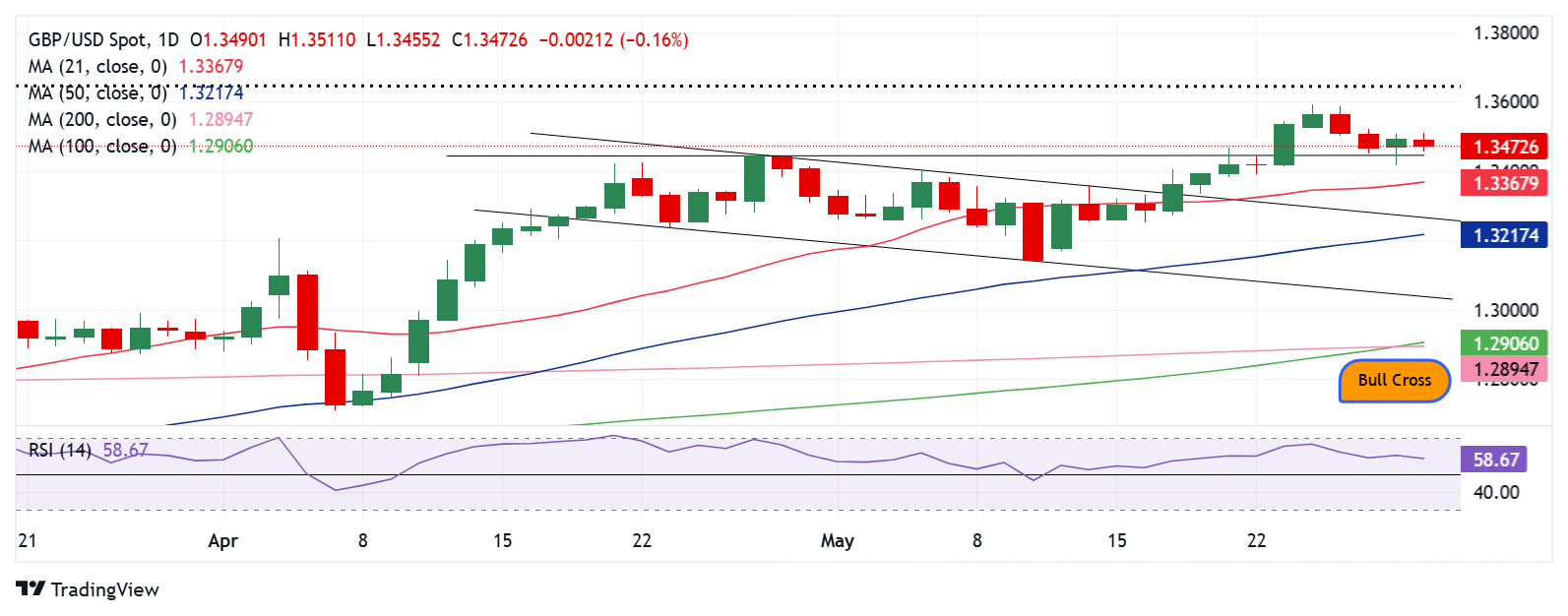
The daily chart shows that GBP/USD extended the falling channel breakout during the week but faced rejection just shy of the 1.3600 threshold.
Despite the turn lower, the near-term technical outlook for the major remains constructive as the 14-day Relative Strength Index (RSI) holds comfortably above the midline, currently near 59.
The pair needs to defend the previous three-year high of 1.3445, now turned support, to resume its upward trajectory toward the February 2022 high at 1.3643 and the $1.3700 round figure.
Ahead of that, buyers need to take out the 1.3600 level on a sustained basis.
Adding credence to the bullish potential, the 100-day Simple Moving Average (SMA) closed above the 200-day SMA on Thursday, validating a Bull Cross.
On the flip side, rejection once again at the 1.3600 barrier could reinforce selling interest.
Failure to defend the aforementioned support at 1.3445 on a daily closing basis could intensify the downside pressure, opening the door for a test of the May 13 low of 1.3270.
Additional declines will challenge the 50-day SMA at 1.3217.
Pound Sterling FAQs
The Pound Sterling (GBP) is the oldest currency in the world (886 AD) and the official currency of the United Kingdom. It is the fourth most traded unit for foreign exchange (FX) in the world, accounting for 12% of all transactions, averaging $630 billion a day, according to 2022 data. Its key trading pairs are GBP/USD, also known as ‘Cable’, which accounts for 11% of FX, GBP/JPY, or the ‘Dragon’ as it is known by traders (3%), and EUR/GBP (2%). The Pound Sterling is issued by the Bank of England (BoE).
The single most important factor influencing the value of the Pound Sterling is monetary policy decided by the Bank of England. The BoE bases its decisions on whether it has achieved its primary goal of “price stability” – a steady inflation rate of around 2%. Its primary tool for achieving this is the adjustment of interest rates. When inflation is too high, the BoE will try to rein it in by raising interest rates, making it more expensive for people and businesses to access credit. This is generally positive for GBP, as higher interest rates make the UK a more attractive place for global investors to park their money. When inflation falls too low it is a sign economic growth is slowing. In this scenario, the BoE will consider lowering interest rates to cheapen credit so businesses will borrow more to invest in growth-generating projects.
Data releases gauge the health of the economy and can impact the value of the Pound Sterling. Indicators such as GDP, Manufacturing and Services PMIs, and employment can all influence the direction of the GBP. A strong economy is good for Sterling. Not only does it attract more foreign investment but it may encourage the BoE to put up interest rates, which will directly strengthen GBP. Otherwise, if economic data is weak, the Pound Sterling is likely to fall.
Another significant data release for the Pound Sterling is the Trade Balance. This indicator measures the difference between what a country earns from its exports and what it spends on imports over a given period. If a country produces highly sought-after exports, its currency will benefit purely from the extra demand created from foreign buyers seeking to purchase these goods. Therefore, a positive net Trade Balance strengthens a currency and vice versa for a negative balance.
Author

Dhwani Mehta
FXStreet
Residing in Mumbai (India), Dhwani is a Senior Analyst and Manager of the Asian session at FXStreet. She has over 10 years of experience in analyzing and covering the global financial markets, with specialization in Forex and commodities markets.