GBP/USD Weekly Forecast: Surging UK Gilt yields raise burden on British Pound
- The British Pound ends the week with significant losses against the US Dollar.
- UK political uncertainty and a risk-off sentiment keep the Pound Sterling under pressure.
- Investors prepare for a UK data-packed week with uncertainty over PM Starmer’s leadership.

GBP/USD saw its worst week in the past few months, losing around 2%, as the US Dollar (USD) regained its strength and the British Pound (GBP) weakened. Market sentiment turned risk-off due to United States (US)-Iran negotiations failing to get a breakthrough, the US Dollar drew support from hot US inflation data, and a setback to the United Kingdom’s (UK) ruling Labour Party in local and regional elections weighed on the Pound.
US President Donald Trump said in a post on Truth Social last weekend that Iran’s response to the US peace proposal is “totally unacceptable”, and then called their counterdemands a “stupid proposal”, which was followed by threats of war resumption.
In regional elections, the anti-immigration Reform UK party, led by Nigel Farage, turned out to be the major beneficiary of Labour’s losses, which prompted concerns regarding Prime Minister Keir Starmer’s leadership during the whole week.
The Cable attempted a recovery move on Monday and closed slightly lower than Friday’s closing price at around 1.3610. However, the recovery move failed to uphold the very next day due to escalated fears of a prolonged Strait of Hormuz closure. A long Hormuz closure is responsible for a sharp run in crude Oil prices, which are up almost 48% since the onset of the war, fuelling inflationary pressures globally.
The impact of higher energy prices was clearly visible in the US Consumer Price Index (CPI) data for April, released on Tuesday, which showed that the headline inflation accelerated to 3.8% YoY, the highest level seen in almost three years, and forced traders to price out dovish Federal Reserve (Fed) bets. This led to further upside in the US Dollar and kept the GBP/USD pair at the mercy of the Greenback for the remainder of the week.
The CME FedWatch tool shows that the odds of the Fed holding interest rates in the current range of 3.50%-3.75% or delivering at least one interest rate hike are both at almost 50%.
Apart from escalating hawkish Fed bets, signs of improving US-China trade relations after the meeting between US President Trump and Chinese leader Xi Jinping on Thursday also offered strength to the US Dollar, which eventually led to a further decline in GBP/USD.
Among all geopolitical developments, the Pound Sterling failed to attract bids despite an expected growth in the preliminary UK Q1 Gross Domestic Product (GDP) data and rising hawkish Bank of England (BoE) bets.
On Thursday, BoE Chief Economist Huw Pill, who was the only policymaker to dissent the decision to hold rates in the April policy meeting, said that the economy needs a “prompt but modest” interest rate hike to counter energy shock-driven inflationary pressures. The same day, the UK GDP data showed the economy expandedat 0.6% in Q1, higher than the previous reading of 0.2%.
Meanwhile, a significant surge in yields on UK Gilt securities has prompted the government’s fiscal concerns. On Friday, 10-year UK gilt yields rose to a fresh multi-year high at 5.14%, last seen during the sub-prime crisis, with Andy Burnham emerging as a potential challenger to PM Keir Starmer after a poor show in local elections.
Events to watch next week
Geopolitical headlines regarding the Middle East, especially the future of the Strait of Hormuz and developments over Andy Burnham’s claim for the UK’s leadership, will be key drivers for GBP/USD.
On the economic data front, investors will pay close attention to the UK employment data for the three months ending March, the Consumer Price Index (CPI) and the Retail Sales data for April, and the preliminary S&P Global Purchasing Managers’ Index (PMI) data for May.
In the US, investors will focus on the flash S&P Global PMI data for May on Thursday.
GBP/USD Technical Analysis: Near-term outlook turns bearish
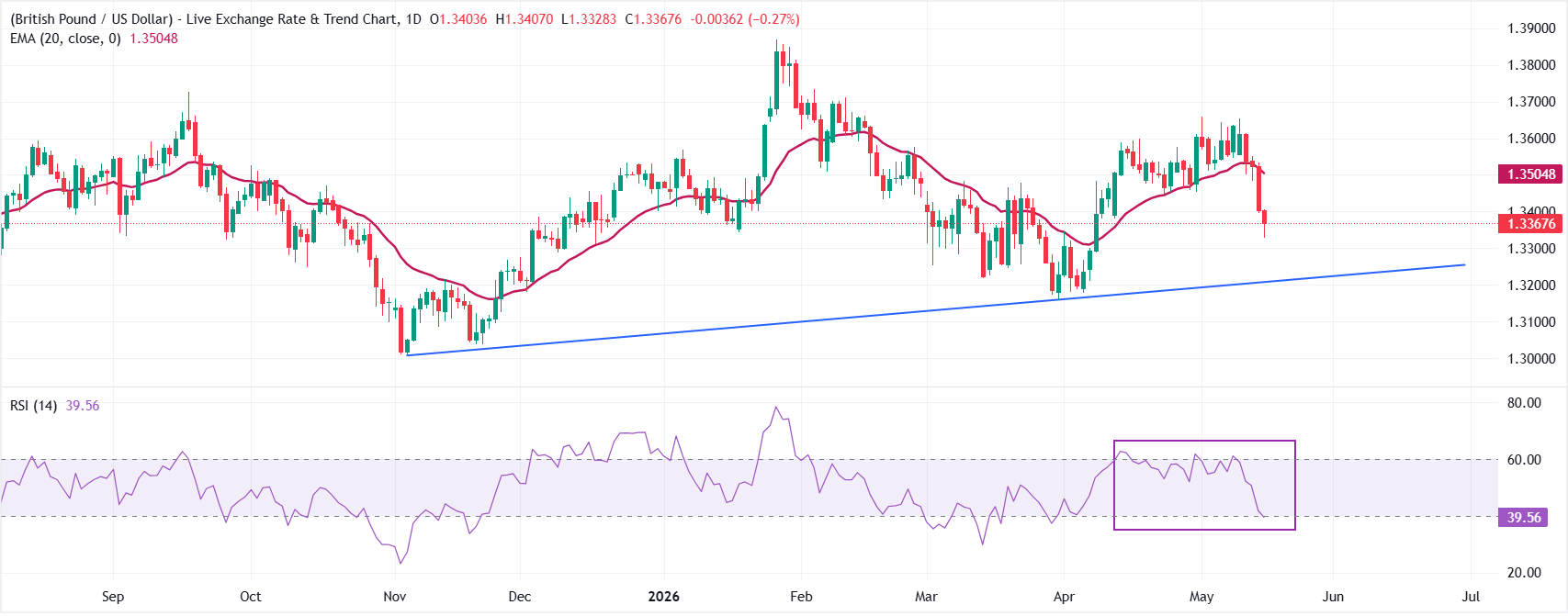
GBP/USD trades lower at around 1.3365, holding below the 20-day Exponential Moving Average (EMA) at 1.3505, which reinforces a bearish near-term bias after the recent breakdown.
The Relative Strength Index (RSI) at 39 suggests weak momentum and keeps the focus on further downside pressure while the pair remains capped beneath the short-term EMA.
On the downside, the next relevant support sits near the prior upward trend-line break area around 1.3207, where buyers may attempt to slow the decline. Looking up, the 20-day EMA at 1.3505 is the first key resistance that bulls would need to reclaim to ease immediate selling pressure and open the door to a more sustained recovery towards 1.3600.
(The technical analysis of this story was written with the help of an AI tool.)
Author

Sagar Dua
FXStreet
Sagar Dua is associated with the financial markets from his college days. Along with pursuing post-graduation in Commerce in 2014, he started his markets training with chart analysis.

















