GBP/USD Weekly Forecast: Pound Sterling struggles despite US government shutdown
- Pound Sterling staged a decent comeback from seven-week lows versus the US Dollar, retested 1.3500.
- GBP/USD looks to Fed Minutes and talks amid a relatively quiet economic docket.
- Technically, GBP/USD sellers lurk above the 50-day SMA yet again as the daily RSI stays below the 50 level.

The Pound Sterling (GBP) recovery from seven-week lows against the US Dollar (USD) lost legs, sending GBP/USD back below the 1.3500 threshold.
Pound Sterling recovery lost steam
Amid cautious remarks by the Bank of England (BoE) policymakers and a broad-based US Dollar downside, the GBP/USD pair staged an impressive turnaround from the 1.3330 region to briefly regain 1.3500 before facing some headwinds above the latter in the second half of the week.
However, buyers retained control, registering a weekly gain for the first time in three weeks.
Benign US core Personal Consumption Expenditures (PCE) inflation data and concerns over a potential government shutdown in the United States (US) fuelled a fresh downtrend in the USD across its competitors at the start of the week.
The latest US Personal Consumption Expenditures (PCE) inflation data, released on September 26, showed that the headline PCE Price Index rose 2.7% year-on-year (YoY) in August, up from 2.6% in July. Core PCE inflation, the Federal Reserve’s (Fed) preferred inflation gauge, held steady at 2.9% YoY in August. The data came in line with market expectations.
Meanwhile, the US was headed for a government shutdown on the first day of the 2026 fiscal year on October 1. US Vice President JD Vance warned that "I think we're headed to a shutdown.”
His comments came after US President Donald Trump and his Democratic opponents appeared to make little progress at a White House meeting aimed at averting the shutdown beyond a Tuesday midnight deadline (Wednesday 4 GMT).
During the same time, BoE officials Dave Ramsden, Catherine Mann and Sarah Breeden warned about higher inflationary pressures, advocating the central bank’s prudence on further easing.
On Wednesday, the Greenback faced a double whammy and accelerated its declines on the US government’s closure of its operations as Congress failed to advance the funding bill.
The shutdown-induced delay in the US statistics raised doubts on the scope and timing of further Fed interest rate cuts beyond the October 28-29 meeting. This narrative dented the sentiment around the USD.
The USD was further hurt by a weak US Automatic Data Processing (ADP) jobs report, which sealed in a 25 basis points (bps) rate cut later this month. Subsequently, GBP/USD reached a five-day high at 1.3527.
The ADP showed on Wednesday that private companies shed a seasonally adjusted 32,000 jobs during the month, the biggest slide since March 2023. Markets expected an increase of 50,000 in the reported month. The US ADP data outweighed the uptick in the ISM Manufacturing PMI to 49.1 in September.
However, the USD received some support in the second half of the week, following news that the Supreme Court allowed Fed Governor Lisa Cook to remain in her post pending oral arguments in January on whether President Donald Trump has legal cause to fire her, per CNBC News.
Further, the Artificial Intelligence (AI) frenzy-driven record highs on global stocks and a bout of profit-taking in Gold (XAU/USD) from lifetime highs, helped the Greenback crawl back some ground heading into the weekend. This, in turn, dragged the pair back under toward the 1.3400 level.
A data-light week ahead
With traders battling from the fallout of the US government shutdown, the upcoming week appears light data-wise amid the continued Golden Week holidays in China.
Monday is devoid of any top-tier economic releases from both sides of the Atlantic.
Until the US government funding is restored, the data publication from the US Department of Labor (DoL), Bureau of Labor Statistics (BLS) and the Census Bureau during the week will be delayed.
Therefore, the focus will remain on the Minutes of the Fed’s September meeting and further shutdown talks for fresh directional impetus on the US Dollar, in turn, on the GBP/USD pair.
Meanwhile, the University of Michigan (UoM) preliminary Consumer Sentiment and Inflation Expectations data will entertain traders heading into the weekend.
Besides, speeches from Fed policymakers, along with any fresh developments on the geopolitical and trade front, will also be closely followed.
GBP/USD: Technical outlook
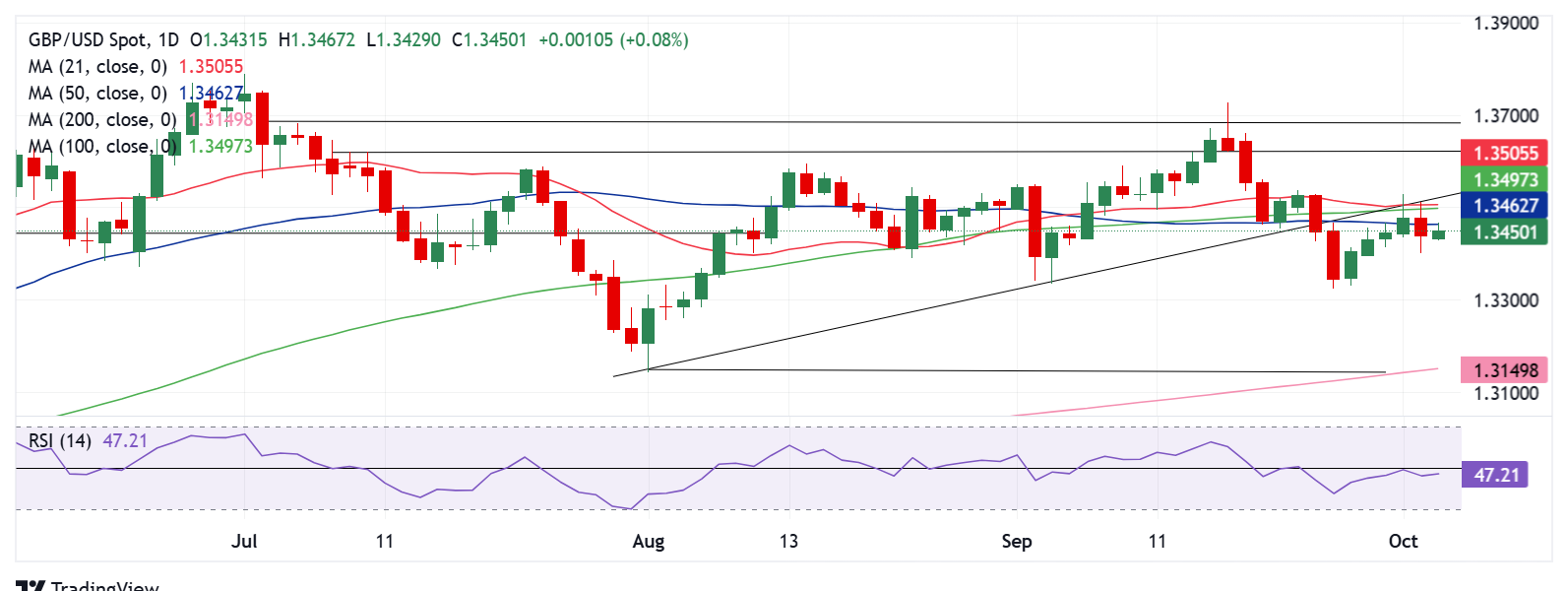
GBP/USD failed its attempts to reclaim the key daily Simple Moving Averages (SMA), surrendering the critical 50-day SMA, now at 1.3462, after having faced rejection at around 1.3500 on multiple occasions.
That level is the confluence of the round level, 21- and 100-day SMAs.
The 14-day Relative Strength Index (RSI) points lower below the midline, suggesting that the downside bias will likely remain in place.
If the GBP/USD pullback gathers strength, the 1.3330 round level will offer initial support, below which the August 4 low of 1.3254 will be tested.
Further south, the August low of 1.3142 could come to the rescue of buyers, where the 200-day SMA coincides.
GBP/USD must find acceptance above the aforesaid confluence resistance zone at around 1.3500, where the rising trendline support-turned-resistance intersects and makes it a powerful barrier.
The next relevant topside hurdle is located in the 1.3600-1.3620 supply area.
A sustained move above the latter will expose the July 4 high of 1.3681 on the way to 1.3788 (July 1 high).
Pound Sterling FAQs
The Pound Sterling (GBP) is the oldest currency in the world (886 AD) and the official currency of the United Kingdom. It is the fourth most traded unit for foreign exchange (FX) in the world, accounting for 12% of all transactions, averaging $630 billion a day, according to 2022 data. Its key trading pairs are GBP/USD, also known as ‘Cable’, which accounts for 11% of FX, GBP/JPY, or the ‘Dragon’ as it is known by traders (3%), and EUR/GBP (2%). The Pound Sterling is issued by the Bank of England (BoE).
The single most important factor influencing the value of the Pound Sterling is monetary policy decided by the Bank of England. The BoE bases its decisions on whether it has achieved its primary goal of “price stability” – a steady inflation rate of around 2%. Its primary tool for achieving this is the adjustment of interest rates. When inflation is too high, the BoE will try to rein it in by raising interest rates, making it more expensive for people and businesses to access credit. This is generally positive for GBP, as higher interest rates make the UK a more attractive place for global investors to park their money. When inflation falls too low it is a sign economic growth is slowing. In this scenario, the BoE will consider lowering interest rates to cheapen credit so businesses will borrow more to invest in growth-generating projects.
Data releases gauge the health of the economy and can impact the value of the Pound Sterling. Indicators such as GDP, Manufacturing and Services PMIs, and employment can all influence the direction of the GBP. A strong economy is good for Sterling. Not only does it attract more foreign investment but it may encourage the BoE to put up interest rates, which will directly strengthen GBP. Otherwise, if economic data is weak, the Pound Sterling is likely to fall.
Another significant data release for the Pound Sterling is the Trade Balance. This indicator measures the difference between what a country earns from its exports and what it spends on imports over a given period. If a country produces highly sought-after exports, its currency will benefit purely from the extra demand created from foreign buyers seeking to purchase these goods. Therefore, a positive net Trade Balance strengthens a currency and vice versa for a negative balance.
Author

Dhwani Mehta
FXStreet
Residing in Mumbai (India), Dhwani is a Senior Analyst and Manager of the Asian session at FXStreet. She has over 10 years of experience in analyzing and covering the global financial markets, with specialization in Forex and commodities markets.

















