GBP/USD Weekly Forecast: Pound Sterling awaits US Jobs data for fresh direction
- Pound Sterling stayed within the August 22 daily range against the US Dollar.
- GBP/USD looks to US employment data as another holiday-shortened week looms.
- The daily technical setup challenges bullish commitments near 1.3450.

The Pound Sterling (GBP) regained ground against the US Dollar (USD), albeit within the August 22 trading range. The GBP/USD pair gradually crawled back above the 1.3500 barrier on the renewed upside.
Pound Sterling oscillated in a range
GBP/USD entered a consolidative mode following a late rebound last week. The bull-bear tug-of-war extended, but bargain-buying remained in vogue, courtesy of a broad-based US Dollar decline.
The USD booked a monthly drop, after having a double-whammy from the increased dovish expectations surrounding the Federal Reserve (Fed) on one hand. On the other hand, concerns over the Fed’s independence sapped investors’ confidence in the US currency.
Dovish Fed commentaries during the week doubled down on Chairman Jerome Powell-led affirmation of an interest rate cut next month.
New York Fed President John Williams noted on Wednesday that “it is likely interest rates can fall at some point but policymakers will need to see what upcoming data indicate about the economy to decide if it's appropriate to make a cut next month,” per Reuters.
Late Thursday, Fed Governor Christopher Waller said that he would support a rate cut in the September meeting and further reductions over the next three to six months to prevent the labor market from collapsing.
Markets maintained their expectations for a September rate cut in the range of 85% to 90%, according to the CME Group’s Fed Watch Tool.
Moving on, the drama between US President Donald Trump and the Fed intensified ever since Trump announced earlier in the week that he plans to fire Fed Governor Lisa Cook over her false statements on mortgage applications.
However, Cook stood her ground and said that Trump had no authority to remove her. Cook filed a lawsuit on Thursday against Trump's effort to fire her.
Meanwhile, US Vice President JD Vance’s comments in a USA Today interview on Thursday confirmed the end of the Fed’s autonomy.
On Friday, Bloomberg reported that UK Chancellor of the Exchequer Rachel Reeves could boost revenues by imposing a windfall tax on commercial lenders to recover the profits they are making from taxpayers on deposits held at the Bank of England (BoE).
The headline failed to have any impact on the Pound Sterling as GBP/USD remained at the mercy of the USD dynamics ahead of the release of the Fed’s preferred inflation measure, the core Personal Consumption Expenditures (PCE) Price Index.
The Bureau of Economic Analysis (BEA) reported that the annual PCE Price Index increased 2.6% in July, matching the market expectation and June's print. The core PCE Price Index, which excludes volatile food and energy prices, rose 2.9% in the same period as anticipated, following June's increase of 2.8%. As this data failed to trigger a significant reaction, GBP/USD struggled to regain its traction heading into the weekend.
US labor data to take center stage
Traders gear up for a flurry of top-tier US economic data releases in another holiday-shortened week. This time, the US markets are closed on Monday in observance of Labor Day.
The UK data docket again lacks any high-impact publications until Friday and, hence, all eyes will be on the other side of the Atlantic for fresh trading incentives.
The US employment data are likely to be in the spotlight, trickling in from Wednesday. But on Tuesday, the Institute for Supply Management (ISM) Manufacturing PMI data will also be eagerly awaited.
Wednesday will feature the US JOLTS Job Openings Survey, paving the way for the Automatic Data Processing (ADP) Employment Change report on Thursday.
The usual weekly Jobless Claims will also drop on Thursday, followed by the ISM Services PMI.
The calendar is the busiest on Friday, with the UK Retail Sales on the cards. Later that day, the US Nonfarm Payrolls (NFP) will be published along with the other details of the monthly jobs report, such as the Unemployment Rate and Average Hourly Earnings.
Markets will also monitor geopolitical, trade developments and speeches from Fed policymakers for their impact on risk sentiment and eventually on the USD and the Pound Sterling.
GBP/USD: Technical Outlook
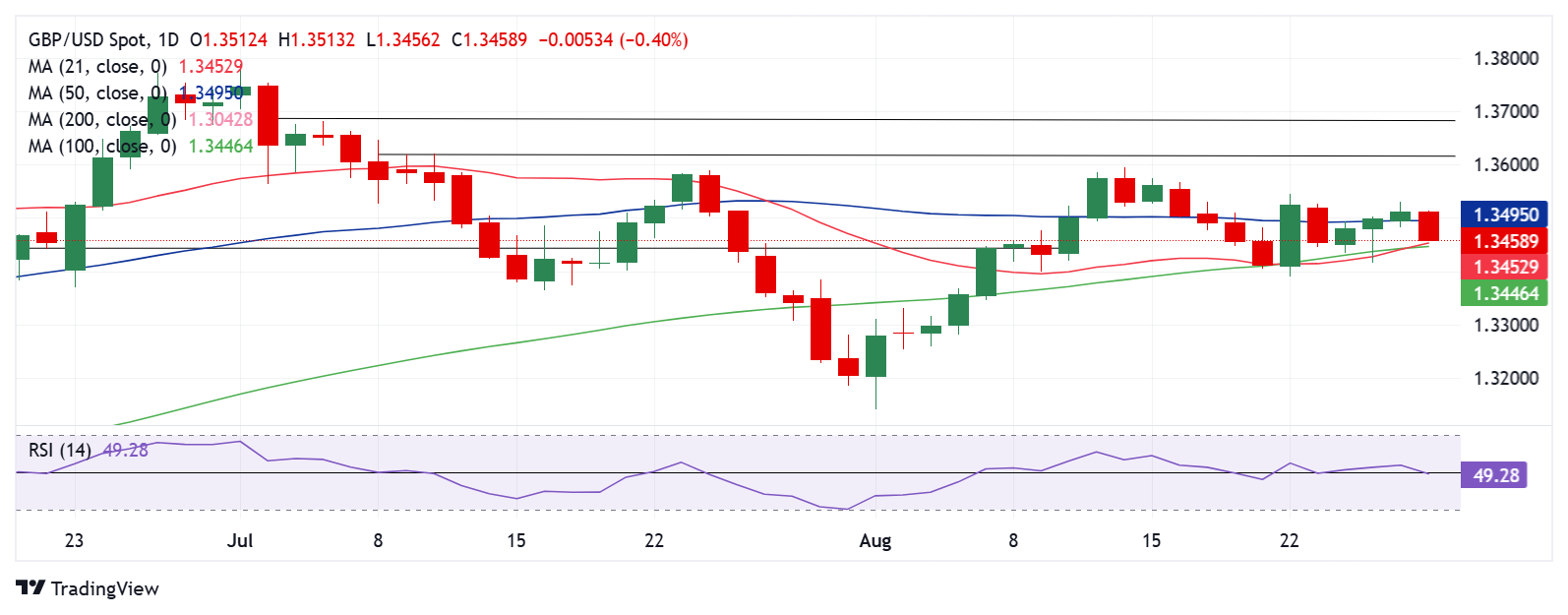
GBP/USD’s daily chart shows that the double top reversal stalled at the confluence of the 21-day Simple Moving Average (SMA) and the 100-day SMA once again, then at around 1.3420.
Subsequently, the 21-day SMA closed above the 100-day SMA on Thursday, confirming a Bull Cross and opening the door for more upside.
The 14-day Relative Strength Index (RSI) flirts with the midline, warranting caution for buyers.
Looking ahead, it is critical for buyers to regain acceptance above the 50-day SMA at 1.3496. The next relevant topside hurdle is seen at the double top high near 1.3590.
Further up, buyers will challenge the July 4 high of 1.3681, followed by 1.3788 (July 1 high).
On the downside, a firm break below the 21-day SMA and 100-day SMA confluence zone, now near 1.3450, could fuel a fresh downtrend toward he 1.3300 round figure.
Additional declines could put the August 4 low of 1.3254 to the test.
Pound Sterling FAQs
The Pound Sterling (GBP) is the oldest currency in the world (886 AD) and the official currency of the United Kingdom. It is the fourth most traded unit for foreign exchange (FX) in the world, accounting for 12% of all transactions, averaging $630 billion a day, according to 2022 data. Its key trading pairs are GBP/USD, also known as ‘Cable’, which accounts for 11% of FX, GBP/JPY, or the ‘Dragon’ as it is known by traders (3%), and EUR/GBP (2%). The Pound Sterling is issued by the Bank of England (BoE).
The single most important factor influencing the value of the Pound Sterling is monetary policy decided by the Bank of England. The BoE bases its decisions on whether it has achieved its primary goal of “price stability” – a steady inflation rate of around 2%. Its primary tool for achieving this is the adjustment of interest rates. When inflation is too high, the BoE will try to rein it in by raising interest rates, making it more expensive for people and businesses to access credit. This is generally positive for GBP, as higher interest rates make the UK a more attractive place for global investors to park their money. When inflation falls too low it is a sign economic growth is slowing. In this scenario, the BoE will consider lowering interest rates to cheapen credit so businesses will borrow more to invest in growth-generating projects.
Data releases gauge the health of the economy and can impact the value of the Pound Sterling. Indicators such as GDP, Manufacturing and Services PMIs, and employment can all influence the direction of the GBP. A strong economy is good for Sterling. Not only does it attract more foreign investment but it may encourage the BoE to put up interest rates, which will directly strengthen GBP. Otherwise, if economic data is weak, the Pound Sterling is likely to fall.
Another significant data release for the Pound Sterling is the Trade Balance. This indicator measures the difference between what a country earns from its exports and what it spends on imports over a given period. If a country produces highly sought-after exports, its currency will benefit purely from the extra demand created from foreign buyers seeking to purchase these goods. Therefore, a positive net Trade Balance strengthens a currency and vice versa for a negative balance.
Author

Dhwani Mehta
FXStreet
Residing in Mumbai (India), Dhwani is a Senior Analyst and Manager of the Asian session at FXStreet. She has over 10 years of experience in analyzing and covering the global financial markets, with specialization in Forex and commodities markets.