GBP/USD Weekly Forecast: Pound Sterling bears eye a sustained move below 1.2000
- GBP/USD extended its sideways momentum for the majority of the week before stretching lower on Friday.
- Hawkish Federal Reserve bets and geopolitical woes favor the United States Dollar.
- Risks remain skewed to the downside for GBP/USD, with eyes still on 2023 low at 1.1841.

The GBP/USD pair continued to display a lackluster performance for the majority of the week but closed in negative territory following Friday's decline. Although the risks remained tilted to the downside, the United States Dollar (USD) kept the upper hand amid hawkish US Federal Reserve (Fed) rate hike expectations and escalating geopolitical tensions surrounding Russia. What is next on the cards for the currency pair?
GBP/USD: What happened last week?
The US Federal Reserve (Fed) and the Bank of England (BoE) policy divergence and geopolitical risks emerged as the main underlying theme in the past week, motivating the US Dollar bulls to build on the previous recovery momentum while leaving the Pound Sterling in limbo. Thus, the GBP/USD pair settled modestly flat on the week, struggling for a clear direction.
Expectations of a higher Federal Reserve peak rate (to near 5.50%) gathered strength as the United States economy continued to show resilience, with the S&P Global Manufacturing and Services PMI data coming in strong. The PMIs followed outstanding US Nonfarm Payrolls, hot Consumer Price Index data and strong Retail Sales report. US Composite PMI Output Index, which tracks the manufacturing and services sectors, increased to 50.2 this month from a final reading of 46.8 in January.
Aside from improving fundamentals, the commentary from several Federal Reserve policymakers also remained hawkish, endorsing a hawkish Federal Reserve outlook. Markets priced in 25 bps rate hikes each at the Fed's March and May meetings. Some US banks forecast 25 bps rate increases each at the following three meetings, raising the terminal rate forecast to 5.25%-5.50%.
The ongoing bullish momentum in the US Dollar found an additional boost following the release of the first FOMC Minutes of this year, which showed that some policymakers debated a 50 bps rate hike in the February meeting. Additionally, they agreed on the need for more rate increases and acknowledged that the tight labor market in the United States would continue to put upward pressure on inflation.
Meanwhile, geopolitical developments worldwide also underpinned the US Dollar's safe-haven appeal. At the start of the week, North Korea fired two ballistic missiles off its east coast, landing in the Sea of Japan, rattling markets. Further, tensions mounted between the United States and China over Russia after US Secretary of State Antony Blinken said that the US has information that China is considering sending weapons to Russia for the war in Ukraine.
In defense, a Chinese Foreign Ministry spokesman, Wang Wenbin, said: "It is a known fact that NATO countries, including the US are the biggest source of weaponry for the battlefield in Ukraine, yet they keep claiming that China may be supplying weapons to Russia." Later on, US officials announced that the Biden administration is considering releasing intelligence that shows that China is weighing whether to supply weapons to support Russia's war in Ukraine. Meanwhile, Germany's Der Spiegel carried the report on Thursday, China and Russia are said to be negotiating the purchase of 100 combat drones, which could be delivered as soon as April.
Across the pond, strong United Kingdom S&P Global Preliminary Manufacturing and Services PMI data did offer the much-needed boost to the Pound Sterling in the early part of the week. The S&P Global/CIPS UK Preliminary Manufacturing Purchasing Managers' Index (PMI) unexpectedly improved to 49.2 in February versus 46.8 expected and January's 47.0 final readouts. Meanwhile, the Preliminary UK Services Business Activity Index for February jumped to 53.3 as against January's 48.7 final print and 48.3 expected.
The British Pound got a bit of a boost after Bank of England (BoE) policymaker Catherine Mann said on Thursday that "more tightening is needed, and a pivot is not imminent." But the US Dollar strength and risk-off flows dominated and fuelled a fresh downturn in the GBP/USD pair, as sellers tested the sub-1.2000 area once again.
On Friday, the US Bureau of Economic Analysis announced that the Core Personal Consumption Expenditures (PCE) Price Index, the Fed's preferred gauge of inflation, edged higher to 4.7% on a yearly basis in January. This reading came in higher than the market expectation of 4.3% and the publication also revealed that December's print got revised higher to 4.6% from 4.4%. On the back of strong PCE inflation data, the USD gathered strength in the American session and caused GBP/USD to break below 1.2000.
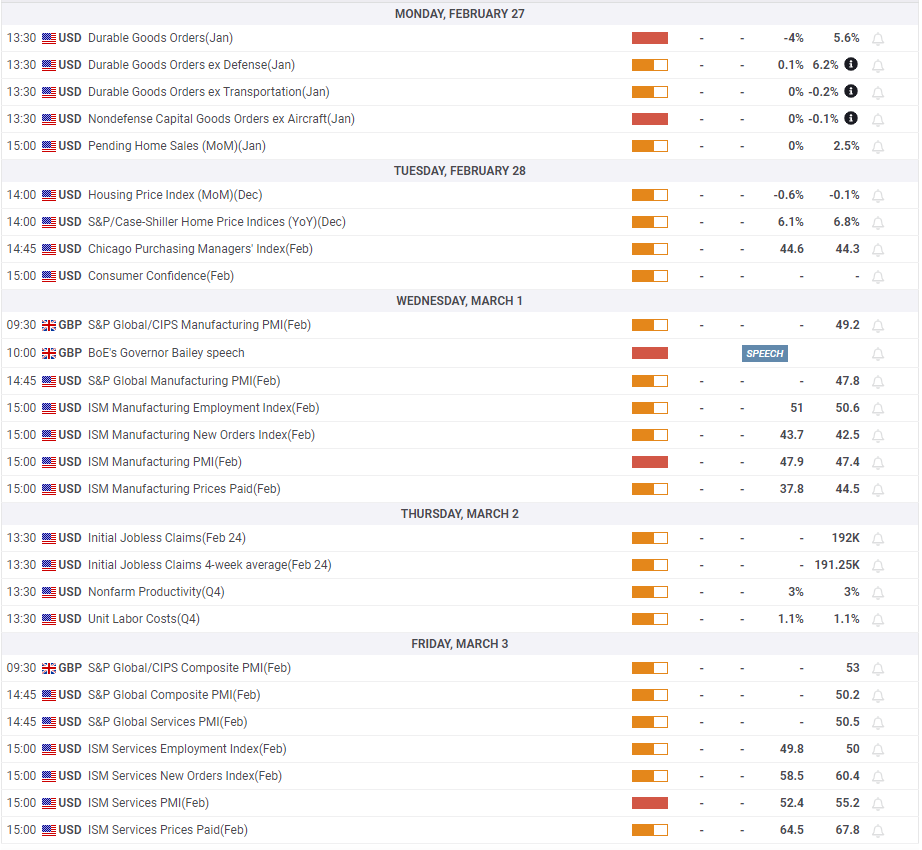
The week ahead: United States data to dominate
After a holiday-thinned past week, traders look forward to a full week, mainly dominated by the key economic release from the United States. It's a busy start to the week, as the US Durable Goods Orders data and Pending Home Sales are scheduled for Monday. Ahead of that, the Bank of England (BoE) Deputy Governor Ben Broadbent will deliver opening remarks at the BoE Agenda for Research Conference, in London.
Another set of BoE policymakers will make their appearances on Tuesday, namely Chief Economist Huw Pill and external member Catherine Mann. Their remarks could provide fresh hints on the central bank's rate hike outlook, especially after the strong business activity data from the United Kingdom last week. From the US, the Conference Board Consumer Confidence data will drop in, followed by a speech from the new Chicago Fed President Austan Goolsbee.
Wednesday's speech from the BoE Chief Andrew Bailey will be important, as he is set to speak at the Cost of Living Crisis Conference organized by the Brunswick Group, in London. His Q&A session will be closely scrutinized for policy guidance. The ISM Manufacturing PMI from the United States will hog the limelight midweek, as investors will pay little attention to the UK Final PMI Manufacturing reading.
Thursday will feature the US weekly Jobless Claims and BoE Chief Economist Huw Pill second appearance for the week. Meanwhile, the UK Final Services PMI will be reported ahead of the US ISM Services PMI, Fed official Logan's speech and the Fed Monetary Policy Report.
GBP/USD: Technical outlook
GBP/USD: Daily chart
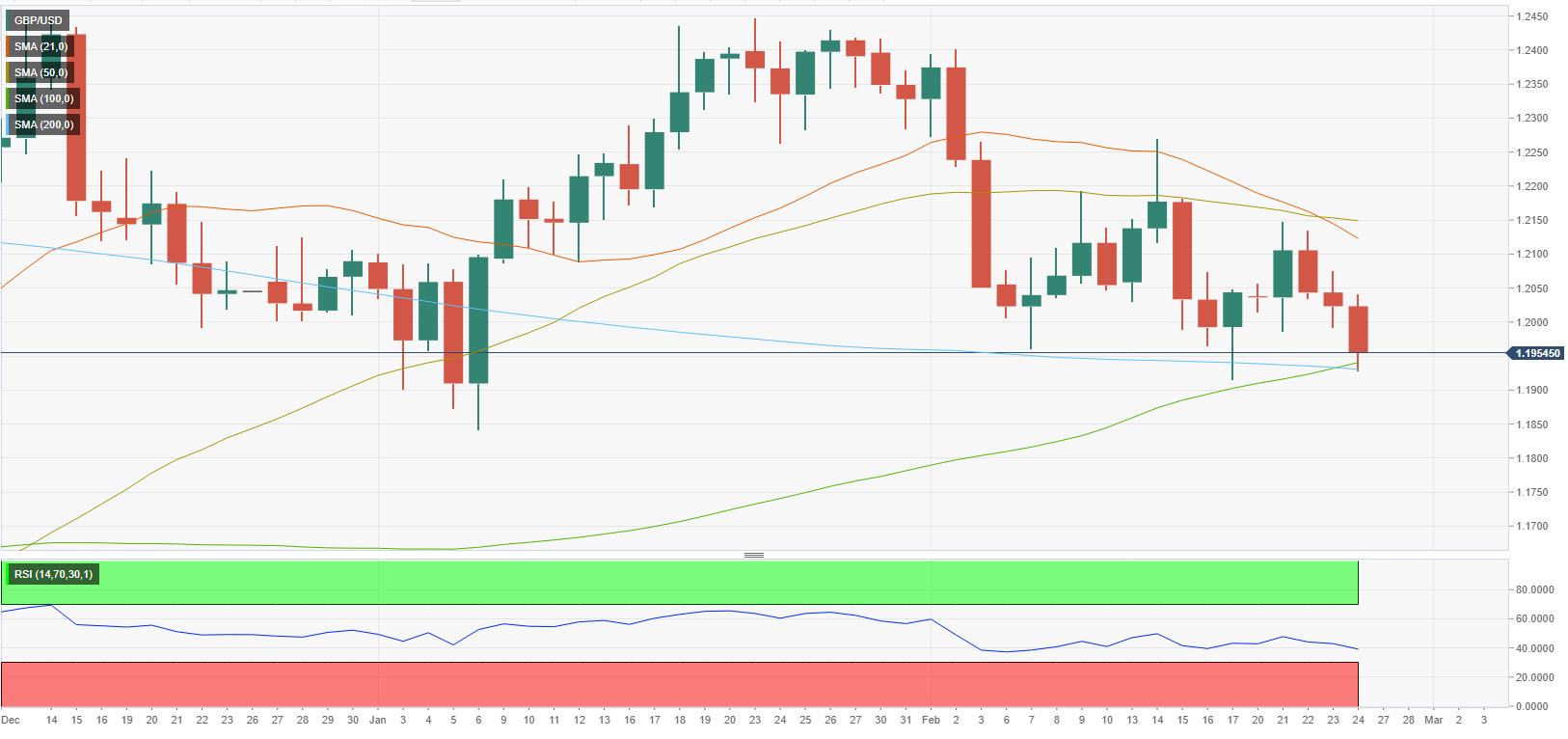
GBP/USD dropped below toward the lower-end of its three-week-old trading range but managed to hold slightly above key support area.
The range play witnessed for the majority of the week could be attributed to the battle between a bearish cross and a bull cross on the daily chart.
The 21 DMA crossed the flattish 50 DMA from above on Wednesday, confirming a bearish crossover while on the same day the 100 DMA pierced through the 200 DMA from below. The bull cross limited the bearish pressures, although GBP/USD buyers stayed cautious amidst the bear cross.
The 14-day Relative Strength Index (RSI) continues to stay below the midline, suggesting that a downside break remains well on the cards.
Should the pair yield a daily closing below the critical support around the 1.1940 level, where the 100 and 200 DMAs converge, a sharp sell-off toward the 1.1900 round figure will be in the offing. Further south, the 2023 low of 1.1841 will be next on sellers' radars.
Alternatively, GBP/USD needs acceptance above the 1.2150 static resistance and 50 DMA to initiate a fresh recovery toward the 1.2200 round figure. Valentine's Day high of 1.2270 could lure the Pound Sterling buyers on a decisive break of the latter.
GBP/USD: Forecast poll
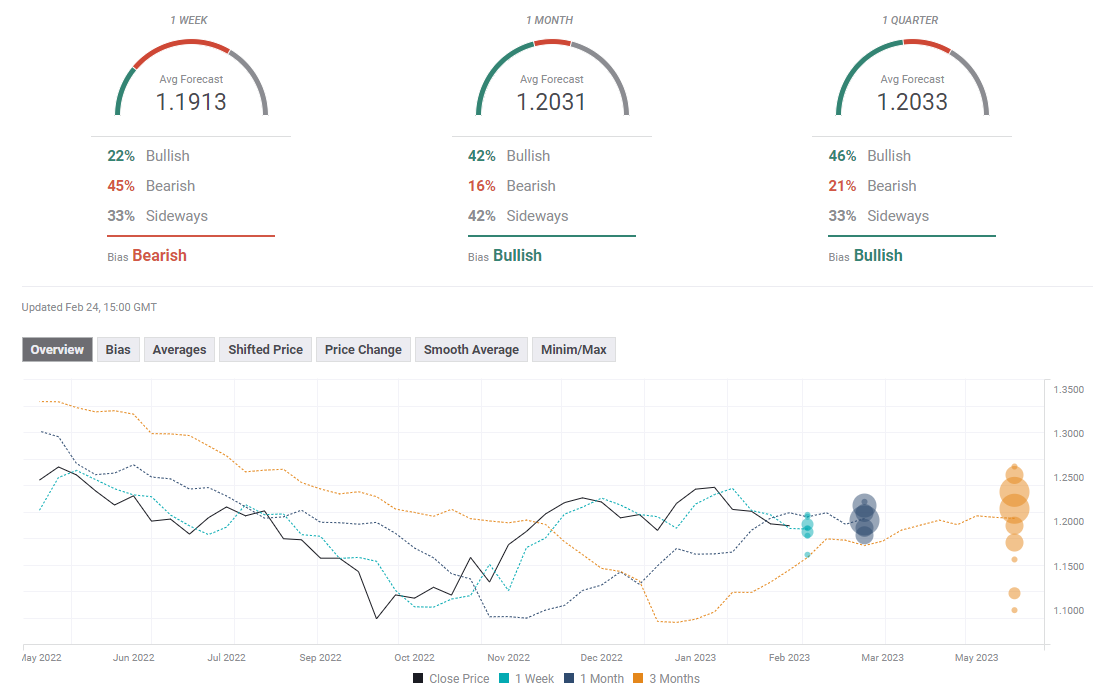
The FXStreet Forecast Poll points to bearish tilt in the short-term outlook with the one-week target aligning slightly above 1.1900. The one-month outlook paints a mixed picture.
Author

Dhwani Mehta
FXStreet
Residing in Mumbai (India), Dhwani is a Senior Analyst and Manager of the Asian session at FXStreet. She has over 10 years of experience in analyzing and covering the global financial markets, with specialization in Forex and commodities markets.