GBP/USD Weekly Forecast: How long can 200 DMA support hold? Powell, NFP in the spotlight
- GBP/USD bulls returned as US Dollar snapped a four-week winning streak.
- Markets weighed hawkish Federal Reserve bets and the Brexit deal.
- 200 DMA remains a tough nut to crack for GBP/USD ahead of Powell, US NFP.

The pause in the US Dollar recovery momentum provided the much-needed respite to the Pound Sterling bulls in the past week. The GBP/USD pair also cheered the Brexit deal announcement amid a week dominated by economic data from the United States. Attention now turns toward the US Federal Reserve (Fed) Chair Jerome Powell’s testimony and the critical US jobs market report for a fresh direction in Cable.
GBP/USD: What happened last week?
Following a down week, the Pound Sterling bulls managed to find some footing in the early part of the week, courtesy of a steep correction in the United States Dollar (USD) and optimism over a Brexit deal reached on the Northern Ireland (NI) Protocol.
Over the weekend, British Deputy Prime minister, Dominic Raab, told BBC’s Laura Kuenssberg that they made 'great progress' negotiating with the European Union (EU). Meanwhile, the Times reported that British Prime Minister, Rishi Sunak, may have obtained 'significant concessions' in a looming Brexit deal. On Monday, European Commission President, Ursula von der Leyen, and PM Sunak said In a joint press conference that they have amended the original Northern Ireland Protocol deal and agreed on a new "Windsor framework,” yielding a decisive breakthrough.
The US Dollar eroded all of its Friday’s US PCE inflation data-led gains in the first half of the week, as the United States Durable Goods Orders and Conference Board Consumer Confidence data disappointed and raised doubts over a potential ‘soft-landing’ in the US economy amidst heightened hawkish Federal Reserve expectations.
In light of the renewed Brexit optimism and dismal US economic data, the GBP/USD pair hit fresh weekly highs at 1.2143 on Wednesday, as the US Dollar Index correction gathered steam from over two-month highs. The US Dollar Index tested the 104.00 level, as sellers took a strong hold amid a strong China data-driven risk rally across the financial markets. China’s official and Caixin Manufacturing PMIs showed a return to expansion, reflecting the reopening optimism.
Brexit critics returned while the better-than-expected US ISM Manufacturing PMI data and its sub-components revived the selling interest around GBP/USD. The pair resumed its downtrend below the 1.2000 threshold, as the hawkish Federal Reserve expectations regained ground amid hot inflation and drove the benchmark US 10-year Treasury bond yields to the highest level in four months above 4.0%. Firmer US Treasury bond yields across the curve helped the US Dollar stage a solid comeback.
Dovish remarks from Bank of England (BoE) Governor, Andrew Bailey, also acted as a headwind to the GBP/USD rebound. Bailey said earlier in the week that some further increase in bank rate may turn out to be appropriate but added that nothing is decided, "I would caution against suggesting either that we are done with increasing bank rate, or that we will inevitably need to do more,” Bailey added.
On Friday, the currency pair attempted a recovery, as the US Dollar returned to the red amid a pullback in the US Treasury bond yields. Latest comments from Atlanta Fed President, Raphael Bostic, citing that "slow and steady is going to be the appropriate course of action," took the wind out of the US Dollar rebound.
The US ISM Services PMI came in at 55.1 on Friday, surpassing the market expectation of 54.5. The Prices Paid sub-index, the inflation component of the survey, edged lower to 65.6 from 67.8 but beat analysts' estimate of 64.5. Although the PMI report helped the USD limit its losses, the market reaction remained short-lived.
Focus on Powell and United States Nonfarm Payrolls
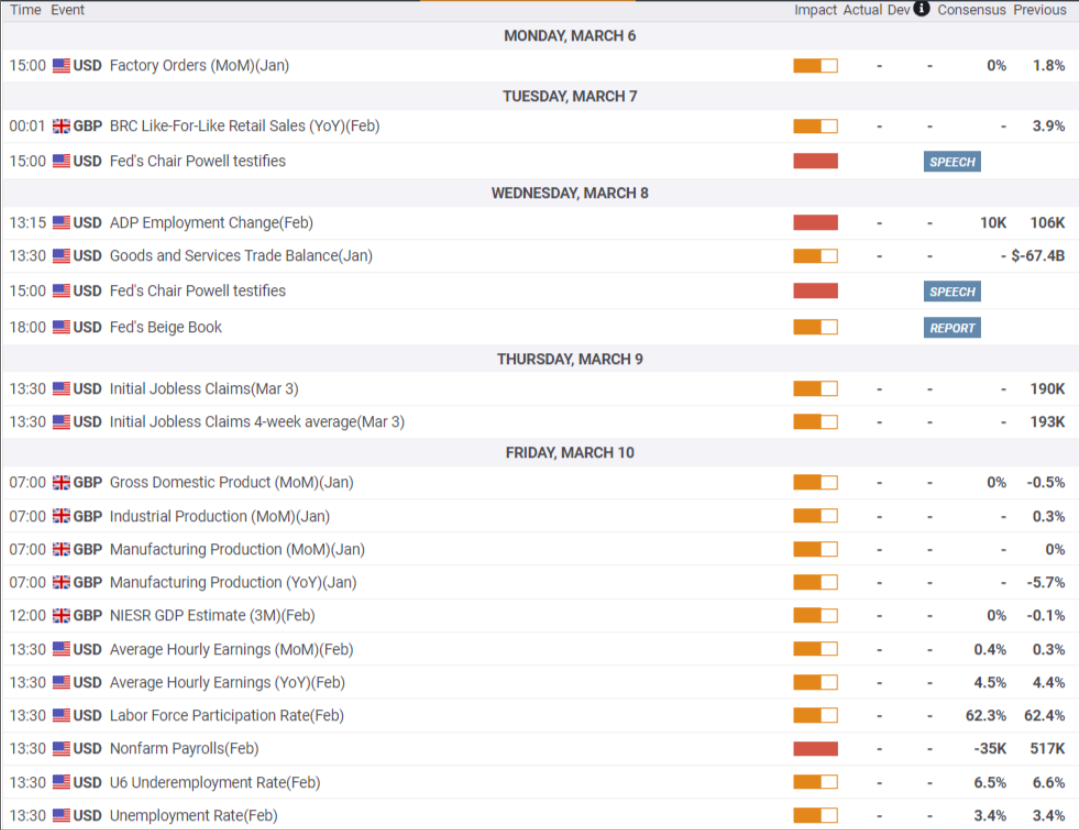
Pound Sterling traders see a quiet start to an action-packed week ahead, once again filled with the economic events from the United States. Monday will feature the only release from the US in the Factory Orders data.
The main focus on Tuesday will be day 1 of Federal Reserve Chairman Jerome Powell’s testimony. Powell will testify about the semi-annual monetary policy report before the Senate Banking Committee in Washington DC. His comments will be closely scrutinized for fresh hints on the pace and timing of rate increases beyond the first quarter.
Wednesday will be day 2 of Powell’s testimony. This time, he will testify about the semi-annual monetary policy report before the House Financial Services Committee. It will be his last appearance before the US central bank enters its ‘blackout period’ from March 11, preparing for the March 22 monetary policy meeting. Ahead of that, the ADP Nonfarm Employment Change data will be reported. The US JOLTS Job Openings data will also garner some attention for fresh US Dollar reaction.
China’s Consumer Price Index (CPI) and Producer Price Index (PPI) will drop in on Thursday and could have a significant impact on the market sentiment, in light of the recent slew of strong Chinese economic figures. There is nothing much of note from the United Kindom’s docket on Thursday and, therefore, the US Jobless Claims and Fed policymaker Micheal Barr’s speech will be awaited for fresh trading cues.
The final trading day of the week is the busiest, with the monthly Gross Domestic Product (GDP) featuring from the United Kingdom, accompanied by the Trade Balance, Manufacturing and Industrial Production numbers. The main event risk on Friday, however, remains the all-important United States Nonfarm Payrolls report. The headline figure, as well as, the wage growth data will be closely assessed by markets to gauge the Federal Reserve rate hike prospects.
GBP/USD: Technical outlook
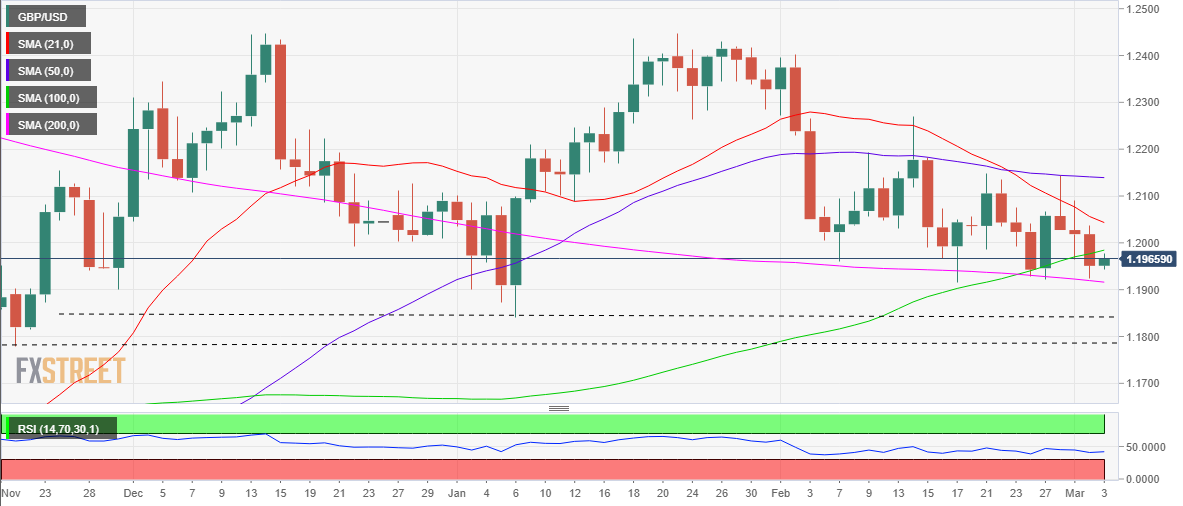
GBP/USD: Daily chart
GBP/USD extended its choppy trading in a four-week-old trading range, having once again defended the critical 200-Daily Moving Average (DMA) support near 1.1920.
Meanwhile, the Pound Sterling buyers continued to run into stiff resistance at the mildly bearish 50 DMA at 1.2139.
The 14-day Relative Strength Index (RSI) remains below the 50.00 level, justifying the ‘sell on rallies’ trading in the GBP/USD pair.
In the week ahead, investors will await a daily closing below the crucial 200 DMA support to place fresh bearish bets on the major.
Should that materialize, a fresh downside will be initiated toward the 2023 low of 1.1841. The next target for GBP sellers is envisioned at the 1.1800, below which the November 21 low at 1.1778 will come into the picture.
Alternatively, GBP/USD will to regain ground above the confluence zone at around 1.2000, where the ascending 100 DMA resistance hangs around. Buyers will then look to challenge the bearish 21 DMA at 1.2043 on the road to recovery.
The abovementioned critical 50 DMA resistance will be back in play on a sustained move above the 21 DMA upside barrier.
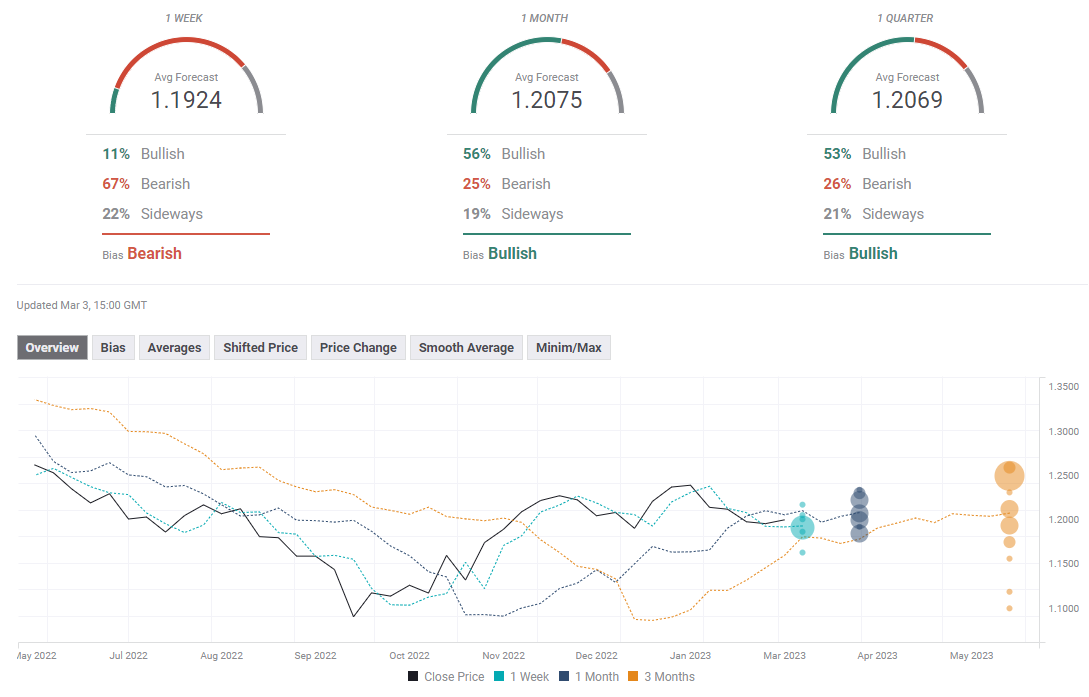
GBP/USD: Forecast poll
The FXStreet Forecast Poll points to an overwhelmingly bearish bias among polled experts in the short term. The one-week average target aligns at 1.1924. The one-month and the one-quarter outlooks both remain bullish.
Author

Dhwani Mehta
FXStreet
Residing in Mumbai (India), Dhwani is a Senior Analyst and Manager of the Asian session at FXStreet. She has over 10 years of experience in analyzing and covering the global financial markets, with specialization in Forex and commodities markets.