GBP/USD Price Forecast: Descending channel breakdown comes into play ahead of Fed’s Powell
- GBP/USD attracts some follow-through buying as the USD climbs to an over two-month high.
- The USD bulls seem unaffected by rising Fed rate cut bets and the US government shutdown.
- Even diminishing odds for more BoE rate cuts in 2025 do little to lend any support to the pair.


The GBP/USD pair turns lower for the third consecutive day and drops to a nearly two-week trough, below mid-1.3300s during the first half of the European session on Thursday amid the emergence of fresh US Dollar (USD) buying. In fact, the USD Index (DXY), which tracks the Greenback against a basket of currencies, has climbed to a fresh high since early August despite dovish Federal Reserve (Fed) expectations and concerns about a prolonged US government shutdown.
Minutes from the September FOMC policy meeting published on Wednesday indicated near unanimity among participants to lower interest rates amid concern about labour market risks and a more balanced inflation outlook. Policymakers, however, remained split on whether there should be one or two more rate reductions before the end of this year. Nevertheless, the overall tone was cautious and pointed to a continued easing bias. Moreover, the CME FedWatch tool indicates that the possibility of a 25-basis-point (bps) interest rate cut by the Fed in October and December currently stands at around 93% and 79%, respectively.
Meanwhile, the Senate failed for the sixth time on Wednesday to advance funding bills to end the government shutdown, which stretches into a ninth day. With both sides seemingly entrenched and no formal negotiations taking place, it could take a while longer to reach a deal. Even easing geopolitical tensions does little to dent the short-term bullish sentiment surrounding the safe-haven USD or lend any support to the GBP/USD pair. US President Donald Trump said Wednesday that Israel and Hamas have agreed on the first phase of his 20-point Gaza peace plan to pause fighting and release at least some hostages and prisoners.
Moreover, the British Pound (GBP) fails to gain respite from expectations that the Bank of England (BoE) will keep interest rates on hold at 4% for the rest of this year as signs of faster inflation and a more resilient economy reduce the case for more easing. In fact, BoE policymaker, Catherine Mann said that monetary policy must remain restrictive for longer to create an environment conducive to growth. This, in turn, suggests that the path of least resistance for the GBP/USD pair is to the downside. Traders now look forward to Fed Chair Jerome Powell's speech for more cues about the rate-cut path. This, in turn, will play a key role in influencing the USD and providing some meaningful impetus to the currency pair.
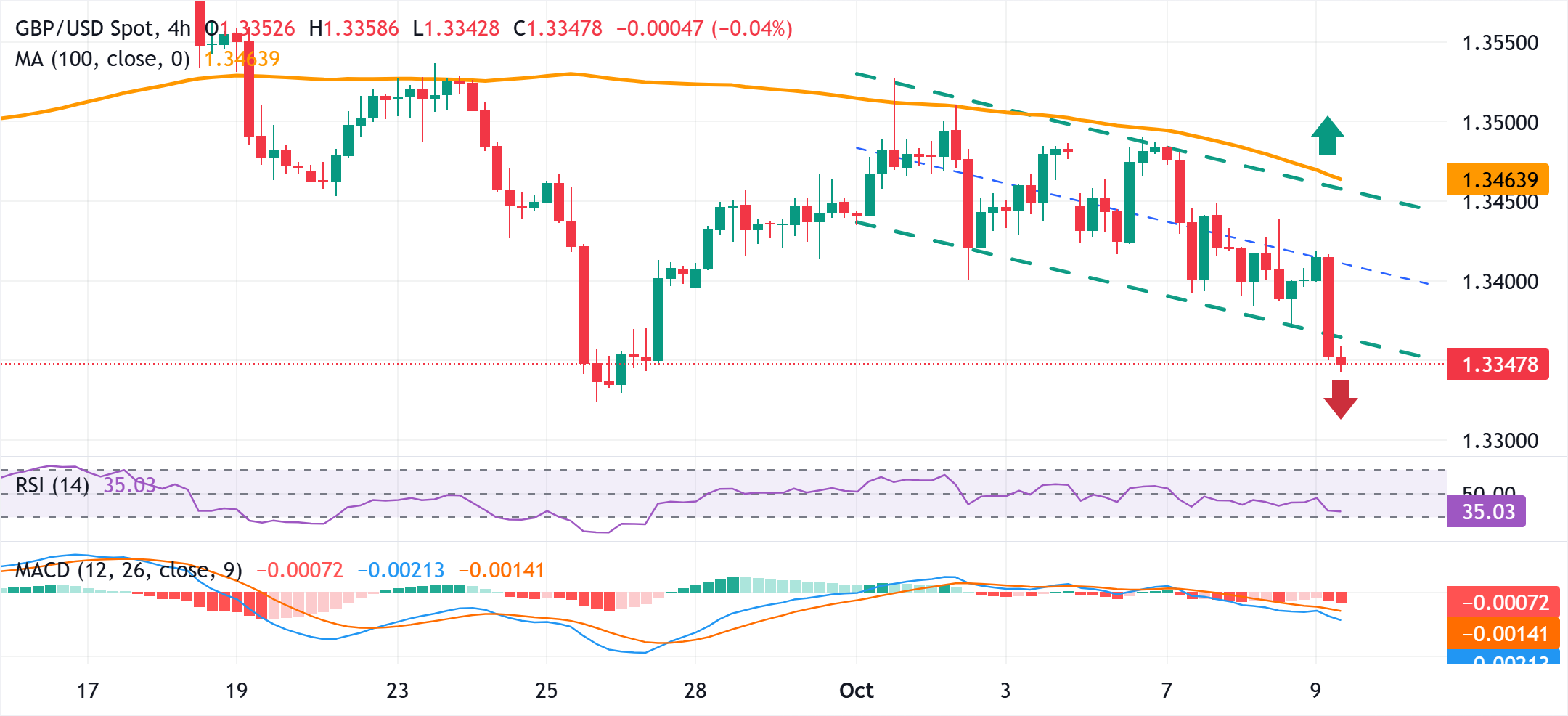
GBP/USD 4-hour chart
Technical Outlook
Against the backdrop of the recent repeated failures near the 100-period Simple Moving Average (SMA), weakness below a descending channel extending since the beginning of this month favors the GBP/USD bears. Furthermore, negative oscillators on 4-hour/daily charts validate the near-term negative outlook. Hence, a subsequent slide towards testing a nearly two-month low, around the 1.3330-1.3325 zone touched in September, looks like a distinct possibility. Some follow-through selling below the 1.3300 round figure will be seen as a fresh trigger for bearish traders and drag spot prices further to the 1.3260-1.3255 intermediate support en route to the 1.3200 mark.
On the flip side, attempted recovery moves might now confront an immediate hurdle near the 1.3400 round-figure mark ahead of the Asian session high, around the 1.3420 region. Any further move up is likely to attract fresh sellers and remain capped near the 1.3465-1.3475 confluence resistance – comprising the top end of the descending channel and the 100-period SMA. Some follow-through buying above the 1.3500 psychological mark could pave the way for additional gains beyond the 1.3525-1.3530 supply zone, towards the next relevant barrier near the 1.3575-1.3580 area.
Author
Haresh Menghani
FXStreet
Haresh Menghani is a detail-oriented professional with 10+ years of extensive experience in analysing the global financial markets.