|

GBP/USD has room to rise on GDP Day — Confluence Detector

GBP/USD is trading in a range as a new week of trading and Brexit headlines begins. UK GDP stands out on Monday and the pair has room to the upside. 

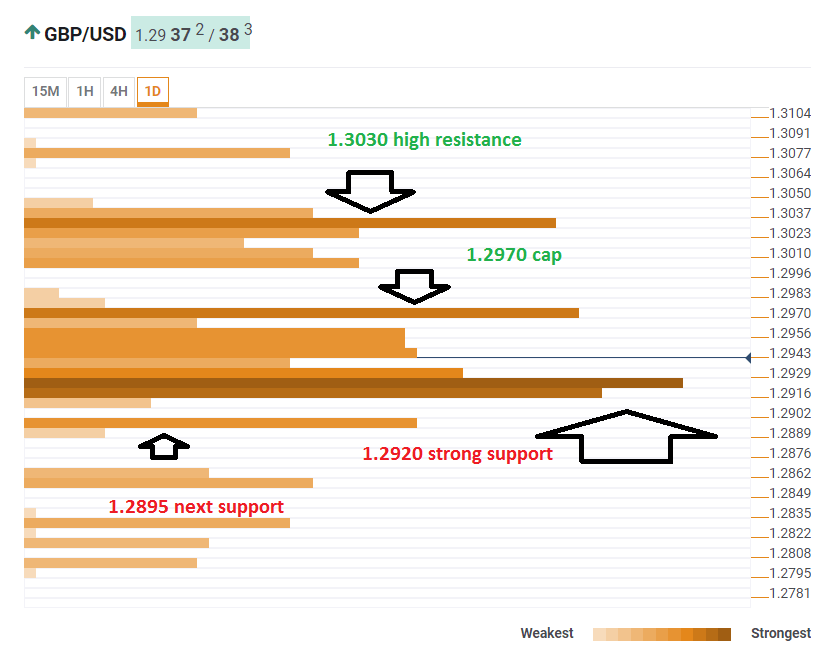
The Technical Confluences Indicator shows that cable enjoys significant support around 1.2920 where we see a dense cluster including the Fibonacci 38.2% one-month, the Friday's low, the Pivot Point one-day Support 1, the Fibonacci 23.6% one-week, and the Bollinger Band 1h-Lower.

The next support line is quite close. At 1.2895 we note the convergence of the Pivot Point one-day Support 2, the Simple Moving Average 100 one-day, and the SMA 200-4h. 

Resistance is weaker than support and found at 1.2970. It is the convergence of the SMA 5-1d, the BB 1h-Upper, and the PP one-day R1. 

The next significant juncture of resistance lines is at 1.3030 where we see the SMA 200-1d, the SMA 100-4h, and the Fibonacci 23.6% one-month converge.

This is how it looks on the tool:
GBP USD confluence analysis February 11 2019

Confluence Detector

The Confluence Detector finds exciting opportunities using Technical Confluences. The TC is a tool to locate and point out those price levels where there is a congestion of indicators, moving averages, Fibonacci levels, Pivot Points, etc. Knowing where these congestion points are located is very useful for the trader, and can be used as a basis for different strategies.

This tool assigns a certain amount of “weight” to each indicator, and this “weight” can influence adjacents price levels. This means that one price level without any indicator or moving average but under the influence of two “strongly weighted” levels accumulate more resistance than their neighbors. In these cases, the tool signals resistance in apparently empty areas.

Learn more about Technical Confluence

Author

Yohay Elam

Yohay Elam

FXStreet

Yohay is in Forex since 2008 when he founded Forex Crunch, a blog crafted in his free time that turned into a fully-fledged currency website later sold to Finixio.


More from Yohay Elam
Share:

Editor's Picks

GBP/USD remains slightly bid near 1.3300

GBP/USD now advances marginally and manages to dispute the 1.3300 region on Tuesday. Indeed, Cable regains some balance on the back of the lacklustre performance of the Greenback, all preceding the Fed’s meeting on Wednesday and the BoE’s gathering on Thursday.

EUR/USD clings to gains around 1.1400

EUR/USD bounces off earlier multi-week lows and remains close to the 1.1400 region on Tuesday. The pair’s decent advance follows hopes of a more sustainable deal between the US and Iran, which in turn keeps the downside pressure on the US Dollar ahead of the key Fed meeting on Wednesday.

Gold meets contention near $4,000

Gold remains under marked downside pressure on Tuesday, although the $4,000 zone per troy ounce emerges as a decent support for now. The precious metal’s pullback comes despite the modest losses in the US Dollar in a context of easing geopolitical tensions ahead of the key Fed event on Wednesday.

Bitcoin slips below $64,000 as risk-off sentiment grips markets
Bitcoin (BTC) is extending its correction, trading below $64,000 at the time of writing on Tuesday after losses of over 2.5% the previous day. Institutional demand shows early signs of weakness, with spot Exchange Traded Funds (ETFs) recording a mild outflow on Monday, marking three consecutive days of withdrawals.
Indian Rupee outlook: Downtrend set to persist – Just at a slower pace
The Indian Rupee just endured its most brutal six-month stretch in years, battered by a perfect storm of global shocks. From United States (US)-India trade uncertainty to surging Oil prices and the significant outflow of Foreign Institutional Investment (FII) from the Indian stock market, every event brought nothing but pain for the Indian currency.
US Dollar mid-year outlook: Exceptional currency, exceptional risks?
The US Dollar enters the second half of 2026 in a markedly different position from a year ago. The King currency has recovered, reflecting persistent US inflation, changing expectations for Fed policy, geopolitical tensions and renewed demand for defensive assets.














