|

GBP/USD has its battle lines clearly drawn on Super Thursday — Confluence Detector

The GBP/USD is waiting anxiously for the all-important Super Thursday decision by the Bank of England. Will they send Sterling higher or lower? 

The Technical Confluences Indicator shows that dense clusters of support and resistance await the pair. On the topside, $1.3681 is the convergence of the Fibonacci 161.8% one-day, the Fibonacci 61.8% one-week and the Simple Moving Average 10 one day, all potent levels.

On the downside, the $1.3490 level is the confluence of the Pivot Point one-day Support 1, the one-month low, the and the one-week low, also three very substantial levels. 

And there are good reasons why the pair is clinging to the $1.3550 region. There is a congestion of many lines there: the SMA 5-1d, the SMA50-15m, the SMA100-15m, the SMA10-1h, the Bolinger Band 15m-Lower, the Fibonacci 23.6% one-week, the Bolinger Band one-hour-Middle, the SMA100 one hour, and the Simple Moving Average10-4h. 

If Sterling shines, high resistance is at $1.3720 where the Pivot Point one-week awaits. If the Pound plummets, low support is at $1.3420. 

Here is how it looks on the tool:
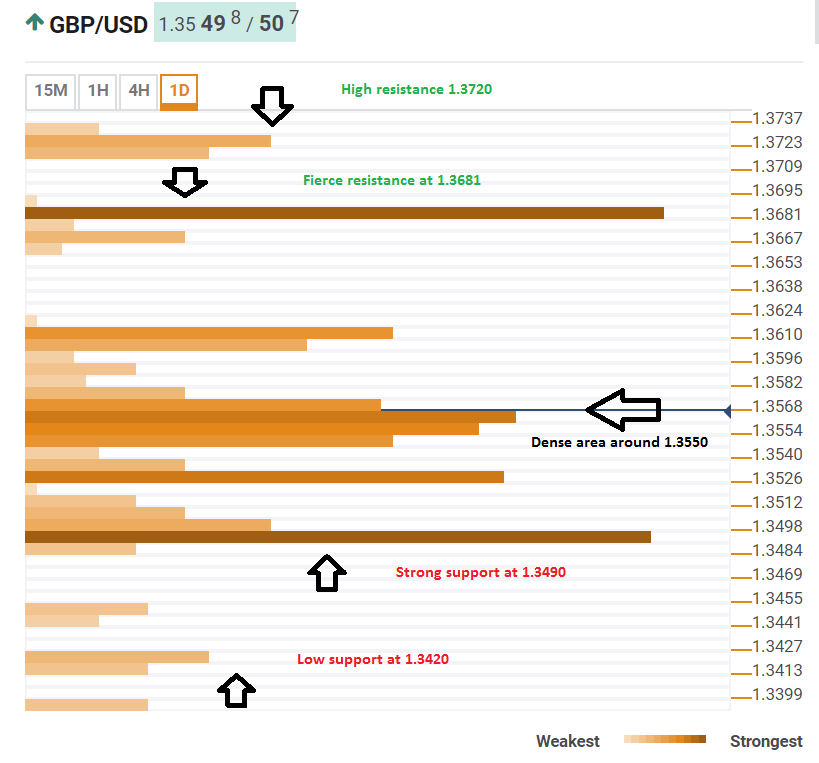
GBP USD technical confluence May 10 2018

Confluence Detector

The Confluence Detector finds exciting opportunities using Technical Confluences. The TC is a tool to locate and point out those price levels where there is a congestion of indicators, moving averages, Fibonacci levels, Pivot Points, etc. Knowing where these congestion points are located is very useful for the trader, and can be used as a basis for different strategies.

This tool assigns a certain amount of “weight” to each indicator, and this “weight” can influence adjacents price levels. This means that one price level without any indicator or moving average but under the influence of two “strongly weighted” levels accumulate more resistance than their neighbors. In these cases, the tool signals resistance in apparently empty areas.

Learn more about Technical Confluence

Author

Yohay Elam

Yohay Elam

FXStreet

Yohay is in Forex since 2008 when he founded Forex Crunch, a blog crafted in his free time that turned into a fully-fledged currency website later sold to Finixio.


More from Yohay Elam
Share:

Editor's Picks

AUD/USD sits at two-month lows near 0.6950 after Australian CPI data

AUD/USD is sitting at two-month lows near 0.6950 in the Asian session on Wednesday, as below-expectations August Australian underlying CPI data pours cold water on expectations for further RBA interest rate hikes. Chinese PMI data also fail to inspire the Australian Dollar, despite a pause in the US Dollar advance.

USD/JPY stays weak below 157.00 amid Japanese intervention risks

USD/JPY keeps losses below 157.00 in the Asian session on Wednesday, as hawkish BoJ expectations, along with intervention risks, underpin the Japanese Yen, countering dismal domestic factory output and retail sales data. Meanwhile, a broad US Dollar retreat also collaborates to the pair's downside.

Gold eyes US PCE inflation data for next move

Gold is consolidating the previous rebound from an eight-week low of $4,110 in Asia on Wednesday, although it remains below $4,200 ahead of the US ADP jobs report and core Personal Consumption Expenditures Price Index data.   


Aave Price consolidates below $161 as profit-taking emerges after 10% surge

Aave slips below $161 on Wednesday after surging more than 10% the previous day, with on-chain data suggesting increased profit-taking. Meanwhile, Aave founder Stani Kulechov is considering an AAVE token-burn mechanism under Aavenomics 3.0, adding a potential catalyst for AAVE.

Warning: The RBI's October rate hike may be too late as oil risks mount
The Indian Rupee (INR) is one of the worst-performing Asian currencies in 2026, down about 6.5% year-to-date against the US Dollar (USD) and trading near historic lows ahead of the October 5–7 Reserve Bank of India (RBI) meeting. Economists expect the RBI to raise its repo rate by 25 basis points (bps) next month and follow up with another increase in December to counter rising retail inflation.
Silver is more volatile than Gold ahead of PCE and NFP. This chart shows the positioning gap
The market’s attention is focused on American data this week, but there’s something only those with a trained eye may be looking at: Gold and Silver positioning gap. Financial markets are moving on fears, mostly related to persistently high energy prices driven by the Middle East war. Sure, the US Dollar (USD) is strong, but at what cost?