GBP/USD growth driven by weakening US Dollar

On Wednesday, GBP/USD remained stable at 1.3436. The British pound was supported by a sell-off in the US dollar following increased trade tensions between the US and Europe over Greenland.
US President Donald Trump has threatened to impose tariffs on imports from the UK, Denmark, Norway, Finland, France, Germany, and the Netherlands if these countries do not agree to transfer control of Greenland to the US. In response, investors began pulling back from American assets, including the dollar, and reallocating funds into European currencies and gold.
While recent UK labour market data showed weakness, with unemployment rates near five-year highs and the largest drop in payrolls since November 2020, there are some positive developments. These include a reduction in layoffs, stabilisation in job vacancies and unemployment, and a slowdown in wage growth that aligns with the Bank of England’s inflation target.
This backdrop sets the stage for further interest rate cuts by the Bank of England. The central bank’s baseline scenario suggests a final reduction to 3.50% in April, with market expectations for one more cut by mid-year and a 60% probability of a second cut by December.
Technical analysis
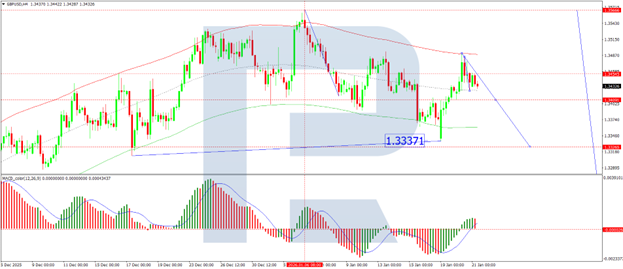
On the H4 GBP/USD chart, the market is forming a broad consolidation range around the 1.3455 level. Today, we expect the range to extend to 1.3395. A correction to 1.3450 is likely, followed by a continuation of the downward trend toward 1.3326, with a potential drop to 1.3220. This scenario is supported by the MACD indicator, with its signal line above zero and pointing downward.
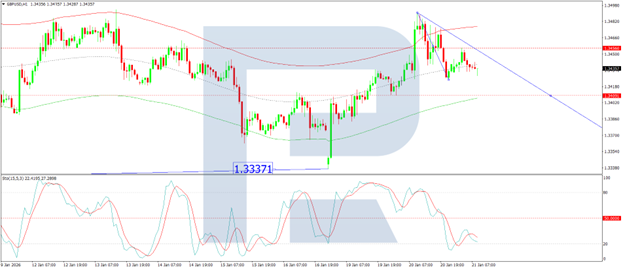
On the H1 chart, the market is consolidating around 1.3450, with a potential decline towards 1.3400. If this level breaks, the downward trend could extend to 1.3326. The Stochastic oscillator confirms this bearish outlook, as its signal line remains below the 50 level and continues pointing downward.
Conclusion
GBP/USD growth is closely linked to the weakening US dollar, primarily driven by geopolitical tensions and shifting market sentiment. The UK’s labour market data and the BoE’s expected rate cuts further support the pound’s position. Technically, GBPUSD may continue its downward correction in the near term, with key support levels at 1.3395 and 1.3326.
Author

RoboForex Analysis Department
RoboForex
RoboForex Analysis Department provides timely market insights, expert technical analysis, and actionable forecasts across forex, commodities, indices, and equities.














