GBP/USD Forecast: Pound Sterling turns bearish despite big BoE hike
- GBP/USD fell to a fresh weekly low below 1.2700 on Friday.
- BoE raised its policy rate by 50 basis points to 5%.
- The technical picture points to a bearish shift in the short term.

After having spiked above 1.2800 with the knee-jerk reaction to the Bank of England's (BoE) policy announcements, GPB/USD reversed its direction and closed in negative territory on Thursday. The pair stays on the back foot and trades below 1.2700 early Friday, its lowest level in a week.
The BoE raised its policy rate by 50 basis points (bps) to 5% following the June policy meeting. Although markets were expecting a 25 bps hike, many experts noted that Wednesday's strong inflation data could pave the way for a 50 bps increase in rates. Hence, the market reaction to the rate decision remained short-lived.
Additionally, the BoE reiterated in its policy statement that inflation was still expected to fall significantly this year. "The BoE seems to be chasing inflation developments rather than fighting them with an active monetary policy, which is damaging for Sterling," said Commerzbank analysts in a research note. "As we do not believe that the BoE will suddenly take a different approach, we remain sceptical for Sterling."
Moreover, data from the UK highlighted a loss of momentum in the private sector's business activity growth in early June. S&P Global/CIPS Composite PMI declined to 52.8 from 54 in May.
Meanwhile, the risk-averse environment, as reflected by falling US stock index futures, allows the US Dollar to find demand.
Uninspiring PMI data from the UK, combined with the broad-based USD strength, could continue to weigh on GBP/USD heading into the weekend, especially if Wall Street's main indexes stretch lower after the opening bell.
The US economic docket will feature S&P Global Manufacturing and Services PMI surveys on Friday. Following FOMC Chairman Jerome Powell's two-day congressional testimony, markets are pricing in a nearly 80% probability of a 25 bps rate hike in July. These reports are unlikely to influence the market pricing of the Fed's rate outlook, leaving the risk perception as the primary driver of the pair's action in the American session.
GBP/USD Technical Analysis
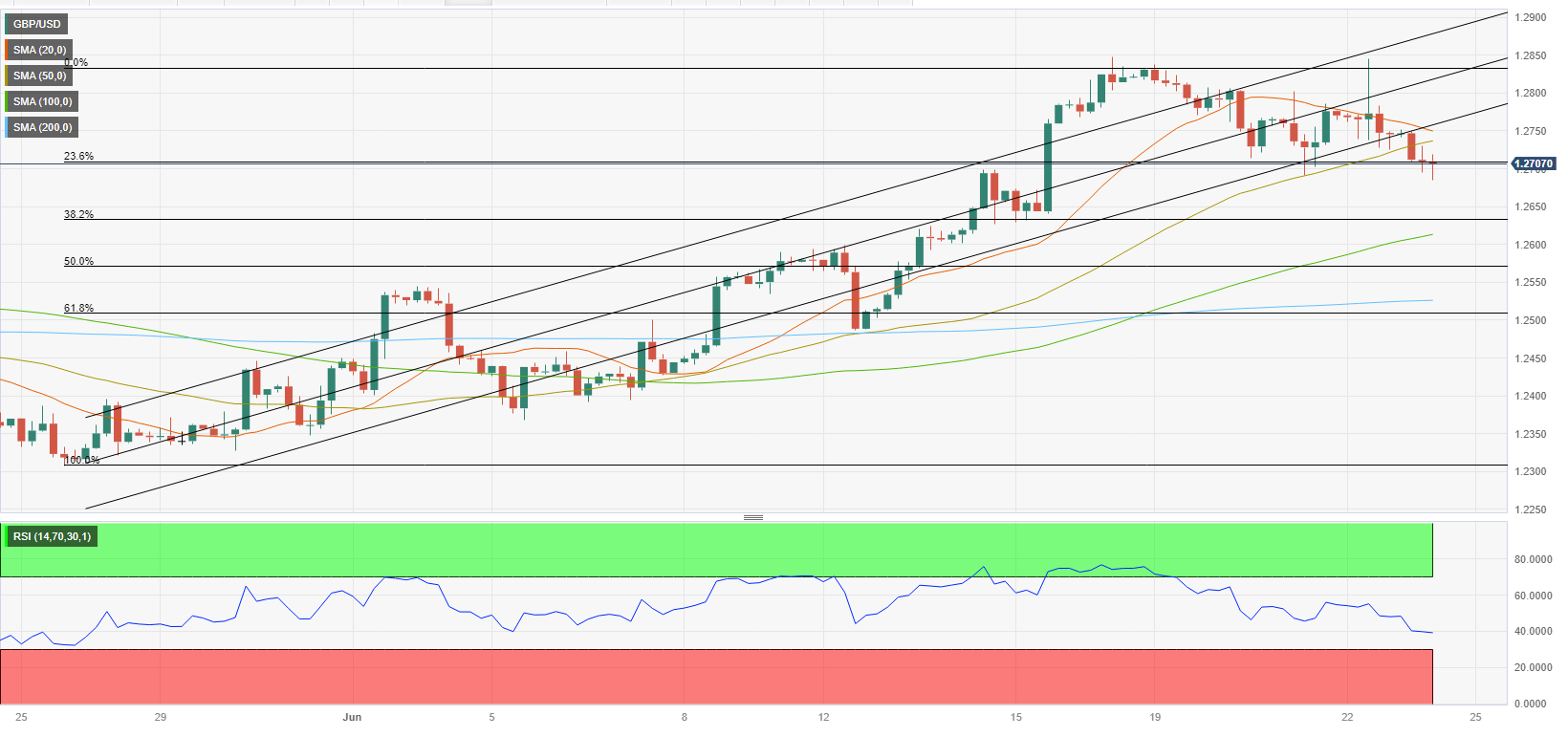
GBP/USD broke below the ascending regression channel and closed the last two 4-hour candles below the 20-period and the 50-period Simple Moving Averages (SMA). Additionally, the Relative Strength Index (RSI) indicator dropped below 50, confirming the bearish tilt in the short-term outlook.
GBP/USD was last seen trading near 1.2700, where the Fibonacci 23.6% retracement of the latest uptrend is located. Once that level is confirmed as support, next bearish targets could be seen at 1.2640 (Fibonacci 38.2% retracement) and 1.2600/1.2610 (psychological level, 100-period SMA).
On the upside, 1.2750 (lower-limit of the ascending channel, 20-period SMA, 50-period SMA) aligns as key resistance. If GBP/USD reclaims that level and returns with the ascending channel, it could rise toward 1.2800 (mid-point of the ascending channel) and 1.2850 (end-point of the uptrend, 14-month high).
Author

Eren Sengezer
FXStreet
As an economist at heart, Eren Sengezer specializes in the assessment of the short-term and long-term impacts of macroeconomic data, central bank policies and political developments on financial assets.