GBP/USD Forecast: Pound Sterling recovery seems brittle as gilt yields edge higher
- GBP/USD recovers above 1.3400 after dropping to its weakest level in nearly a month.
- Long-dated UK gilt yields remain near multi-decade highs.
- Key resistance area for GBP/USD aligns at 1.3440-1.3460.

After falling more than 1% and registering its biggest one-day loss since April on Tuesday, GBP/USD touched its lowest level since early August at 1.3333 in the Asian session on Wednesday. Although the pair recovered above 1.3400 in the European trading hours, investors could refrain from betting on an extended rebound.
Pound Sterling Price This week
The table below shows the percentage change of British Pound (GBP) against listed major currencies this week. British Pound was the weakest against the US Dollar.
| USD | EUR | GBP | JPY | CAD | AUD | NZD | CHF | |
|---|---|---|---|---|---|---|---|---|
| USD | 0.35% | 0.68% | 1.02% | 0.45% | 0.21% | 0.44% | 0.51% | |
| EUR | -0.35% | 0.32% | 0.61% | 0.10% | -0.14% | 0.09% | 0.15% | |
| GBP | -0.68% | -0.32% | 0.18% | -0.22% | -0.45% | -0.23% | -0.12% | |
| JPY | -1.02% | -0.61% | -0.18% | -0.50% | -0.80% | -0.55% | -0.49% | |
| CAD | -0.45% | -0.10% | 0.22% | 0.50% | -0.23% | -0.01% | 0.10% | |
| AUD | -0.21% | 0.14% | 0.45% | 0.80% | 0.23% | 0.23% | 0.35% | |
| NZD | -0.44% | -0.09% | 0.23% | 0.55% | 0.00% | -0.23% | 0.11% | |
| CHF | -0.51% | -0.15% | 0.12% | 0.49% | -0.10% | -0.35% | -0.11% |
The heat map shows percentage changes of major currencies against each other. The base currency is picked from the left column, while the quote currency is picked from the top row. For example, if you pick the British Pound from the left column and move along the horizontal line to the US Dollar, the percentage change displayed in the box will represent GBP (base)/USD (quote).
Growing concerns over the global fiscal health lifted borrowing costs of long-dated government bonds of major economies on Tuesday, opening the door for a flight to safety. Following Tuesday's sharp increase, the yield on the 30-year UK gilt touched its highest level since 1998 at 5.75% early Wednesday before retreating. In turn, Pound Sterling found support and managed to erase its daily losses.
Reporting on the matter, "in Britain, Prime Minister Keir Starmer's reshuffle of his top team of advisers on Monday renewed focus on fiscal challenges given the UK's high levels of borrowing and slow growth," Reuters reported. "A budget is due later in the year, prompting weeks of speculation about tax rises that could dampen the economy."
In the second half of the day, the US Bureau of Labor Statistics will release the JOLTS Job Openings data for July. Markets expect the number of job openings to decline slightly to 7.4 million. A noticeable increase, with a print above 7.7 million, could boost the USD and weigh on GBP/USD. On the flip side, a disappointing reading close to 7 million is likely to have the opposite impact on the pair's action. Nevertheless, investors could remain reluctant to bet on a steady recovery in Pound Sterling unless there is a sharp downward correction in long-dated gilt yields.
GBP/USD Technical Analysis
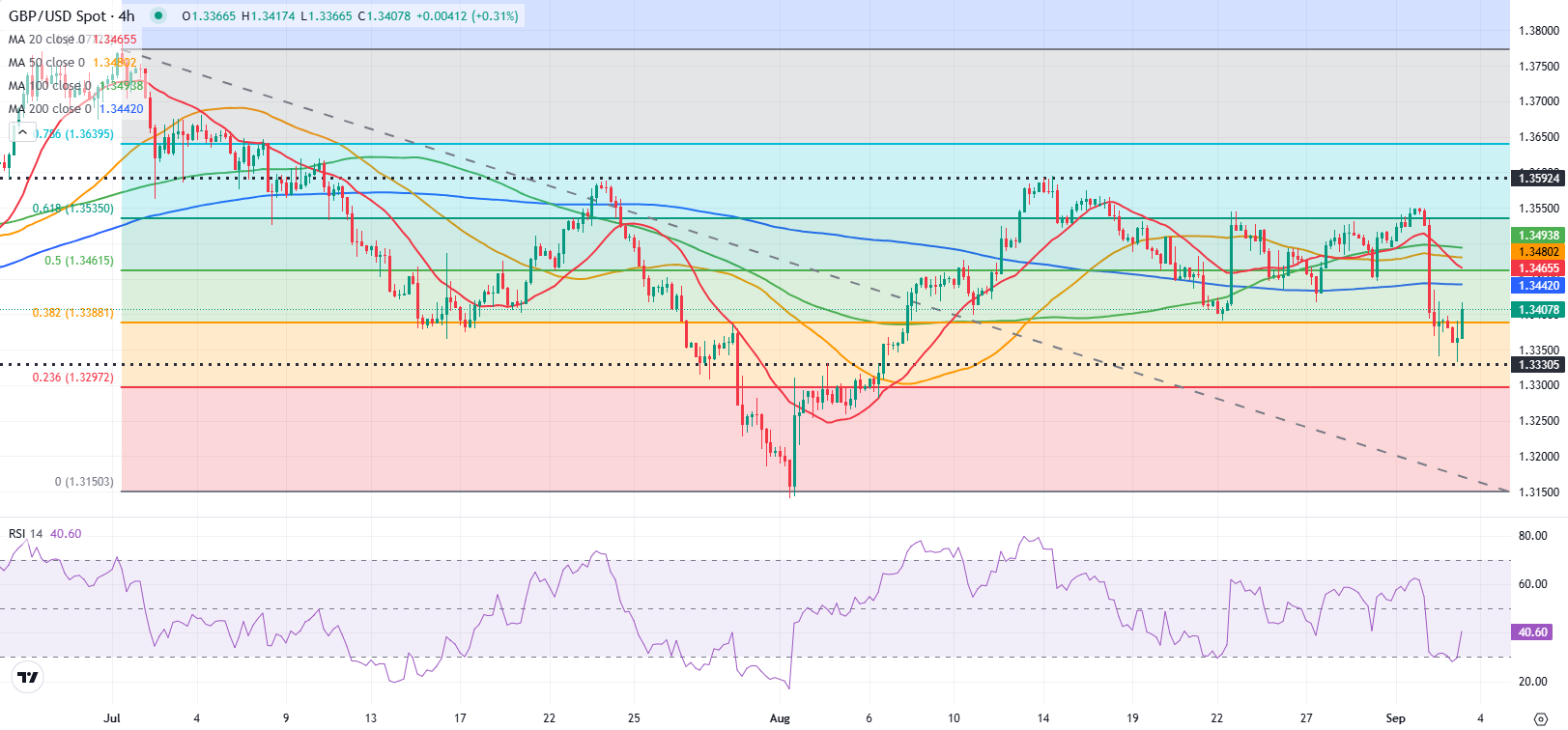
The Relative Strength Index (RSI) indicator on the 4-hour chart stays near 40 and GBP/USD continues to trade well below the 200-period Simple Moving Average (SMA), suggesting that the bearish bias remains intact despite the latest recovery attempt.
On the upside, GBP/USD faces a critical resistance area at 1.3440-1.3460, where the 200-period SMA, Fibonacci 50% retracement of the latest downtrend and the 100-day SMA are located. While this resistance area stays intact, buyers are likely to remain on the sidelines. On the downside, 1.3330 (static level) could be seen as the next support level before 1.3300 (Fibonacci 23.6% retracement).
If GBP/USD manages to clear 1.3440-1.3460, next resistance levels could be spotted at 1.3490-1.3500 (round level, 100-period SMA) and 1.3535 (Fibonacci 61.8% retracement).
UK gilt yields FAQs
UK Gilt Yields measure the annual return an investor can expect from holding UK government bonds, or Gilts. Like other bonds, Gilts pay interest to holders at regular intervals, the ‘coupon’, followed by the full value of the bond at maturity. The coupon is fixed but the Yield varies as it takes into account changes in the bond's price. For example, a Gilt worth 100 Pounds Sterling might have a coupon of 5.0%. If the Gilt's price were to fall to 98 Pounds, the coupon would still be 5.0%, but the Gilt Yield would rise to 5.102% to reflect the decline in price.
Many factors influence Gilt yields, but the main ones are interest rates, the strength of the British economy, the liquidity of the bond market and the value of the Pound Sterling. Rising inflation will generally weaken Gilt prices and lead to higher Gilt yields because Gilts are long-term investments susceptible to inflation, which erodes their value. Higher interest rates impact existing Gilt yields because newly-issued Gilts will carry a higher, more attractive coupon. Liquidity can be a risk when there is a lack of buyers or sellers due to panic or preference for riskier assets.
Probably the most important factor influencing the level of Gilt yields is interest rates. These are set by the Bank of England (BoE) to ensure price stability. Higher interest rates will raise yields and lower the price of Gilts because new Gilts issued will bear a higher, more attractive coupon, reducing demand for older Gilts, which will see a corresponding decline in price.
Inflation is a key factor affecting Gilt yields as it impacts the value of the principal received by the holder at the end of the term, as well as the relative value of the repayments. Higher inflation deteriorates the value of Gilts over time, reflected in a higher yield (lower price). The opposite is true of lower inflation. In rare cases of deflation, a Gilt may rise in price – represented by a negative yield.
Foreign holders of Gilts are exposed to exchange-rate risk since Gilts are denominated in Pound Sterling. If the currency strengthens investors will realize a higher return and vice versa if it weakens. In addition, Gilt yields are highly correlated to the Pound Sterling. This is because yields are a reflection of interest rates and interest rate expectations, a key driver of Pound Sterling. Higher interest rates, raise the coupon on newly-issued Gilts, attracting more global investors. Since they are priced in Pounds, this increases demand for Pound Sterling.
Author

Eren Sengezer
FXStreet
As an economist at heart, Eren Sengezer specializes in the assessment of the short-term and long-term impacts of macroeconomic data, central bank policies and political developments on financial assets.














