GBP/USD Forecast: Pound Sterling could extend uptrend on hawkish BoE
- GBP/USD trades below 1.2500 after posting gains on Wednesday.
- The Bank of England is forecast to lower the policy rate by 25 basis points.
- Pound Sterling could gather strength in case the vote-split shows that the rate cut was a close call.

After posting gains for three consecutive days, GBP/USD corrects lower on Thursday and trades near 1.2450 as investors gear for the Bank of England's (BoE) monetary policy announcements.
British Pound PRICE Today
The table below shows the percentage change of British Pound (GBP) against listed major currencies today. British Pound was the weakest against the Japanese Yen.
| USD | EUR | GBP | JPY | CAD | AUD | NZD | CHF | |
|---|---|---|---|---|---|---|---|---|
| USD | 0.38% | 0.40% | -0.08% | 0.31% | 0.42% | 0.55% | 0.31% | |
| EUR | -0.38% | 0.02% | -0.44% | -0.08% | 0.03% | 0.16% | -0.10% | |
| GBP | -0.40% | -0.02% | -0.49% | -0.10% | 0.01% | 0.14% | -0.10% | |
| JPY | 0.08% | 0.44% | 0.49% | 0.38% | 0.49% | 0.58% | 0.38% | |
| CAD | -0.31% | 0.08% | 0.10% | -0.38% | 0.12% | 0.24% | 0.00% | |
| AUD | -0.42% | -0.03% | -0.01% | -0.49% | -0.12% | 0.13% | -0.14% | |
| NZD | -0.55% | -0.16% | -0.14% | -0.58% | -0.24% | -0.13% | -0.24% | |
| CHF | -0.31% | 0.10% | 0.10% | -0.38% | -0.00% | 0.14% | 0.24% |
The heat map shows percentage changes of major currencies against each other. The base currency is picked from the left column, while the quote currency is picked from the top row. For example, if you pick the British Pound from the left column and move along the horizontal line to the US Dollar, the percentage change displayed in the box will represent GBP (base)/USD (quote).
On Wednesday, the disappointing ISM Services PMI data made it difficult for the US Dollar (USD) to find demand. Additionally, the bullish action seen in US stocks put additional weight on the currency's shoulders, allowing GBP/USD to hold its ground.
The BoE is forecast to lower the policy rate by 25 basis points (bps) to 4.5% after the February meeting. Investors expect the vote split to be 8 against 1, in favor of the rate cut. If the policy statement shows that the decision to lower the policy rate was a close call, with at least 3 members of the Monetary Policy Committee preferring to hold the policy rate steady, the immediate reaction could boost Pound Sterling.
Investors will also pay close attention to comments from Governor Andrew Bailey. In case Bailey adopts a cautious tone in regard to further policy easing, citing uncertainty surrounding the inflation outlook, GBP/USD could hold its ground. On the flip side, the pair could extend its slide if Bailey leaves the door open to additional rate cuts in the first half of this year.
GBP/USD Technical Analysis
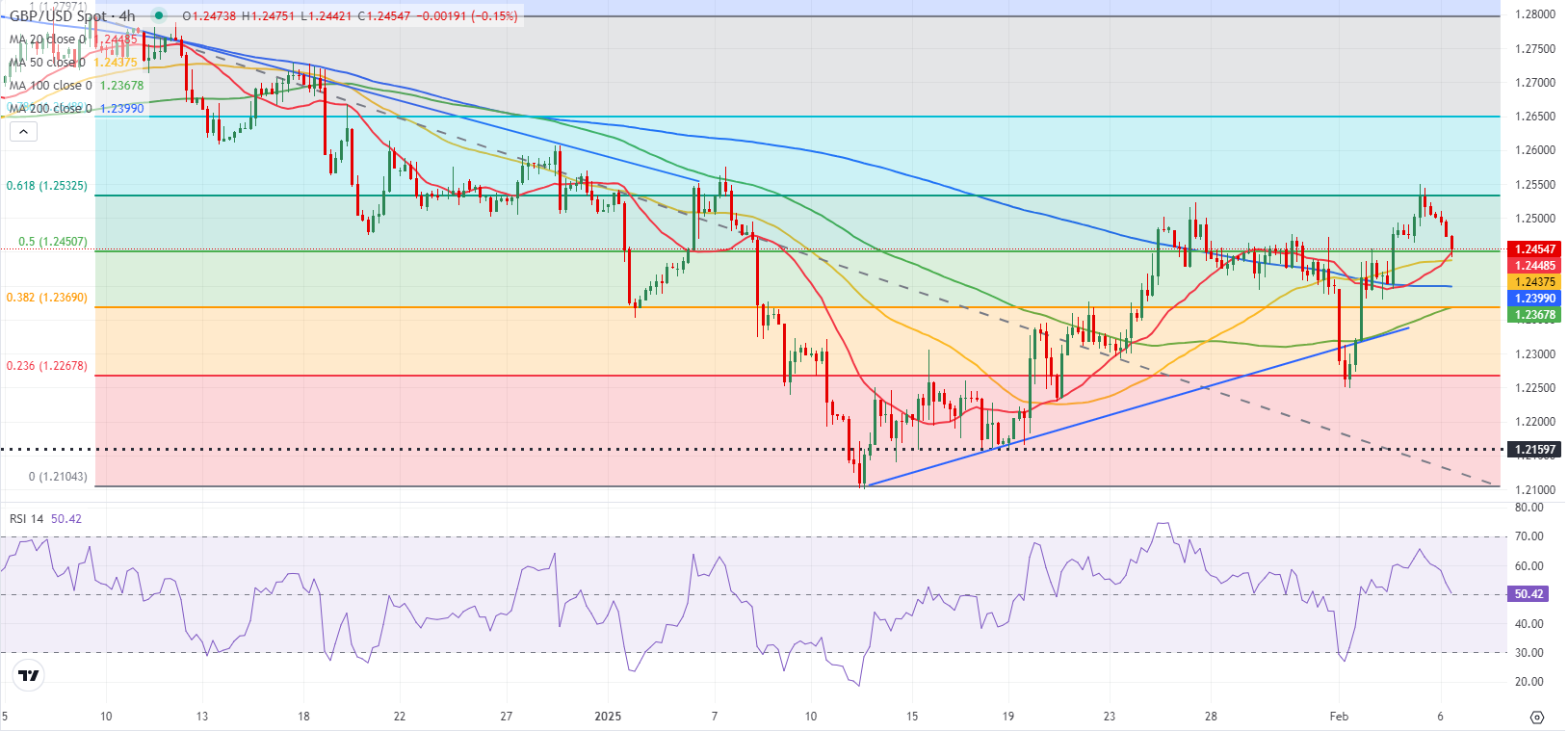
The Relative Strength Index (RSI) indicator on the four-hour chart declined slightly below 50, reflecting a loss of bullish momentum. GBP/USD was last seen trading near 1.2450 (Fibonacci 50% retracement of the latest downtrend). If GBP/USD falls below this level and starts using it as resistance, the 200-period Simple Moving Average (SMA) could act as next support at 1.2400 before 1.2370 (Fibonacci 38.2% retracement).
On the upside, 1.2500 (static level, round level) could be seen as interim resistance before 1.2530 (Fibonacci 61.8% retracement) and 1.2600 (static level, round level).
BoE FAQs
The Bank of England (BoE) decides monetary policy for the United Kingdom. Its primary goal is to achieve ‘price stability’, or a steady inflation rate of 2%. Its tool for achieving this is via the adjustment of base lending rates. The BoE sets the rate at which it lends to commercial banks and banks lend to each other, determining the level of interest rates in the economy overall. This also impacts the value of the Pound Sterling (GBP).
When inflation is above the Bank of England’s target it responds by raising interest rates, making it more expensive for people and businesses to access credit. This is positive for the Pound Sterling because higher interest rates make the UK a more attractive place for global investors to park their money. When inflation falls below target, it is a sign economic growth is slowing, and the BoE will consider lowering interest rates to cheapen credit in the hope businesses will borrow to invest in growth-generating projects – a negative for the Pound Sterling.
In extreme situations, the Bank of England can enact a policy called Quantitative Easing (QE). QE is the process by which the BoE substantially increases the flow of credit in a stuck financial system. QE is a last resort policy when lowering interest rates will not achieve the necessary result. The process of QE involves the BoE printing money to buy assets – usually government or AAA-rated corporate bonds – from banks and other financial institutions. QE usually results in a weaker Pound Sterling.
Quantitative tightening (QT) is the reverse of QE, enacted when the economy is strengthening and inflation starts rising. Whilst in QE the Bank of England (BoE) purchases government and corporate bonds from financial institutions to encourage them to lend; in QT, the BoE stops buying more bonds, and stops reinvesting the principal maturing on the bonds it already holds. It is usually positive for the Pound Sterling.
Premium
You have reached your limit of 3 free articles for this month.
Start your subscription and get access to all our original articles.
Author

Eren Sengezer
FXStreet
As an economist at heart, Eren Sengezer specializes in the assessment of the short-term and long-term impacts of macroeconomic data, central bank policies and political developments on financial assets.