GBP/USD Forecast: Pound Sterling could extend correction toward 1.2500
- GBP/USD has reversed its direction following Friday's upsurge.
- Key near-term support for Pound Sterling is located at 1.2500.
- Investors could refrain from making large bets ahead of this week's key events.

GBP/USD has started the new week under bearish pressure and declined below 1.2550 after having touched its highest level in nearly a year 1.2584 on Friday. 1.2500 aligns as the next key support for the pair but market participants could opt to remain on the sidelines ahead of the Federal Reserve's policy announcements on Wednesday.
In the absence of high-impact fundamental drivers, GBP/USD has capitalized on month-end flows and registered impressive gains ahead of the weekend. Early Monday, the US Dollar stays resilient against its rivals support by recovering US Treasury bond yields.
Earlier in the session, the California Department of Financial Protection and Innovation (DFPI) announced that it had closed First Republic Bank and approved a deal to sell its assets to JPMorgan Chase & Co. This development seems to be helping the US yields edge higher. In case Wall Street's main indexes open in positive territory, the USD could find it difficult to gather strength and help GBP/USD limit its losses.
In the meantime, the ISM Manufacturing PMI, which is forecast to improve slightly to 46.6 in April 46.3 in March, will be featured in the US economic docket. Following last week's disappointing first-quarter Gross Domestic Product (GDP) growth data from the US, a weak PMI print could hurt the USD and vice versa. As mentioned at the beginning of the article, however, the market reaction should remain short-lived.
It's also worth noting that trading conditions are likely to remain thin in the first half of the day due to the Labor Day holiday in Europe.
GBP/USD Technical Analysis
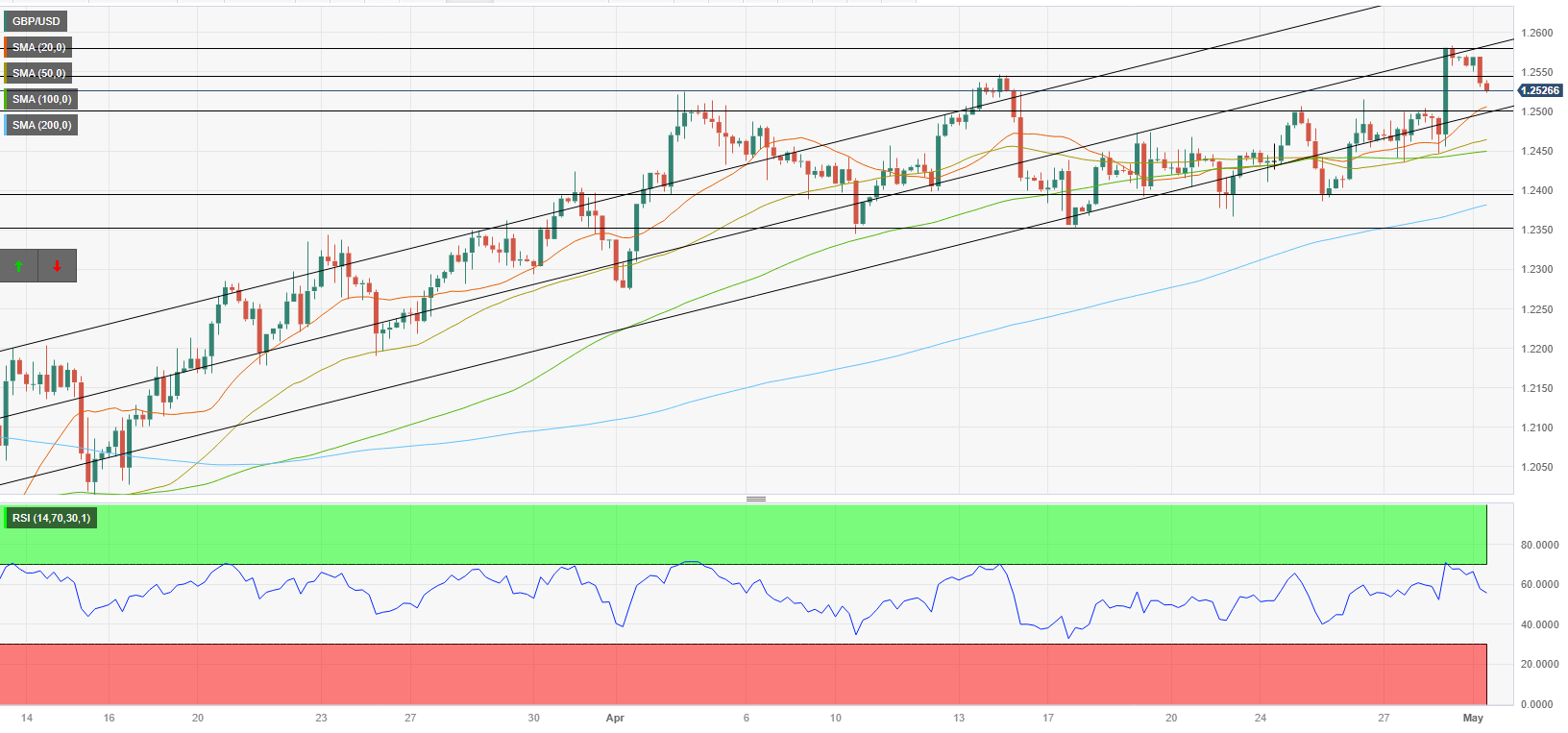
GBP/USD has reversed its direction after having met resistance near 1.2600, where the mid-point of the long-term ascending regression channel is located. The lower limit of this channel aligns at 1.2500 and this level is reinforced by the 20-period Simple Moving Average (SMA) on the four-hour chart.
In case the pair makes a four-hour close below 1.2500, additional losses toward 1.2450 (100-period SMA; 50-period SMA) and 1.2400 (static level, psychological level, 200-period SMA) could be witnessed.
On the upside, 1.2550 (static level) aligns as interim resistance before 1.2585/1.2600 (multi-month high, psychological level).
Author

Eren Sengezer
FXStreet
As an economist at heart, Eren Sengezer specializes in the assessment of the short-term and long-term impacts of macroeconomic data, central bank policies and political developments on financial assets.
















