GBP/USD Forecast: Pound Sterling could extend correction once below 1.2350
- GBP/USD has turned south after having climbed above 1.2400 on Thursday.
- PCE inflation data from the US and month-end flows could ramp up market volatility.
- The pair could turn bearish if it breaks below 1.2350.

After having touched its highest level since late January at 1.2423 in the Asian session on Friday, GBP/USD has reversed its direction and declined below 1.2400. The pair closes in on key support level that aligns at 1.2350. The Personal Consumption Expenditures (PCE) Price Index data from the US will be watched closely by market participants. It's also worth noting that the market volatility is likely to pick up later in the day amid month and quarter-end flows.
Earlier in the day, the data published by the UK's Office for National Statistics revealed that the UK Gross Domestic Product (GDP) expanded at an annualized rate of 0.6% in the fourth-quarter. This reading followed the 0.4% growth recorded in the third quarter and came in better than the market expectation of 0.4%. Nevertheless, Pound Sterling failed to capitalize on the upbeat UK GDP data.
Meanwhile, the UK's FTSE 100 Index opened flat after having closed the first four trading days of the week in positive territory. Moreover, US stock index futures also stay virtually unchanged on the day, pointing to a cautious market stance.
The Core PCE inflation, the Fed's preferred gauge of inflation, is forecast to hold steady at 4.7% on a yearly basis in February. On a monthly basis, the Core PCE Price Index is expected to come in at 0.4% following January's 0.6% increase.
At the moment, the CME Group FedWatch Tool shows that markets are still indecisive about the US Federal Reserve's next rate decision. A stronger-than-expected monthly Core PCE inflation, at 0.6% or higher, could bring back hawkish Fed bets and cause GBP/USD to extend its daily correction and vice versa.
GBP/USD Technical Analysis
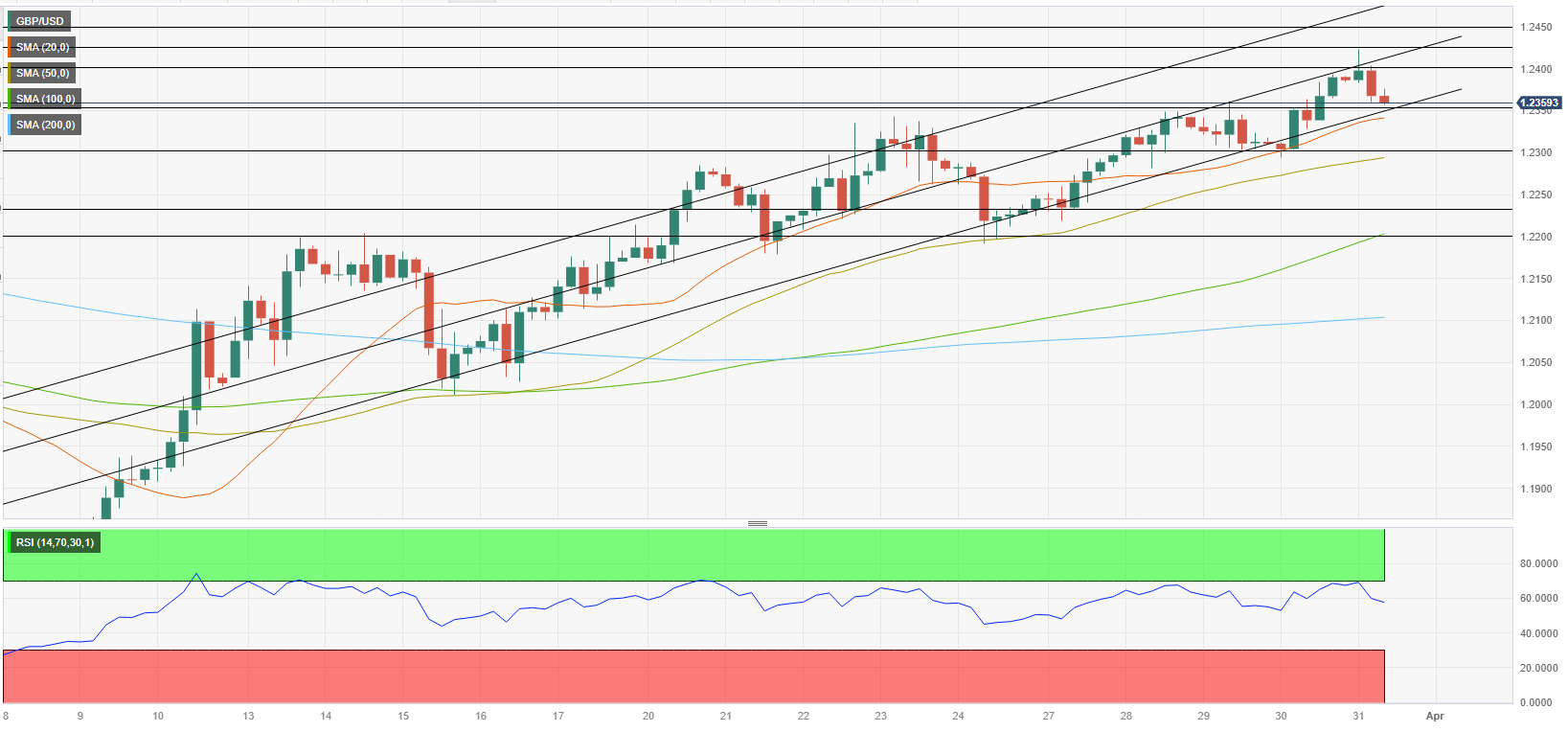
The lower limit of the ascending regression channel forms key support at 1.2350. This level is also reinforced by the 20-period Simple Moving Average (SMA) on the four-hour chart. If GBP/USD falls below that level and starts using it as resistance, it could continue to push lower toward 1.2300 (50-period SMA, psychological level) and 1.2230 (static level).
If 1.2350 stays intact, buyers could remain interested. In that scenario, resistances are located at 1.2400 (mid-point of the ascending channel), 1.2420 (multi-month high set on Friday) and 1.2450 (December 22 high).
Author

Eren Sengezer
FXStreet
As an economist at heart, Eren Sengezer specializes in the assessment of the short-term and long-term impacts of macroeconomic data, central bank policies and political developments on financial assets.