|

GBP/USD Forecast: Holding above 1.3100 but lacking strength

GBP/USD Current Price: 1.3103

  • Brexit is happening, market waiting for clues on future UK-EU relationship.
  • UK preliminary January Markit PMI seen improving modestly from December figures.
  • GBP/USD meeting sellers around 1.3150 a critical Fibonacci resistance level.
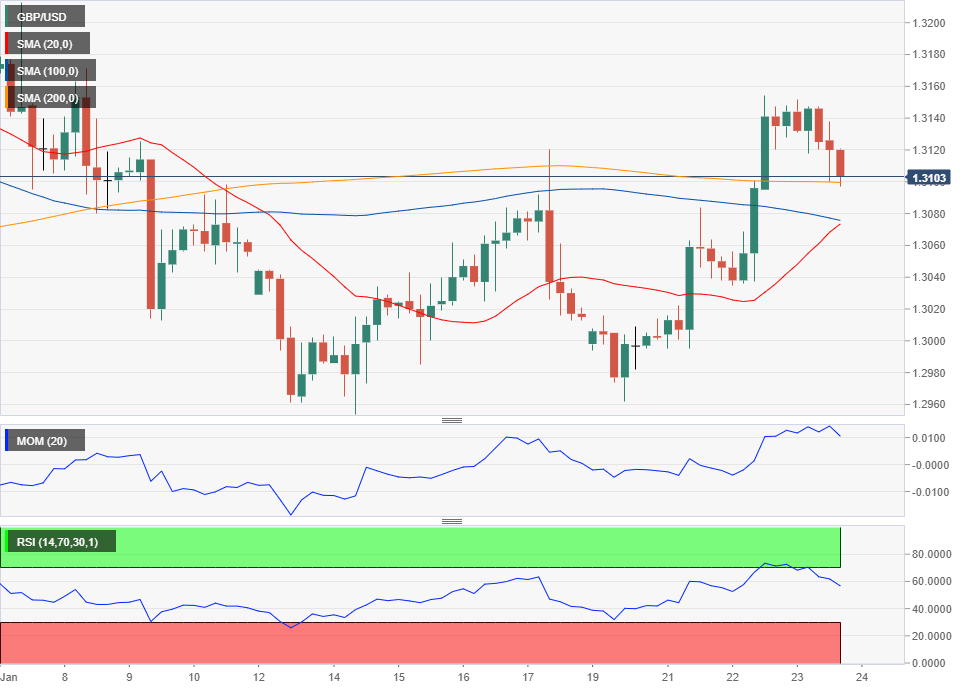
The GBP/USD pair ended the day with modest losses, settling around the 1.3100 figure. The UK didn’t release macroeconomic data, with the market’s focus now on the BOE’s meeting next week, amid increased odds for a rate cut.  In the Brexit front, the UK has finally passed the legislation needed to make it happen. The upcoming week, the European Parliament is expected to give its approval. Market concerns are now on whether the UK and the EU can get to an agreement on their future relationship before the year-end. EU Economic Commissioner, Paolo Gentiloni, said that the EU is ready to seal a deal, as long as there’s a levelled playing field.

This Friday, Markit will release the preliminary estimate of the January Manufacturing PMI, foreseen at 48.9 from the previous 47.5 and the Services PMI for the same period, expected at 51 from 50 in December.

GBP/USD short-term technical outlook

The GBP/USD pair failed to extend gains beyond the 38.2% retracement of its late December slump at around 1.3150, where the pair topped this week. The 4-hour chart shows multiple failed attempts around the Fibonacci resistance, although it also shows that the pair is still developing above all of its moving averages. These lasts, however, are confined to a tight range, reflecting the absence of a clear trend. Technical indicators eased, but hold within positive levels, suggesting limited selling interest at the time being.

Support levels: 1.3080 1.3040 1.3000

Resistance levels: 1.3150 1.3185 1.3215   

View Live Chart for the GBP/USD

Author

Valeria Bednarik

Valeria Bednarik was born and lives in Buenos Aires, Argentina. Her passion for math and numbers pushed her into studying economics in her younger years.


More from Valeria Bednarik
Share:

Editor's Picks

AUD/USD keeps the red near 0.6950 after weak Aussie jobs data

AUD/USD holds losses near 0.6950 on disappointing Australian jobs data, extending the previous day's retracement slide from the monthly high and hitting a fresh weekly low during Thursday’s Asian session. Meanwhile, declining US bond yields drag the US Dollar away from the April 2025 high, touched after Wednesday's hot US CPI, helping limit losses for the currency pair.

USD/JPY slides back below 158.00 as USD reverses post-CPI gains

USD/JPY extends the previous day's pullback from a three-week high, attracting follow-through selling and sliding below 158.00 during Thursday's Asian session. Traders remain on high alert amid speculation that authorities will step in to prop up the Japanese Yen. The US Dollar, meanwhile, reverses Wednesday's hot CPI-led gains to April 2025 highs as US bond yields retreat on China bond-buying talk, further pressuring the pair.

Gold pares intraday gains, trades below $4,150 as Fed hike bets cap upside

Gold struggles to capitalize on its strong Asian session move up on Thursday and currently trades below $4,150. The commodity, however, retains an intraday bullish bias, snapping a three-day losing streak to a one-week low, touched on Wednesday, amid a broadly weaker US Dollar (USD). 

Zcash declines as US inflation surprise offsets fresh ETF inflows
Zcash (ZEC) is trading in the red on Friday, extending its previous day’s roughly 6% losses as the broader cryptocurrency market falls on rising US inflation. The US Consumer Price Index (CPI) print came in higher than expected, at an annual increase of 3.7% versus the expected 3.6%, raising concerns about inflation and rate hikes.
China seems routing US Treasury holdings through Canada

According to a Bloomberg report, China seems to be moving United States securities to non-US custodian banks in other countries, masking its role in financing US deficits.

Has Bitcoin really escaped the macro forces it was built to fight?
Over 17 years ago, Satoshi Nakamoto designed Bitcoin (BTC) on the back of a global financial crisis as an alternative to the global monetary system outside the control of central banks, governments and traditional intermediaries. This raises a key question: has Bitcoin really become independent of the macroeconomic forces it was built to challenge?















