GBP/USD Forecast: Bulls try to keep Pound Sterling above key support
- GBP/USD has stabilized near 1.2500 following Monday's decline.
- A four-hour close below 1.2480 could open the door for additional losses.
- Investors could move to the sidelines ahead of Wednesday's key events.

GBP/USD seems to have stabilized at around 1.2500 early Tuesday after having stage a deep downward correction on Monday. The pair's near-term technical outlook fails to provide a directional clue but buyers could remain interested in Pound Sterling as long as 1.2480 support holds.
Following a quiet European session on Monday, the US Dollar (USD) gathered strength against its rivals as the US Treasury bond yields started to push higher ahead of this week's highly-anticipated Federal Reserve policy meeting. With the benchmark 10-year US T-bond yield rising more than 4% and reclaiming 3.5%, the US Dollar Index advanced to the 102.00 area.
Early Tuesday, markets stay relatively quiet and GBP/USD consolidates Monday's losses. The only data from the UK showed earlier in the day that the Nationwide Housing Prices rose by 0.5% on a monthly basis in April but failed to trigger a noticeable market reaction.
In the second half of the day, JOLTS Job Openings data for March will be featured in the US economic docket. In February, job openings declined to 9.9 million from 10.4 million in January and the USD weakened against its rivals. Hence, a similar market reaction could be expected. Investors, however, could refrain from making large bets ahead of the Fed's policy announcements.
In the meantime, US stock index futures trade virtually unchanged on the day, supporting the idea of further consolidation in the pair.
GBP/USD Technical Analysis
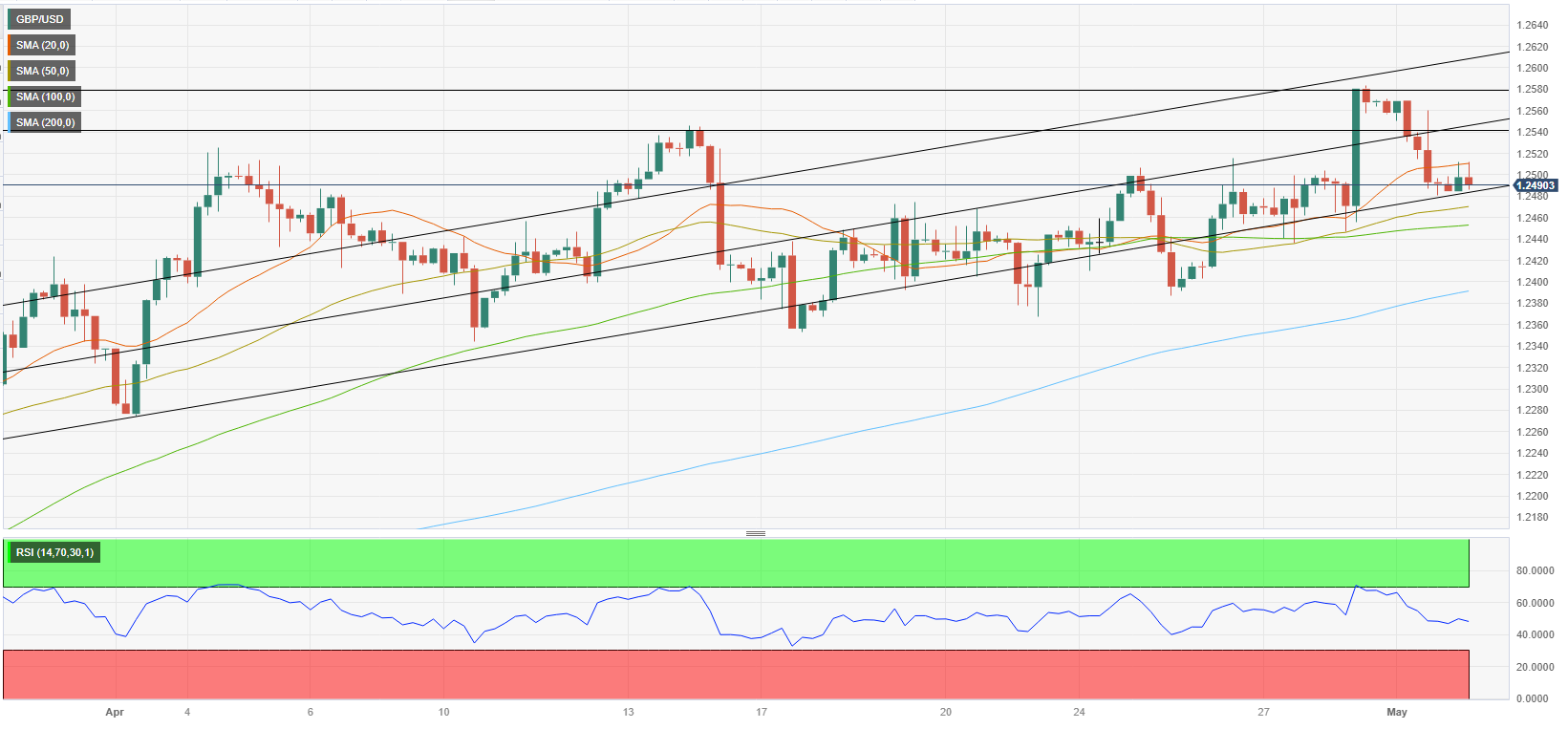
The lower limit of the long-term ascending regression channel forms key support level at 1.2480. If the pair makes a four-hour close below that level, it could extend its slide toward 1.2450 (100-period Simple Moving Average (SMA) on the four-hour chart) and 1.2400 (200-period SMA; static level, psychological level).
On the upside, GBP/USD could advance toward 1.2550 (mid-point of the ascending channel) and 1.2600 (psychological level, static level, upper limit of the ascending channel) if it manages to confirm 1.2500/1.2510 area (psychological level, 20-period SMA) as support.
Author

Eren Sengezer
FXStreet
As an economist at heart, Eren Sengezer specializes in the assessment of the short-term and long-term impacts of macroeconomic data, central bank policies and political developments on financial assets.