|

GBP/USD entrenched in a clear range ahead of the UK budget — Confluence Detector

The GBP/USD is consolidating the losses from the US Dollar storm last week. A new week begins with the UK budget standing out. The pair is trading in clear trading ranges.

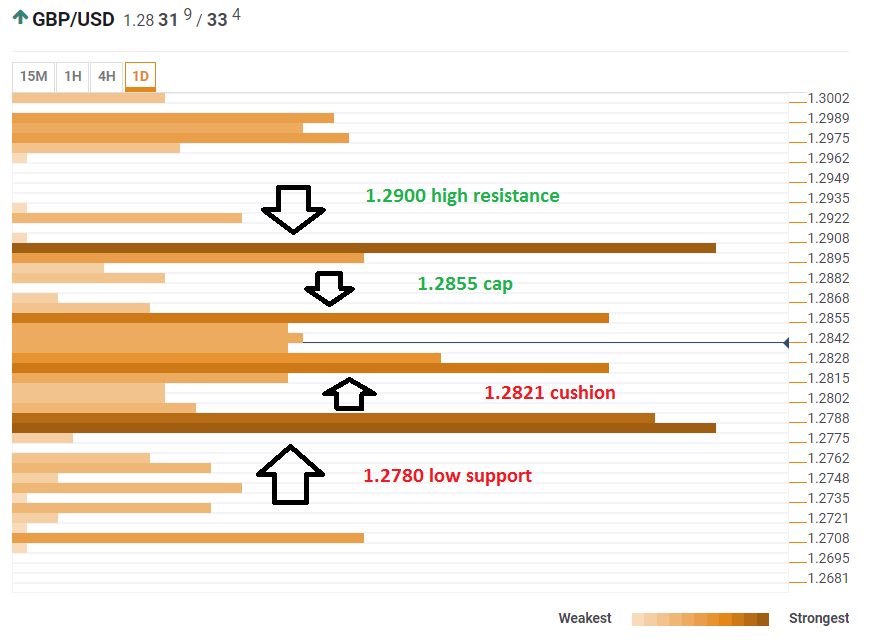
The Technical Confluences Indicator shows that the GBP-USD faces resistance around 1.2855, which is the convergence of the Fibonacci 23.6% one'week, the Bollinger Band one-hour Upper, and the Pivot Point one-day Resistance 1. 

The bottom end of the range is 1.2821 where we see the confluence of the Fibonacci 38.2% one-day, the Simple Moving Average 10-4h, the SMA 100-15m, the Bollinger Band 1h-Middle, and the Fibonacci 23.6% one-day.

Looking beyond this narrow range, substantial resistance awaits at 1.2900 where the Fibonacci 38.2% one-week coincides with the SMA 100-1h and the SMA 5-one day.

Lower support awaits at 1.2780 which is the previous day's low and the Pivot Point one-month Support 1.

The path of least resistance is to the downside.

This is how it looks on the tool:
gbp usd technical confluence October 29 2018

Confluence Detector

The Confluence Detector finds exciting opportunities using Technical Confluences. The TC is a tool to locate and point out those price levels where there is a congestion of indicators, moving averages, Fibonacci levels, Pivot Points, etc. Knowing where these congestion points are located is very useful for the trader, and can be used as a basis for different strategies.

This tool assigns a certain amount of “weight” to each indicator, and this “weight” can influence adjacents price levels. This means that one price level without any indicator or moving average but under the influence of two “strongly weighted” levels accumulate more resistance than their neighbors. In these cases, the tool signals resistance in apparently empty areas.

Learn more about Technical Confluence

Author

Yohay Elam

Yohay Elam

FXStreet

Yohay is in Forex since 2008 when he founded Forex Crunch, a blog crafted in his free time that turned into a fully-fledged currency website later sold to Finixio.


More from Yohay Elam
Share:

Editor's Picks

EUR/USD stays defensive below 1.1600 as USD rebounds

EUR/USD  trades marginally lower below 1.1600 in the European session on Friday. The pair edges down as the US Dollar rebounds slightly after Thursday’s massive profit-taking pullback. Looming US-Iran uncertainty revives the haven demand for the Greenback, while the Euro takes a breather after the hawkish ECB hike-led rally.

GBP/USD keeps losses around 1.3400 after UK GDP data

GBP/USD trades on the back foot around 1.3400 in the European trading hours on Friday. The UK Gross Domestic Product (GDP) declined by 0.1% in April, keeping the offered tone intact around the British Pound amid a broad US Dollar rebound.


Gold sticks to losses amid Iran peace deal doubts and hawkish Fed bets

Gold attracts some sellers near the $4,246-$4,247 region during the Asian session, stalling the previous day's solid recovery move from its lowest level since November 2025. Mixed signals regarding a potential US-Iran peace deal revive demand for the safe-haven US Dollar.

Pi Network: Bulls attempt comeback as bearish strength fades

Pi Network (PI) is trading at around $0.120 after a modest recovery the previous day. Despite this recent rebound, traders should be cautious as a scheduled unlock of 14.8 million PI tokens on Friday could limit the token's recovery potential by increasing market supply. Meanwhile, the technical outlook is showing early signs of fading bearish momentum, suggesting a short-term bounce.

U.S. economic outlook: The Warsh era starts with a great debate

Warsh is starting his tenure at the Fed during a transition of sorts. Given the prior FOMC statement and the countless Fed speakers we’ve heard from since then, it seems Fed officials are in the midst of shifting toward a more neutral policy stance.

4.2% headline, 0.2% core: Why the Fed's next hike may be targeting the wrong problem

May's CPI put headline inflation at 4.2% on the year, up from 3.8% in April and the hottest reading since April 2023, while core prices rose just 0.2% on the month, undershooting the 0.3% consensus and halving April's pace.














