|

GBP/JPY back in an uptrend

  • GBPJPY reaches fresh multi-year highs as February peak turns into support.
  • Overbought signals emerge, but the uptrend remains intact; next target near 217.80.

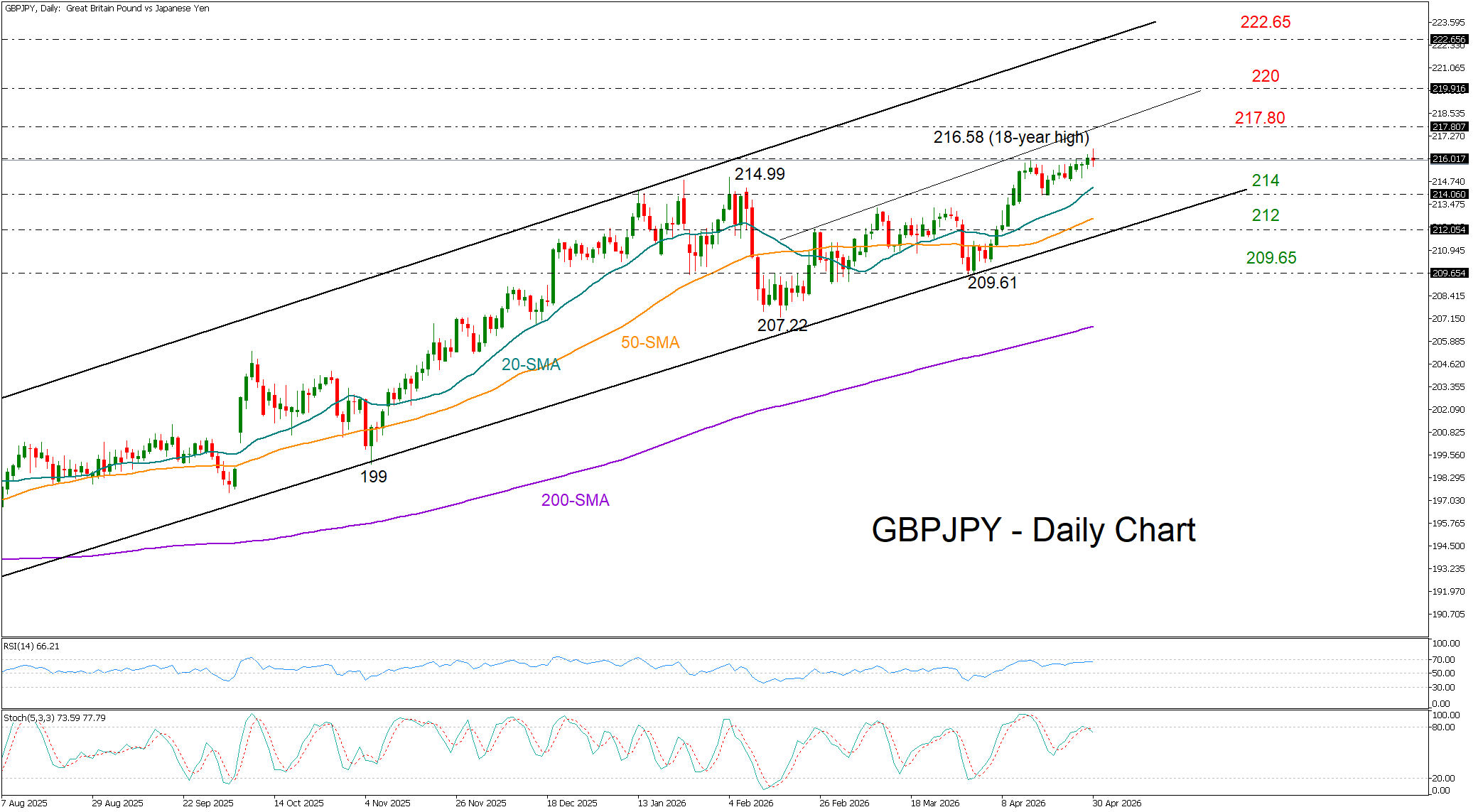
GBPJPY has resumed its broader upward path following a two-week consolidation period, climbing to a more than 18-year high of 216.47 on Thursday.

With the BoJ providing limited clarity on the timing of its next rate hike, and the BoE expected to keep rates unchanged today but deliver two increases by the end of the year, bullish sentiment has favored the pound.

February’s peak around 215 acted as support earlier in the week, allowing the pair to move above its weekly resistance near 216. If the 217.80–218.00 zone breaks as well, the rally could initially meet the 220 psychological mark before potentially accelerating toward the upper boundary of the year-long bullish channel, seen around 222.65.

That said, it remains uncertain whether the pair has enough momentum for such a strong push higher, as both the RSI and stochastic indicators are already in overbought territory, hinting that upward momentum may soon ease. Still, the upward trajectory shows no signs of weakness and any potential pullbacks may continue to support a "buy the dip" strategy.

On the downside, the 214 area is likely to attract attention, as a break below it could quickly drive prices toward the lower boundary of the channel near 212. If sellers maintain control below that level, indicating a negative trend reversal, the focus may then shift to the key support zone at 209.65.

Overall, GBPJPY has returned to a bullish trajectory, reinforcing its positive trend above recent multi-year highs. While further gains appear likely, a pause or slowdown cannot be ruled out given the overbought conditions and the possibility of FX intervention from Japanese authorities.

Author

Christina Parthenidou

Christina joined Trading Point in May 2017. She holds a master degree in Economics and Business from the Erasmus University Rotterdam with a specialization in International economics.


More from Christina Parthenidou
Share:

Editor's Picks

GBP/USD drops to 1.3200 region as UK PM Starmer resigns

GBP/USD has come under renewed selling pressure in the European session on Monday, falling back to the 1.3200 region. UK PM Keir Starmer announced that he will resign and noted that nominations for new contender will open on July 9.

EUR/USD turns south toward 1.1400 amid concerns over Iran deal progress

EUR/USD turns south toward 1.1400 in the European trading hours on Monday. Concerns about progress for the US-Iran peace deal and expectations of higher US interest rates keep the US Dollar supported against the Euro. ECB President Lagarde is set to speak later on Monday.  

Gold lacks bullish conviction near $4,200 as Fed hike bets and Iran risks underpin USD

Gold maintains its bid tone near the $4,200 mark through the first half of the European session, and seems to have snapped a three-day losing streak, to a more than one-week low set the previous day. Crude Oil prices turn lower after mediators – Qatar and Pakistan – announced a formal 60-day roadmap aimed at securing a final US-Iran peace deal.

Breaking: Iran closes the Strait of Hormuz amid ceasefire deal violation
Iran says it is closing the Strait of Hormuz after accusing the United States (US) and Israel of violating the ceasefire. According to Iran, the decision came over the continued Israeli strikes in Lebanon. The Iranian Revolutionary Guard Corps Navy issued a warning to all vessels: "Do not approach the Strait of Hormuz; otherwise, your security will be jeopardized."
Canada CPI Preview: Inflation expected to tick higher in May, pressuring BoC outlook

The publication of Canada’s May Consumer Price Index figures on Monday will be the focus of attention. Indeed, Statistics Canada data will provide markets with an update on price pressures following its June 10 meeting, where policymakers kept the interest rate steady at 2.25%, matching the broad consensus.

Regime change: Inside Kevin Warsh's first move to make the Fed unreadable on purpose

The rate did not move. That was the least interesting thing about Kevin Warsh's first meeting in charge of the Fed. The FOMC held its benchmark at 3.50%-3.75% for the fourth straight meeting, exactly as priced, and then the new chair used his first press conference to dismantle the machinery the market has leaned on for a decade.