|

GBP/AUD is in a bearish impulse, But prepare for a wave four correction [Video]

GBPAUD was in a strong uptrend over the past few years, but it appears that the fifth wave of the larger bullish impulse completed in 2025. After every completed five-wave cycle, the market usually enters a corrective or reversal phase, so the current bearish turn is not surprising. The break below the base channel support line further confirms that a larger trend reversal may already be underway.

Following the sharp decline, we believe the pair is currently trading within wave 3 of a new five-wave bearish cycle, which suggests that more downside can follow in the bigger picture. However, in the near term, price may soon complete subwave “v” of wave 3 around the 1.85–1.82 support area. This opens the door for a higher-degree wave 4 corrective rebound that could lift the pair back toward the 1.93–1.94 resistance zone before the broader bearish trend resumes in wave 5 toward 1.82 and potentially lower.
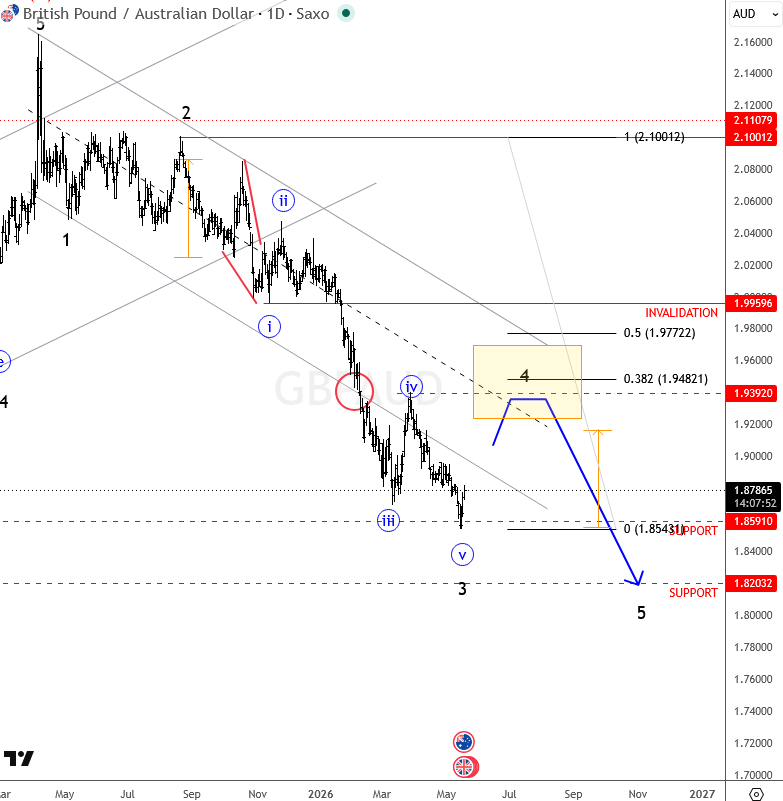
GBPAUDd
GBPAUD Daily Chart

Fundamentally, the latest RBA minutes suggest the central bank may be leaning toward a pause after three rate hikes this year, as policymakers appear willing to wait for additional economic data and monitor how the US-Iran situation develops. At the same time, equity markets are starting to pull back, which could temporarily support crosses such as GBPAUD and EURAUD.

Technically, GBPAUD already shows a clear five-wave decline within an extended third wave, which supports the idea of a corrective wave four recovery in the weeks ahead. In addition, relatively hawkish tones from both the ECB and BOE could provide extra support for these European currency crosses against the Australian dollar.

Youtube preview

Get Full Access To Our Premium Elliott Wave Analysis For 14 Days. Click here.

Author

Gregor Horvat

Gregor Horvat

Wavetraders

Experience Grega is based in Slovenia and has been in the Forex market since 2003.

More from Gregor Horvat
Share:

Editor's Picks

AUD/USD sticks to positive bias above 0.7100; lacks bullish conviction

AUD/USD trades with a positive bias for the second straight day, holding above 0.7100 in the Asian session on Friday as softer US bond yields keep US Dollar bulls on the back foot. Furthermore, hawkish RBA Governor Bullock's comments boost rate hike bets and support the Aussie. However, the Fed's hawkish outlook, along with geopolitical uncertainties, limits USD losses and caps the pair.

USD/JPY  holds firm above 157.00 ahead of Ueda's presser

USD/JPY holds the uptick above 157.00 in the European session on Friday as the Japanese Yen remains under intense selling pressure despite the Bank of Japan's (BoJ) interest rate hike to 1.25% and a somewhat hawkish Monetary Policy Statement, as two dissents against the rate hike weigh. All eyes now remain on BoJ Governor Ueda's press conference for further trading impetus.

Gold advances to fresh weekly top; eyes $$4,400 as softer US bond yields cap USD gains

Gold attracts some follow-through buying for the second straight day, and touches a fresh weekly high heading into the European session. US bond yields retreat further from multi-year highs as the recent pullback in crude oil prices helped alleviate immediate fears of runaway inflation. This caps gains for the US Dollar and supports the bullion.

Bitcoin extends recovery, Ethereum eyes $2,500, XRP holds $1.30
Bitcoin (BTC), Ethereum (ETH) and Ripple (XRP) extend their recovery, trading above $76,700, $2,400 and $1.300, respectively, on Friday. These top three cryptocurrencies now face key technical levels that could determine whether their recoveries extend further or pull back.
Cardano extends gains on bullish derivatives
Cardano (ADA) extends its recovery, trading above $0.210 at the time of writing on Friday, after finding support around a key zone earlier this week. Improving derivatives positioning and supporting technical indicators indicate growing bullish sentiment among ADA traders. Derivatives data shows a bullish tilt among Cardano traders.
How Japan became the World's Banker and why that era may be ending

Japan's ultra-low interest rates helped finance trillions of dollars in global investments for more than a decade, making the Japanese Yen one of the world’s cheapest sources of funding. With the Bank of Japan expected to tighten policy again this week, that advantage may be entering a new phase. While most major economies raised interest rates, Japan remained the world's outlier.