The Fed can't fix this inflation. It's a mechanical weight, not a demand problem
Producer prices are rising 2.6 points faster than consumer prices, the widest gap since 2022, because most of the Iran war's costs haven't reached shoppers yet. The part that has is fuel, and rate hikes can't make fuel cheaper.
The Producer Price Index (PPI), which tracks what US businesses get for the goods and services they sell, rose 6.3% through September. The Consumer Price Index (CPI) rose 3.7%. In February, the last full month before the Iran war, the gap between them was about a point. It's now 2.6 points, the widest since April 2022.
Most of the war's costs still fall on businesses, and shoppers pay at the pump. The Federal Reserve (Fed) raised its rate to 3.75-4.00% in September and held it in October, with two members voting for another hike. The number that matters most for inflation is the price of Brent, the main global Oil price, and no one at the Fed sets it.
Seven months of war, a tenth of a point outside energy
Energy prices, which cover gasoline and the power and fuel used in homes, rose 20.4% through September, and gasoline alone rose 34.2%. Energy makes up about 7% of the CPI, so it added about 1.3 percentage points to the 3.7% total. In February it added almost nothing.
Everything else barely changed. Prices outside food and energy, often called underlying inflation, were up 2.6%, a tenth of a point faster than in February. Food prices are rising more slowly than they were before the war.
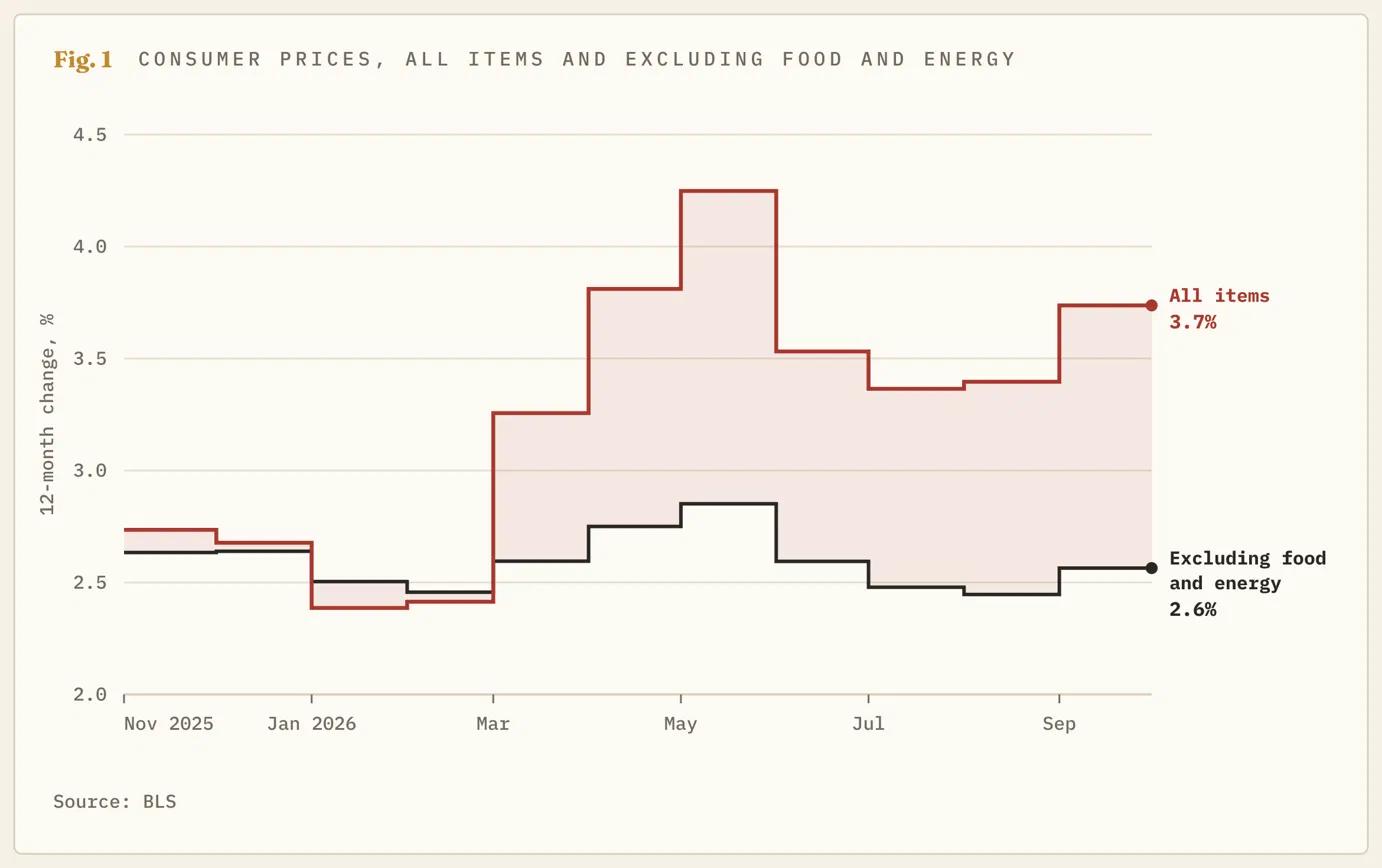
So almost all of the 1.3-point rise in inflation since February is the fuel bill, and with Brent trading near its highest since mid-2022, that bill hasn't gone away.
The costs have reached businesses but not shoppers yet
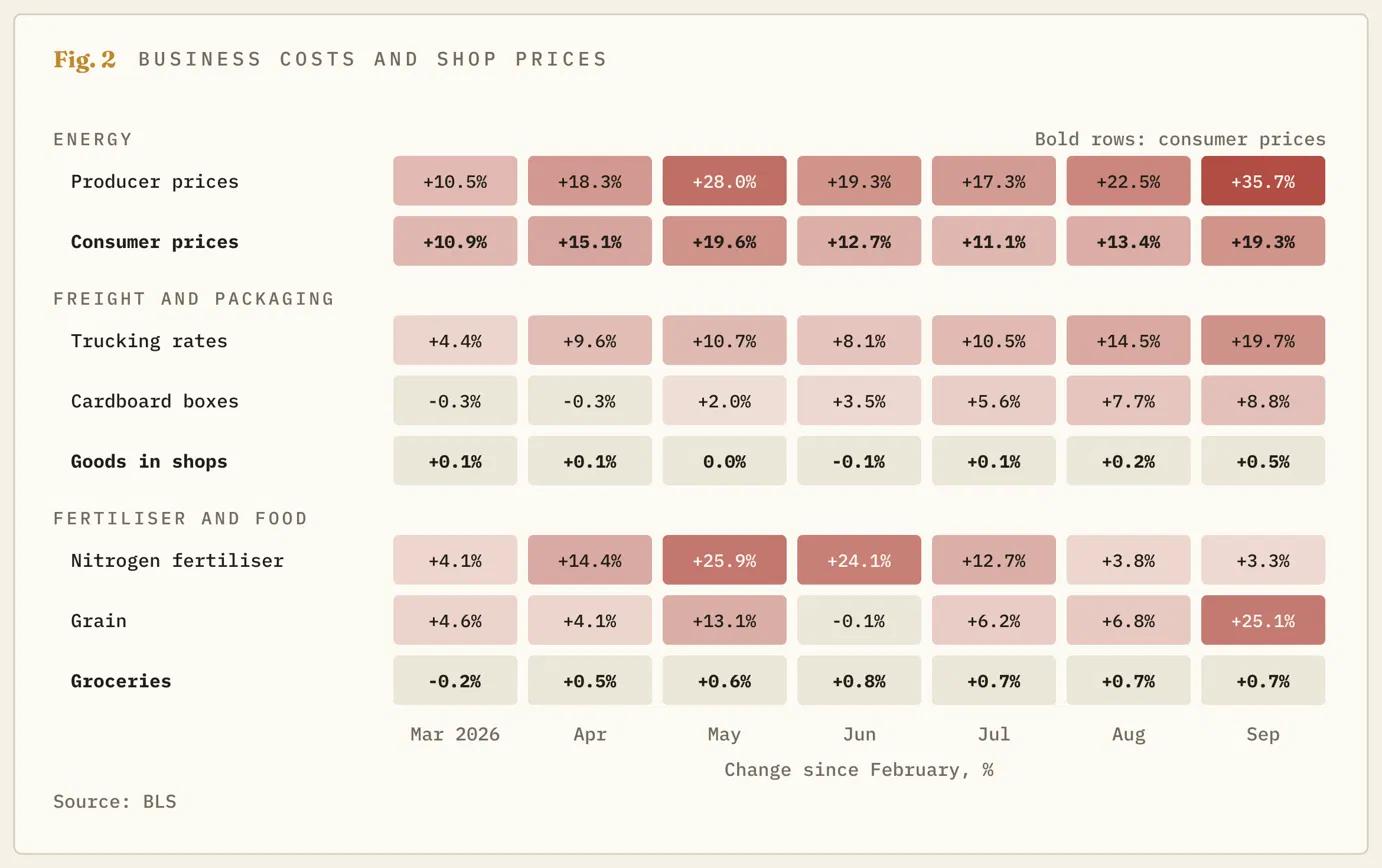
Fuel came through in full. Energy prices are up about a third for businesses since February and about a fifth for shoppers. Diesel at the pump costs about two-thirds more, and airfares are up 22.4% on the year.
Freight and packaging have reached businesses but not shoppers yet. Long-distance trucking rates are up a fifth since February and cardboard boxes 9%. A grocery chain in the Richmond Fed's district reported in October that trucking a head of lettuce now costs more than the lettuce. Goods in shops outside food and energy are up 0.7% on the year, slower than in February.
The fertiliser bill has moved into grain
World urea prices nearly doubled between February and April and are now below their pre-war level. US farmers are still paying more. In mid-October, anhydrous ammonia, the main nitrogen fertiliser for corn, cost 18% more than a year earlier and urea 13% more, according to farm-data company DTN's survey of retailers.
The harvests are smaller. The US corn crop is 5% below last year's and the wheat crop is the smallest since 1970, mostly because of drought and heat. Half of corn growers surveyed in April also expected trouble applying all the nitrogen they planned to. The US Department of Agriculture (USDA) expects farmers to get about 13% more for corn this season and 25% more for wheat.
Food makers haven't passed it on yet. The prices food producers charge were unchanged on the year in September, grocery prices were up 1.8%, and bread and breakfast cereal prices have barely moved in three months. Farmers are absorbing their share too, with the USDA expecting their fertiliser bill to rise 15% this year and their fuel bill 29%. Supermarkets are the exception, with margins up about 5% on the year.
No sign yet of a hidden rise
If the war's costs were reaching shoppers in ways the main categories miss, the broad measures of underlying inflation would show it. They don't. The Cleveland Fed's median CPI, the middle of hundreds of price changes, slowed from 2.85% in February to 2.61% in September, and the Dallas Fed's trimmed-mean measure slowed too.
Smaller packs don't hide it either, because the CPI counts a smaller pack as a price rise at the same price. Restaurant prices are up 3.5% on the year, slower than before the war.
The blind spot is the measurement itself. No prices were collected in October 2025 because of the government shutdown, so the report due on November 10 won't include 12-month rates for most categories. Price collection is also still suspended in three cities.
How long can businesses keep paying?
Probably not much past the winter. Firms told the Fed in October that prices will rise further as contracts expire and hedges are renegotiated, and some said they reset prices once a year. Containerboard makers are phasing in their latest increase through March 2027. General Mills (GIS) expects its input costs to rise about 6% in the March-May 2027 quarter, up from about 4% now, with three-quarters of its needs hedged.
The shopper slows it down. About half of the manufacturers the Kansas City Fed surveyed in October said customers had become more price-sensitive in the past six months. About half were passing on a fifth or less of their cost increases. Food and household-goods makers have less room to wait than most, with profit margins at about their five-year average while the S&P 500's are well above it.
Purdue University's agricultural economists estimated in March that a sustained energy shock would add 3-6 points to grocery inflation over 12-18 months. In October, they said food prices were only partway through that. Groceries are about 8% of the CPI, so that would add roughly a quarter to half a point to overall inflation by mid-2027.
What a rate hike can reach was there before the war
Higher interest rates slow spending, so they mainly affect prices that rise and fall with demand, like rents, services, and goods outside food and energy. On the Personal Consumption Expenditures Price Index (PCE), the Fed's preferred gauge, underlying inflation was about 3% before the war and is about 3% now. The economy grew at a 3.4% yearly pace in July-September, and all that spending moved underlying inflation by less than two tenths of a point.
The Fed's September forecast assumes the war's costs reach shoppers. It puts underlying PCE inflation at 3.4% at the end of 2026. That requires prices to rise at about a 4% yearly pace from October to December, up from 2.9% since March. A December hike would target freight and grain costs, and a higher rate makes neither cheaper.
Inflation drops a point by spring 2027 with no price falling
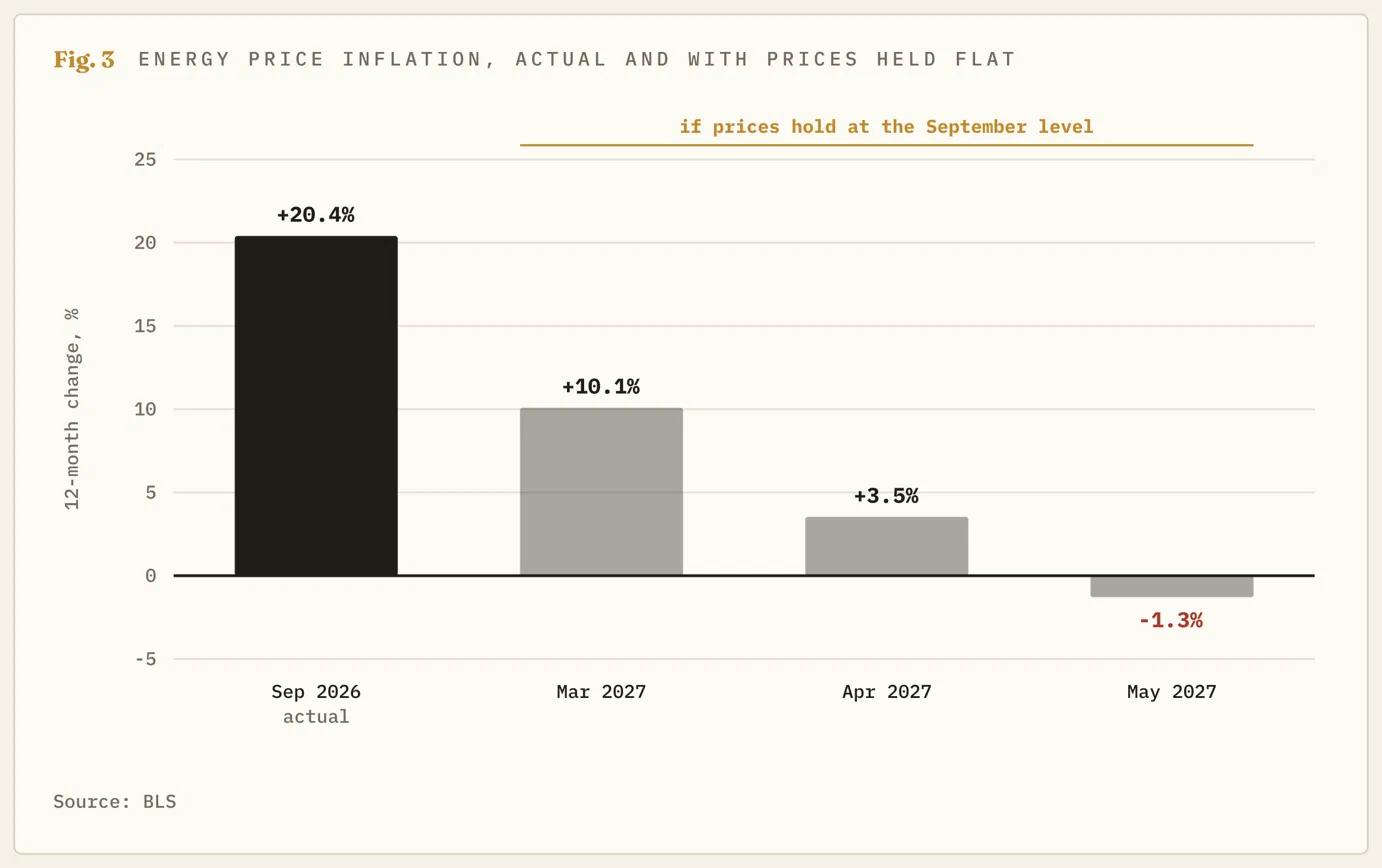
Inflation is measured against prices a year earlier, so the jump in fuel prices in spring 2026 drops out of the comparison in spring 2027. Hold energy prices where they were in September and energy inflation falls from 20.4% to about 3.5% by April, then below zero in May. That alone takes more than a point off overall inflation by May without a single price falling.
Food could fill part of that hole. If food makers pass on their grain and freight costs in the first half of 2027, grocery prices would be rising in the same months the fuel spike drops out. Traders who expect Fed cuts in 2027 because inflation is falling would be leaning on a drop that was on the calendar all along. The food bill would take some of it back.
The next move in inflation runs through Iran
It comes down to what the US does about Iran after the November 3 midterms. The US has been trying to restart talks with Tehran, and reports say the president has been briefed on military options. If talks hold and Oil falls, the spring drop gets bigger. If strikes resume and Oil climbs, inflation could top 4%, and the Fed would be raising rates into a fuel shock it can't lower.
The November 10 report will still show the monthly changes. Faster rises in grocery and goods prices would mean businesses have started passing on their costs, which is still a cost shock rather than a demand problem. The case that the Fed can't fix this inflation stops holding if the median and trimmed-mean measures speed up too, because then prices would be rising across the board.
Author

Joshua Gibson
FXStreet
Joshua joins the FXStreet team as an Economics and Finance double major from Vancouver Island University with twelve years' experience as an independent trader focusing on technical analysis.