French political chaos ruins happy Euro narrative


We touched on the French bond crisis only back in early September, explaining how, despite superficial similarities, too high a level of spending, weak growth, heavy taxation, the UK was more vulnerable to a fiscal squeeze than France.
But not to be outdone in their ability to create chaos for themselves by the British across the channel, France has somersaulted headfirst into a political crisis that would be difficult to replicate in the UK.
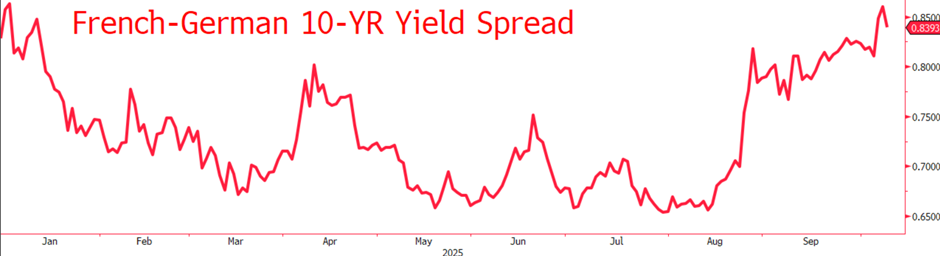
Sébastien Lecornu, the 4th French Prime Minister in the space of a year, resigned on Monday, following his inability to push his cabinet through the National Assembly. This was mostly due to most members being members of the previous cabinet of François Bayrou, Lecornu’s predecessor who resigned following his inability to pass a budget that would see France trim its 5.8% deficit, the widest in Europe.
All of this uncertainty has naturally triggered a rise in the yields on French bonds, widening the differential between the risk premium paid on French debt and its German counterpart. This difference widened to its highest since December of last year, which is usually a poor sign for the Euro in the near term. It suggests that the two biggest Euro economies are drifting apart and that the overall fiscal integrity of the Eurozone is weakened.
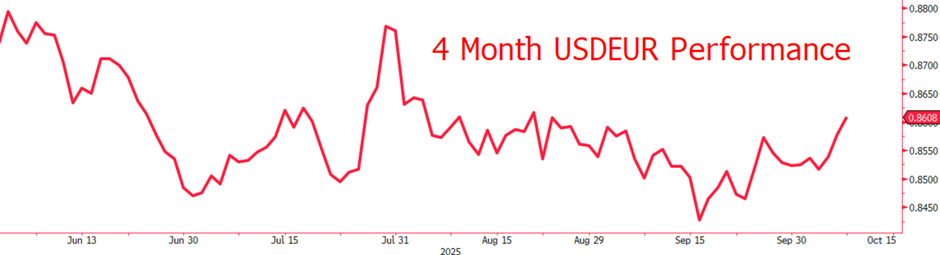
But there is a wider point at play here, with the Euro’s YTD rally being checked at last. Much of this rally was the reallocation of capital away from the more volatile US and into the seemingly more solid European markets. The chaos unfolding in the French parliament is not isolated nor rare, the Dutch Government went through a similar crisis back in June, when the governing right-wing coalition collapsed over an immigration row.
Investors may be releasing that Europe is not always sleepy or slow, but in fact, just as prone (if not more) to political instability as the United States. Lecornu was given until Wednesday to find some sort of a workable solution by President Macron. His comments made early Wednesday suggested that some small progress was being made, but only if steep demands were met.
The Socialist party for example, demanded that Macron’s flagship pension legislation, that made the national retirement age 64 as opposed to 62, would be shelved. Such a move would come at an exorbitant cost to France at a time when the country’s fiscal credibility is under serious scrutiny, dreadful news for Euro bulls.
Whatever happens when Lecornu delivers his suggestions on how to break this latest crisis, it will undoubtedly move the Euro. Given what is presently being suggested just makes the problem Macron is trying to fix worse, I’m not overly confident.
Author
David Stritch
Caxton
Working as an FX Analyst at London-based payments provider Caxton since 2022, David has deftly guided clients through the immediate post-Liz Truss volatility, the 2020 and 2024 US elections and innumerable other crises and events.