France: Don’t be fooled by the fall in the unemployment rate


The fall in France's unemployment rate to 8% in the fourth quarter of last year, from 9.1% in Q3, cannot be considered as good news and is simply the consequence of the health situation. The crisis has not yet shown its true face on the French labour market.
A decline due to an increase in inactivity
In France, the unemployment rate (as defined by the ILO) fell in the fourth quarter of 2020, reaching 8% after 9.1% in the third quarter. Over one year, and therefore compared to the situation that prevailed before the health crisis, the unemployment rate is almost stable. At the time of the first lockdown, in the second quarter of 2020, the unemployment rate had fallen to 7.1 per cent.
Given the current health context, this decrease in the unemployment rate over one quarter cannot be considered good news. Indeed, the unemployment rate is defined as the share of those actively looking for a job in relation to the active population, i.e. those who are looking for a job and those who have one. However, the health crisis and the lockdowns, including the one in force between 30 October and 15 December, are having the effect of discouraging some of those who wish to look for work or pushing them to refrain from taking the steps to find employment.
These people then fall into inactivity and are therefore no longer counted in the unemployment statistics. INSEE estimates that 4.1% of all 15-64 year old were in this situation in Q4, a figure that is slightly higher than the pre-crisis situation and comparable to the third quarter (4%). Nevertheless, this phenomenon is much less significant than that which prevailed during the first lockdown, when the share of 15-64-year-olds in this situation had increased to 6%, a historically high number.
Historically high underemployment
Moreover, the unemployment rate figures do not show the impact of the short-time working scheme. This scheme affected 6% of people in employment during the November 2020 lockdown and 3% in December. This is much less than the 25% observed in April 2020 during the first lockdown. Contrary to the situation prevailing in the spring, when most sectors had recourse to short-time working, short-time working was concentrated in only some sectors (accommodation and restaurants; arts, entertainment and recreation; service activities). The extensive use of short-time working is not included in the unemployment statistics. But, it does lead to a decrease in the volume of hours worked by those in employment.
To complete the unemployment statistics, it is therefore interesting to analyse data on underemployment, i.e. people who have involuntarily worked less than usual or who have a part-time job but wish to work more. In Q4 2020, 8.9% of the employed population was underemployed. This is a lower figure than the 20% observed during the first wave, but it is historically high. Over one year, it has risen by 3.5 points. It should be noted that underemployment affects women (11.1%) much more than men (6.9%). At the end of 2020, in France, there were more people in a situation of underemployment than people counted in the unemployment rate.
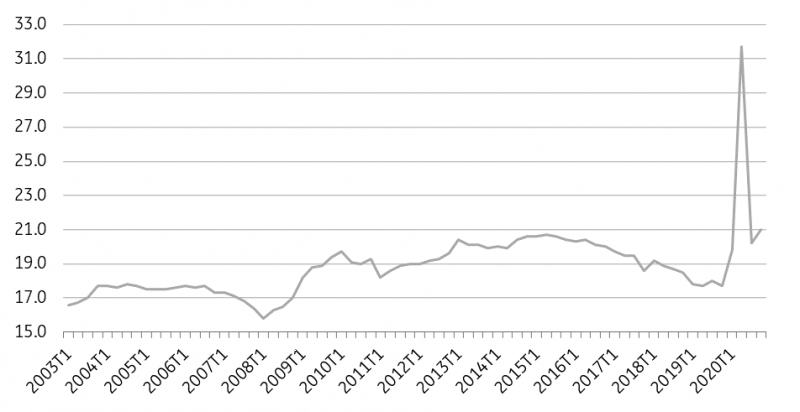
In total, in Q4 2020, 21% of labour market participants are constrained in their labour supply, either by the absence of employment or in a situation of underemployment. Compared to the situation before the crisis, when 17.7% were underemployed, this is an increase of 3.3 points. Excluding the exceptional Q2 2020, this is a historically high figure.
Labour market constraints
Share of people constrained in their labour supply among participants in the labour market (employment, unemployment, halo).
The outlook for unemployment and employment
For 2021, we estimate that the labour market should experience two major developments. Firstly, the number of people in underemployment should decrease once health restrictions have been lifted and the use of short-time working has been reduced. At the same time, once the recovery begins, the unemployment rate is expected to rise. Indeed, some people who have exited the labour market are expected to re-enter it.
At the same time, some companies that survived thanks to the aid schemes are likely to undertake restructuring or lay off some of their workers. As the economic situation improves, the crisis will finally show its true face and labour market statistics are likely to deteriorate sharply. The ILO's unemployment rate could rise to 10 per cent in 2021, before falling slowly in 2022 and 2023. However, it is unlikely to return to pre-crisis levels before the end of 2023 or even 2024.
Read the original analysis: France: Don’t be fooled by the fall in the unemployment rate
Author
ING Global Economics Team
ING Economic and Financial Analysis
From Trump to trade, FX to Brexit, ING’s global economists have it covered. Go to ING.com/THINK to stay a step ahead.