Four reasons why Bitcoin prices could keep falling

Bitcoin has struggled to regain momentum despite a favorable macro backdrop for risk assets. While US equity indices continue to push to record highs, the world’s largest cryptocurrency remains under pressure.
After falling more than 30% since the start of the year, traders are increasingly questioning whether Bitcoin’s latest weakness reflects temporary profit-taking or the beginning of a more prolonged bearish phase. Several fundamental and sentiment-driven factors suggest the downside risks may not be over yet.
1. Investors need money to invest in AI and upcoming IPO
Historically, Bitcoin has benefited when investors sought exposure to high-growth, high-risk opportunities. However, the spotlight has shifted dramatically toward artificial intelligence and next-generation technology companies. Today, one of the biggest challenges facing Bitcoin could be the hot AI and IPO trade.
Strong earnings from major players such as NVIDIA have reinforced confidence in the AI investment theme, attracting significant speculative capital that might otherwise have flowed into cryptocurrencies. The enthusiasm surrounding artificial intelligence is also being amplified by anticipation for some of the most closely watched public offerings in recent years.
Potential IPOs involving Anthropic, alongside continued investor interest in the upcoming listing of SpaceX, are generating excitement across financial markets. The combination of AI and space-related growth stories has become one of the dominant investment narratives of 2026.
As investors reposition portfolios to gain exposure to these opportunities, Bitcoin appears to be losing some of its appeal as the market’s preferred speculative asset and the divergence between crypto and equities highlights this shift.
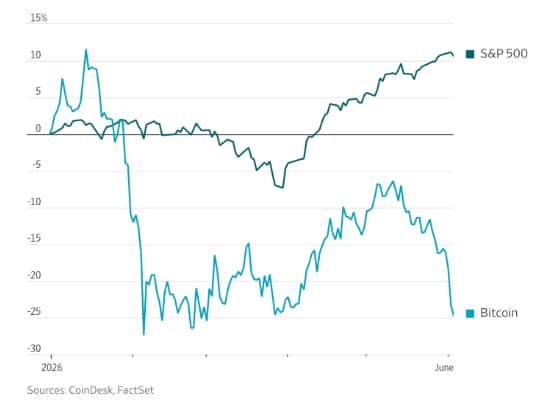
While the Nasdaq Composite has gained more than 14% this year and the S&P 500 has advanced over 9% to fresh record highs, Bitcoin has fallen more than 30% over the same period. According to CNBC data, Bitcoin’s relative performance versus the Nasdaq-100 has deteriorated by approximately 70 percentage points over the past year, marking the largest gap in favor of stocks since March 2019.
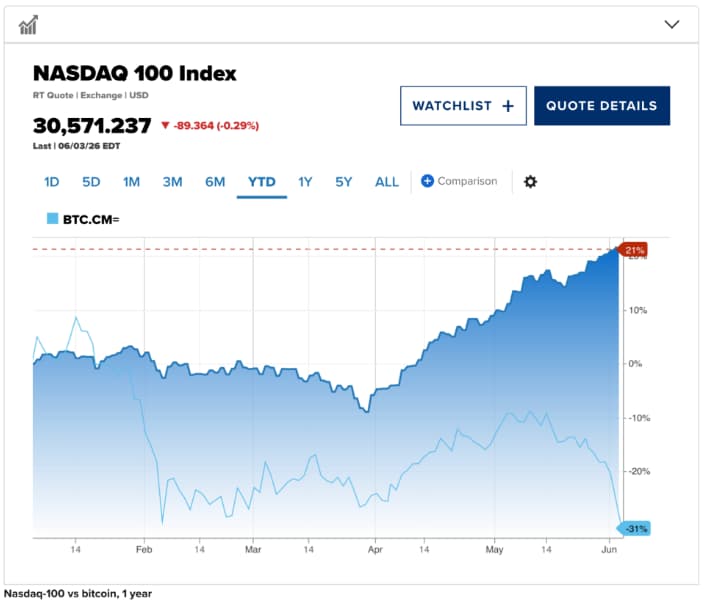
If capital continues flowing toward AI-driven equities and high-profile IPOs, Bitcoin may struggle to attract the fresh demand needed to reverse its current downtrend.
2. Bitcoin ETFs are experiencing sustained institutional selling
Another major headwind comes from the institutional side of the market, as US-listed spot Bitcoin exchange-traded funds (ETFs), once considered a key catalyst for Bitcoin’s long-term adoption, are currently experiencing their worst period of outflows since launch.
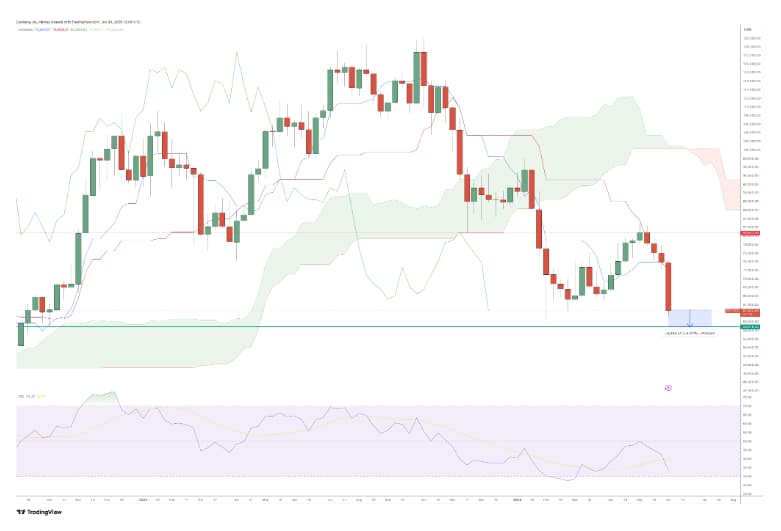
Data from SoSoValue highlights the severity of this shift, noting a $396.6 million net outflow on Wednesday alone. This extended a historic, 13-day streak of consecutive withdrawals that has drained roughly $4.4 billion from the market since May 15. To put this into perspective, the previous record was an 8-day stretch in February 2025 that saw $3.2 billion in redemptions. This aggressive capital flight has heavily weighed on the BTC performance. According to ActivTrades, Bitcoin’s price plummeted roughly 23% during this 13-day window, collapsing from around $80,790 to $62,230.
The brunt of this selling pressure has come from BlackRock’s iShares Bitcoin Trust (IBIT), which accounted for nearly 75% of the total outflow with $3.3 billion in withdrawals. This capital flight extended across the board, with CoinDesk reporting that Fidelity’s Wise Origin Bitcoin Fund (FBTC) and Grayscale’s Bitcoin Trust (GBTC) bled over $456 million and $303 million, respectively.
ETF flows offer crucial insight into institutional conviction. While persistent inflows signal strong long-term confidence and reduce available supply, prolonged outflows do the opposite—creating a downward spiral of declining prices, triggered redemptions, and mounting sell pressure. The current trend, therefore, suggests that institutional investors remain cautious, limiting one of Bitcoin’s most important sources of demand.
3. Strategy’s Bitcoin sales are raising concerns about market sentiment
A third factor weighing on Bitcoin is the symbolic significance of recent selling activity from Strategy, formerly known as MicroStrategy.
For years, Executive Chairman Michael Saylor became one of Bitcoin’s most vocal advocates, repeatedly encouraging investors to hold rather than sell the cryptocurrency. However, Strategy recently disclosed that it sold 32 Bitcoin for approximately $2.5 million to help fund distributions associated with its preferred stock.
Although the transaction is relatively small compared with the company’s massive Bitcoin holdings, the move has attracted significant attention because it marks a notable shift in narrative. The company has previously indicated that Bitcoin sales could be used strategically to monetize gains, manage capital requirements and support dividend obligations.
Investors have become increasingly focused on related comments from the company as Strategy’s cash reserve for dividend commitments reportedly declined from $1.44 billion to $900 million. The concern is not necessarily the size of the sale itself but what it could signal for future activity. If Bitcoin prices remain under pressure and Strategy faces growing financial obligations, investors may fear that additional sales could follow.
More broadly, when one of Bitcoin’s strongest corporate supporters begins actively selling—even for operational reasons—it risks undermining market confidence at a time when sentiment is already fragile.
4. Bearish positioning is increasing across crypto-related assets
Finally, options markets also suggest traders are becoming more defensive toward the crypto sector.
Recent data shows put options are increasingly outnumbering call options in both BlackRock’s IBIT ETF and Strategy shares. In Strategy alone, nearly 100,000 puts were reportedly purchased compared with fewer than 37,000 calls, highlighting growing expectations of further downside. The bearish sentiment has also spread to crypto exchange Coinbase, where call selling has significantly exceeded call buying.
While some investors remain hopeful that future regulatory developments, including the proposed Clarity Act, could unlock additional institutional participation in digital assets, skeptics argue that much of the regulatory optimism is already reflected in market expectations.
Last word
Capital is increasingly being redirected toward AI-related equities and highly anticipated IPO opportunities, institutional investors are withdrawing billions of dollars from spot Bitcoin ETFs, bearish sentiment is increasing and even Strategy—the company’s most influential corporate backer—is now demonstrating a willingness to sell Bitcoin when necessary.
Taken individually, each factor may not be enough to trigger a prolonged bear market. Together, however, they paint a picture of weakening demand, deteriorating sentiment and growing competition for investor capital. Unless Bitcoin can attract a new catalyst capable of reversing institutional outflows and restoring speculative interest, the bearish momentum is likely to continue
Stay up to date with what's moving and shaking on the world's markets and never miss another important headline again! Check ActivTrades daily news and analyses here.
Author

Carolane de Palmas
ActivTrades
Carolane graduated with a Masters in Corporate Finance & Financial Markets and got the AMF Certification (Financial Markets Regulator in France). Afterward, she became an independent trader, investing mostly in European and American stocks/indices.