Should We Worry About American Debt?: Part III


Executive Summary
In the third part of our series on debt in the U.S. economy, we focus on the debt of the business sector. Business debt has risen by roughly $5 trillion over the past decade, and the debt-to-GDP ratio in the sector currently stands at its highest in at least 40 years. But balance sheets generally remain sound, and strong cash flow gives most businesses the wherewithal to service their debts without much difficulty, at least at this time.
That said, the financial health of the business sector is not as strong as it was a few years ago. The increase in debt in the business sector in recent years probably will not be the catalyst for recession, at least not in the near term. But the increase in corporate debt over the past decade means that some businesses may not be able to weather a downturn, should one occur, as well as they would have a few years ago.
Business Sector Debt Has Risen Significantly in Recent Years
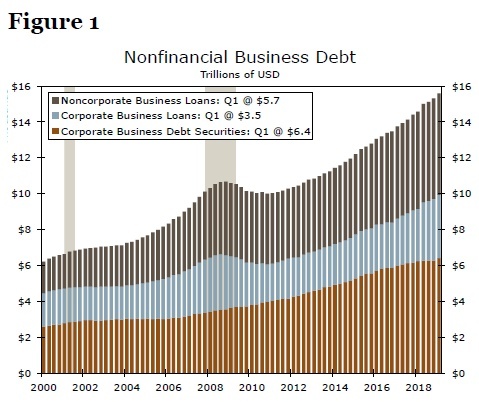
In Part I of this series we showed that the total amount of debt in the overall U.S. economy has risen by more than $15 trillion (nearly 30%) over the past ten years. But the debt of the household sector, which we addressed in Part II, is up by less than $2 trillion over that period. Indeed, we argued in that report that the financial health of the consumer sector has generally improved over the past decade, and that the risk of an economic downturn stemming from excessive household debt seems to be rather low at this time. In this, our third report in the series, we focus on debt in the nonfinancial business sector. Debt in the non-financial business sector has risen from nearly $11 trillion about ten years ago to roughly $16 trillion today (Figure 1). Non-financial corporations, which tend to be the largest business organizations in the economy, account for the majority of this debt (about $10 trillion). Drilling down further shows that there are $6.4 trillion worth of corporate bonds outstanding and $3.5 trillion worth of bank loans that have been extended to the corporate sector. Loans to nonfinancial non-corporate businesses currently total $5.7 trillion.
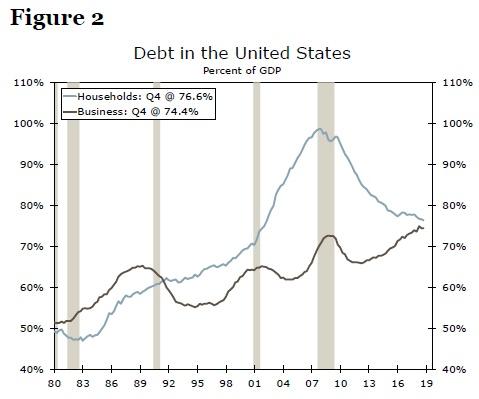
As discussed in our previous report and as shown in Figure 2, the debt-to-GDP ratio of the household sector has receded markedly over the past decade. In contrast, the comparable ratio for the non-financial business sector has trended higher in recent years and is now about 9 percentage points higher than it was relative to its recent nadir in 2012. Moreover, the debt-to-GDP ratio of the business sector presently is the highest it has been in at least 40 years. Is the business sector over-indebted?
Author
Wells Fargo Research Team
Wells Fargo

















