Fed Chair Warsh runs open-mouth operations at Jackson Hole but can he deliver?
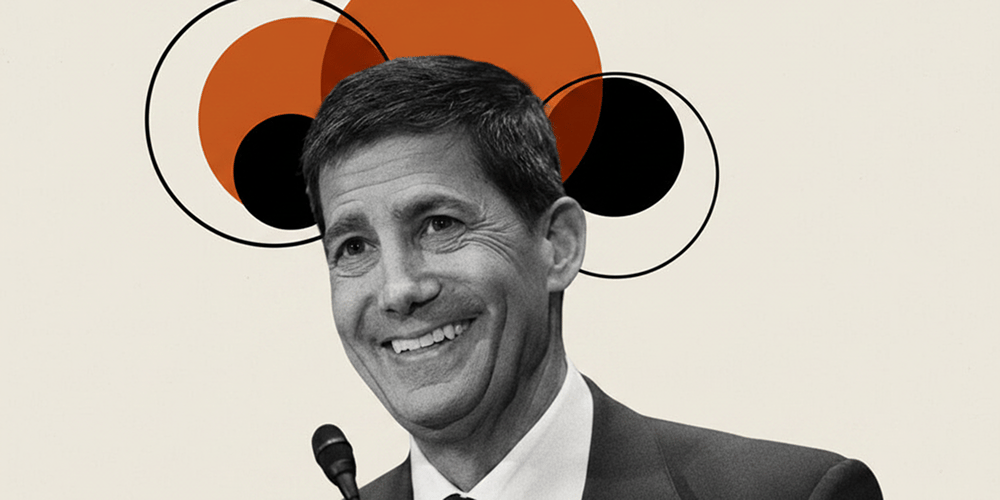
Federal Reserve Chairman Kevin Warsh moved markets on Friday with his Jackson Hole speech, even though the central bank has yet to do anything to move inflation.
Clearly, Warsh wants to convey a message. He’s tough on inflation, and the Fed will “deliver price stability.”
It’s less clear that he will ever be able to deliver on his hawkish promise.
In fact, the Warsh Fed looks a whole lot like the Powell Fed, relying on rhetoric instead of policy.
Ironically, Warsh insisted, “We should not indulge a regime in which market participants are looking primarily to the Fed for their next trade.”
After the speech, gold and silver both tanked, with the yellow metal falling by over 3 percent and silver plunging by more than 4 percent. Stocks also corrected, with the NASDAQ dropping by nearly 139 points.
Why the strong market reaction?
Because the economy is addicted to easy money, and Warsh hinted he’s not inclined to fill up the punch bowl with inflation still running well above the mythical 2 percent target.
In fact, Warsh’s speech reignited speculation that the central bank will likely raise interest rates at least once before the end of the year. Since gold and silver are non-yielding assets, a higher-rate environment is perceived as negative for metals.
So much for market participants not looking to the Fed.
And keep in mind, the central bank hasn’t done a darn thing. The markets reacted to Warsh’s “open-mouth operations,” not a policy change. And there are about 40 trillion reasons Warsh will have an extremely hard time delivering on his hawkish promises.
What Warsh said
Warsh never mentioned a rate hike during the speech. However, he dropped enough hints to convince everybody that rate hikes are still on the table.
John Hopkins economist and former Jerome Powell advisor, Jon Faust, told the Associated Press, “He found a way to convey that, if necessary, he would support raising rates, which is one thing people were concerned about.”
While Warsh conceded inflation has cooled somewhat, he insisted the data “do not tell me that underlying trends have meaningfully improved.”
“We must be confident that underlying inflation is moving to our objective, clearly and at sufficient speed. Otherwise, we have work to do.”
He insisted that the “objective” is price inflation at 2 percent.
“The Fed's price-stability objective of 2 percent, as measured by the personal consumption expenditures (PCE) price index, is a firm, fixed target.”
He also emphasized that it’s the central bank’s job to keep inflation reined in.
“That’s our job, our mandate, and our charge to keep.”
Warsh pointed out that “price stability is not self-executing, nor is inflation necessarily mean-reverting.”
“It is the Fed's job to deliver stable prices.”
And how does the Fed do that, according to our intrepid Fed chair?
“Short-term interest rates are the predominant tool to achieve the dual mandate.”
Analysts widely took this statement as a sign that Warsh & Co. are on the rate-hiking path, possibly as early as next month.
“The Fed's price-stability objective of 2 percent, as measured by the personal consumption expenditures (PCE) price index, is a firm, fixed target.”
But it’s important to note that Warsh never said the Fed will hike rates. He didn’t hint at any timeline. He just blustered about being tough on inflation.
But as most bullies learn, talking tough and being tough when the punches fly are two different things.
40-trillion reasons the Fed probably can’t deliver
The Fed head has been talking tough on inflation since he took the chair in May. However, two Fed meetings into the Warsh regime, there hasn’t been any policy change. In fact, the federal funds rate has been set at 3.5 percent since December 2025, despite both Powell and Warsh warning about persistently sticky inflation.
This raises a question. If inflation remains stuck well above the target, as it has been for years, shouldn’t the central bank do something besides talk about how big a problem it is? At some point, don’t you stop talking and act?
The answer is yes – unless there is a reason you can’t?
And there is, indeed, a reason – about 40 trillion of them.
I am, of course, referring to the $40 trillion national debt.
The national debt is costing the federal government over $1 trillion per year. The U.S. Treasury Department just announced a bond market intervention in an effort to drive long-term rates lower. (It didn’t work.)
How does the Fed hike rates in this environment?
And the national debt is only one part of the massive debt black hole. Americans are buried under more trillions in consumer debt at extremely high credit card rates. Meanwhile, corporations are leveraged to the hilt.
If the Fed raises rates to tackle inflation, it will almost certainly crash the debt-riddled bubble economy.
This is the Catch-22 I’ve been harping on for months.
The Fed simultaneously needs to raise rates to push inflation back to the target and cut rates to manage the debt black hole and keep the economy limping along.
So, I don’t think the Fed will hike rates. And if it does, I think it will tip the economy into a deep recession and likely a financial crisis.
Either way, you want to have gold and silver.
To receive free commentary and analysis on the gold and silver markets, click here to be added to the Money Metals news service.
Author

Mike Maharrey
Money Metals Exchange
Mike Maharrey is a journalist and market analyst for MoneyMetals.com with over a decade of experience in precious metals. He holds a BS in accounting from the University of Kentucky and a BA in journalism from the University of South Florida.

















