Australian Dollar Price Forecast: Focus shifts to 0.7200
- AUD/USD regains traction, refocusing on the key 0.7200 region.
- The US Dollar looks offered amid persistent tensions in the Middle East.
- Housing data and the final prints from business activity are next in Oz.
The Aussie Dollar keeps the trade in the upper end of its recent range following last week’s piercing of the key 0.7200 hurdle against the US Dollar. Indeed, AUD/USD has been gaining momentum since early July, mostly underpinned by the RBA’s hawkish bias, while still sticky domestic inflation continues to bring some cushion against occasional bouts of weakness.
The Australian Dollar (AUD) starts the week in a positive footing, prompting AUD/USD to bounce off the mid-0.7100s and partially recoup Friday’s marked losses. The attention, thus, has now shifted back to the 0.7200 yardstick and beyond.
The improved sentiment around the pair follows a daily correction in the US Dollar (USD), as market participants appear to have already digested Chair Warsh’s cautious message at the Jackson Hole Symposium on Friday, while the unabated tensions in the Middle East always prompt some caution.
Australia’s domestic backdrop remains resilient
The Australian economy does look healthy and stable altogether and, honestly, in much better shape than many of its G10 peers.
This performance appears reinforced by a solid domestic demand and pretty decent figures when it comes to economic growth. In addition, the spectre of sticky inflation seems to justify the cautious and data-dependent stance from the Reserve Bank of Australia (RBA).
Contributing to the healthy fundamentals, domestic business activity is expected to remain in the expansion territory in August, after the advanced prints from the Purchasing Managers’ Index (PMI) showed Manufacturing at 52.0 (unchanged from July) and Services a tad lower at 52.9 (from 53.6).
Adding extra shine, the latest trade balance figures showed an A$1.929 billion surplus in June, reversing May’s A$2.367 billion deficit. However, the latest Gross Domestic Product (GDP) data disappointed expectations after the economy expanded by 0.3% QoQ in Q1 2026 (from 0.9%) and 2.5% YoY, matching the Q4 2025 expansion.
Meanwhile, the labour market appears to have tempered the previous optimism after the Unemployment Rate ticked higher to 4.5% in July, and the Employment Change fell by 15.8K individuals (from the revised 80.3K gain seen in the previous month).
Regarding inflation, July data saw inflationary pressures still running well above the RBA’s band, further justifying the view of a cautious RBA. Overall, the latest inflation readings suggest a bumpy path to the bank’s target, if, and only if, consumer prices manage to enter the 3%-2% band at some point in the (distant?) future.
Somehow reinforcing that view, the latest Consumer Inflation Expectations rose to 4.9% in August (from 4.7%), according to the Melbourne Institute.
For the RBA, that means the job is still incomplete, as policymakers continue to signal that inflation may only return to target at some point early in 2028, keeping the focus firmly on patience rather than any imminent pivot.
Looking ahead, investors now expect the central bank to tighten its monetary policy by just over 4 basis points by year-end, while it should keep its OCR unchanged at its September 29 gathering.
China offers stability rather than momentum
China now looks more like a stabilising force than the tailwind it usually provides for the Australian economy.
Let’s see some numbers: the economy expanded by 4.3% YoY in the April-June period, while Retail Sales gained just 0.6% in the year to July. In addition, Industrial Production eased its traction and expanded by 4.5% during the last month.
Of note is the strong recovery of the trade balance, with June’s surplus widening to $125.62 billion from $105.4 billion in the previous month, with both imports and exports expanding markedly.
However, the latest business activity gauges left investors puzzled after the National Bureau of Statistics (NBS) reported the Manufacturing PMI improved slightly to 49.8 in August (from 49.2) and Services held steady at 49.0. We should get further details from the upcoming RatingDog prints later in the week.
The disinflationary trend in China seems to have re-emerged after the CPI disappointed expectations and rose by just 0.5% in the year to July (from 1.0%). On a monthly basis, prices dropped by 0.1%, while Producer Prices gained 3.5% over the last twelve months, easing from the 4.1% annual gain recorded in the previous month.
Regarding monetary policy, the People’s Bank of China (PBoC) left its Loan Prime Rates (LPR) unchanged at 3.00% for the one-year tenor and 3.50% for the five-year tenor at its meeting earlier in the month.
In summary, China is stabilising growth rather than pushing it higher or dragging it down aggressively. It is simply keeping things steady.
RBA keeps the door open to further tightening
The RBA left its Official Cash Rate (OCR) unchanged on August 11 but retained a clear tightening bias as inflation remains too high and risks are skewed to the upside. In addition, the decision to hold rates was unanimous.
With numerous officials cautioning that upside inflation risks might materialise and leave the Board prepared to hike rates, the RBA Minutes maintained a cautious but hawkish stance. In fact, threats include the increase in data centres, cost pass-through, and rising energy costs.
After discussing a 25-basis-point increase, officials decided that the present policy was adequately restrictive. Policymakers also acknowledged balanced risks, including declining house prices and the potential to lower inflation with less harm to employment, with new GDP, labour-market, and inflation data expected before September.
Market investors anticipate a tightening of little more than 4 basis points by year's end, while the central bank is expected to maintain current rates at its meeting on September 29.
AUD/USD outlook: Three possible paths
Base case
While above its key 200-day SMA, around 0.6970, the pair’s outlook is expected to remain tilted to further advances. However, for such a scenario to materialise, it needs a strong catalyst to emerge and is heavily dependent on the broader backdrop: without a sustained improvement in risk sentiment or continued US Dollar weakness, the probability of extra gains could start to lose momentum.
Bull case
Further conviction is needed. If risk appetite gathers serious pace, spot should first leave behind the key 0.7200 barrier with solid conviction to face the next hurdle at the 2026 ceiling near 0.7280. Up from here comes the minor 0.7300 barrier. Further up, the 2022 peak at 0.7593 is the next key level to watch.
Bear case
In case the global sentiment deteriorates, the Greenback gains extra momentum, or Chinese data continue to disappoint, spot could recede further and initially challenge its provisional 100- and 55-day SMAs near 0.7080 and 0.7015, respectively, prior to the critical 200-day SMA near 0.6970. The loss of this zone could lead to a renewed wave of bearish moves in the short term.
Speculative selling continues to lose traction
According to the Commodity Futures Trading Commission (CFTC) data, non-commercial net shorts in AUD increased marginally in the week to August 25, reaching nearly 44.5K contracts and extending the bearish trend that has started in mid-June. The weekly deterioration, however, moderated to roughly -300 contracts from nearly -5K contracts.
Once again, participation was at the centre of the debate after open interest rose for the sixth consecutive week, this time by nearly 334K contracts, the highest level in more than 15 years. The move continued to look more like a new bearish position than just a long liquidation. However, conviction behind the negative bias in the Aussie could be dwindling, as noted by the fourth week in a row of shrinking net shorts.
Furthermore, speculative exposure fell to -13.3%, and the 4-week change improved to around -4.5K contracts from about -6.5K contracts. The Speculative Exposure Percentile remained high at 80.8, meaning bearish exposure is historically high, although the Net Position Percentile at 59.7 indicates positioning is not yet extreme.
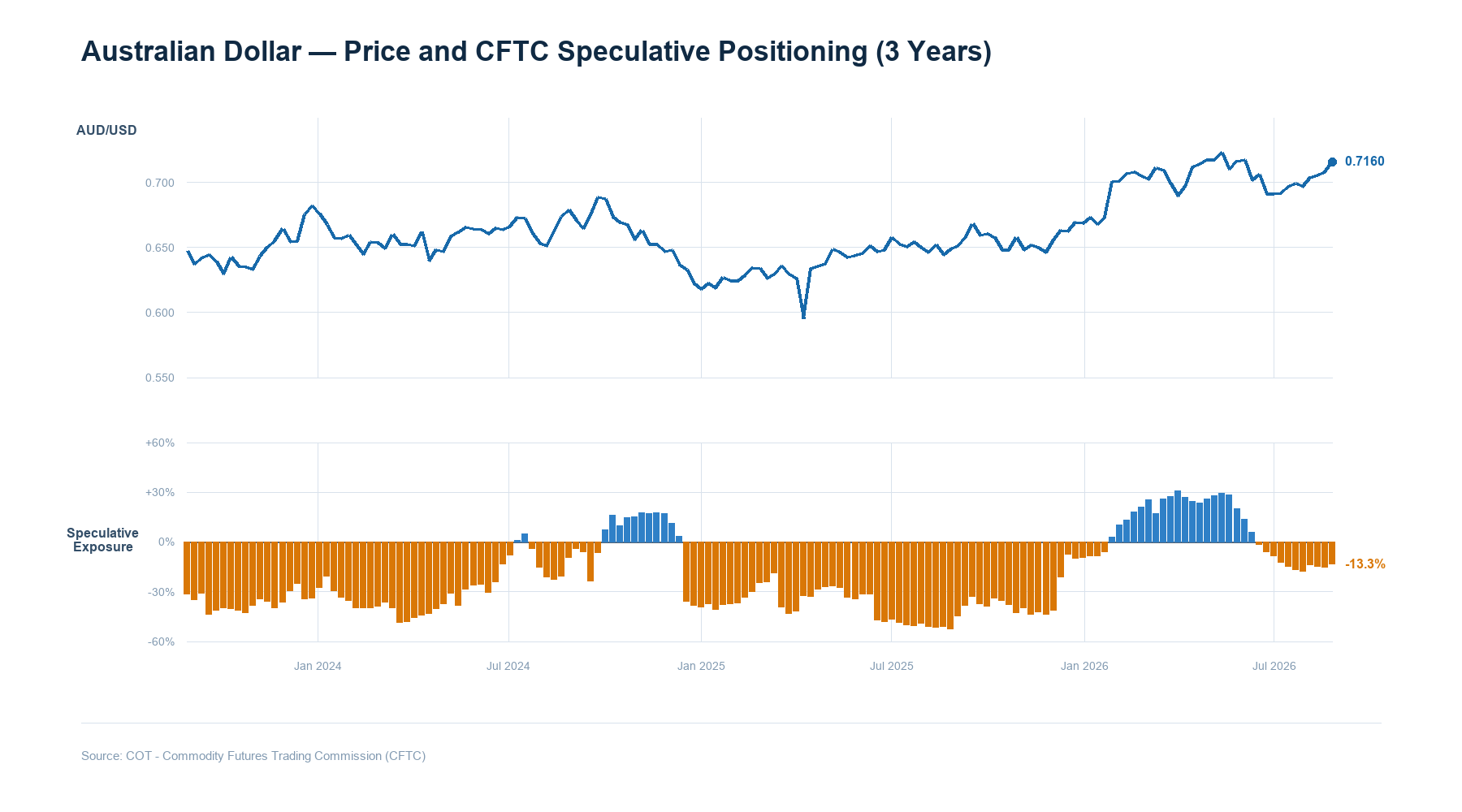
That said, AUD positioning remains bearish, while increasing participation underpins the stance. However, the persistent improvement in the 4-week trend and moderate net-position percentile suggest that the short bias could be losing traction and is not yet excessively crowded, leaving room for further improvement if shorts continue to decline.
Next up for the Aussie
In the near term, dynamics around the Greenback, global risk sentiment, and geopolitics remain the main focus. Those remain the key drivers of price action. Meanwhile, the domestic calendar will release Building Permits, Private House Approvals and the final S&P Global Manufacturing PMI.
Looking at the broader picture, potential risks include a sharper slowdown in China, a persistently cautious Fed, a change in investors' risk sentiment, or any shift in the RBA’s current cautious stance. Any of these could quickly destabilise the Australian currency in the near term.
Technical analysis
In the daily chart, AUD/USD trades at 0.7165, maintaining a bullish near-term bias as spot holds above the 55-, 100- and 200-day simple moving averages (SMAs) clustered between 0.6973 and 0.7078. The Relative Strength Index (RSI) at 63.5 leans toward bullish momentum without yet reaching overbought territory, while the Average Directional Index (ADX) near 22 suggests a steadily improving but still moderate trend rather than an explosive rally.
On the topside, immediate resistance sits at 0.7278, just ahead of the nearby horizontal cap at 0.7283, with a more distant barrier at 0.7661. On the downside, initial support emerges at the recent horizontal level around 0.7079, followed by the 100-day SMA at 0.7078 and the 55- and 200-day SMAs at 0.7017 and 0.6973, respectively, before deeper structural floors at 0.6833, 0.6660, 0.6593, 0.6414 and 0.6373.
(The technical analysis of this story was written with the help of an AI tool. Know more.)
Broader outlook stays positive
The Aussie remains constructive on the bigger picture, but the path higher is getting tougher.
Australia's domestic background continues to compare favourably with that of many advanced economies, and the RBA is in no rush to abandon its mildly hawkish bias.
However, the ongoing recovery remains exposed to bouts of strength from the US Dollar, steady geopolitical uncertainty and a Chinese economy that is stabilising rather than accelerating.
For now, the 200-day SMA remains the key zone. Holding above that level keeps the broader bullish structure intact, but a convincing break above 0.7200 will likely require either further deterioration in sentiment surrounding the Greenback, a more upbeat mood in the risk-linked complex, additional cooling of US inflation, or a dovish turn from the Fed.
Author

Pablo Piovano
FXStreet
Born and bred in Argentina, Pablo has been carrying on with his passion for FX markets and trading since his first college years.